All about dinosaurs, fossils and prehistoric animals by Everything Dinosaur team members.
About Mike
Mike runs Everything Dinosaur, a UK-based mail order company specialising in the sale of dinosaur and prehistoric animal models, He works alongside Sue, and between them they have become the "go to guys" for museum quality prehistoric animal models and figures. An avid fossil collector and reader of dinosaur books, Mike researchers and writes articles about palaeontology, fossil discoveries, research and of course, dinosaur and prehistoric animal models.
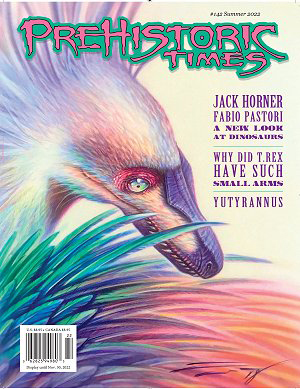
Everything Dinosaur team members have received the latest edition of “Prehistoric Times” magazine and issue 142 proves to be a jam-packed edition. Phil Hore provides details on the feathered, Chinese tyrant Yutyrannus as well as documenting the fearsome, prehistoric fish Xiphactinus and the front cover features one of a series of remarkable illustrations by the very talented Fabio Pastori.
The front cover of “Prehistoric Times” issue 142 (Summer 2022). The front cover artwork was supplied by Fabio Pastori, an exquisite illustration of Velociraptor mongoliensis entitled “Mongolian Swift Seizer”. Picture credit: Everything Dinosaur.
Fabio worked with the famous American palaeontologist Jack Horner, and both were generous enough to permit examples of their collaboration to be highlighted in issue 142, the artwork is simply stunning.
A stunning image of the bizarre theropod Citipati featured in issue 142 of “Prehistoric Times” magazine. Picture credit: Fabio Pastori.
Further artistic endeavours are highlighted, this time using a different medium as Paul McFarland demonstrates how to cast a figure of a European bison in bronze and of course, there are lots of examples of reader submitted artwork to admire too. We liked Wade Carmen’s very exotic looking Xiphactinus and the Yutyrannus themed diorama depicted by James Gurney. Naturally, Fabio Pastori couldn’t resist getting in on the action too. Take a look on page fifteen for his beautiful Yutyrannus and juvenile artwork.
Zdeněk Burian – The Early Years
John Lavas departs from cataloguing the artwork of influential Czech artist Zdeněk Burian and focuses on his early life and upbringing. The piece includes some fascinating photographs of Burian as a young man. Randy Knoll updates readers about what is new in the world of prehistoric animal model collecting and Tracy Lee Ford focuses on feathers in part four of his series on integumentary coverings.
The magazine’s editor Mike Fredericks casts his eyes over the latest book releases including “Dinosaurs: 10 Things You Should Know” by our chum and talented author Dean Lomax and the “Paleonews” section features an explanation as to why the fearsome T. rex had such small arms – an interesting new theory sent direct to the editor by palaeontologist Kevin Padian (University of Berkeley, California).
The summer issue of this quarterly magazine does not disappoint. It is highly recommended.
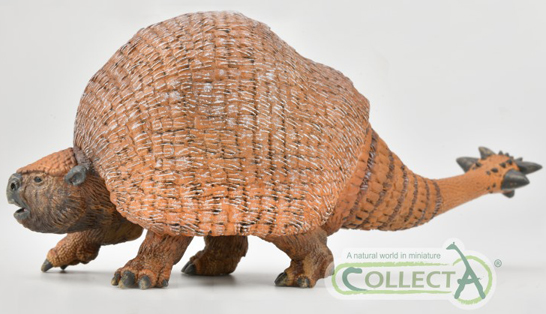
The CollectA Deluxe Prehistoric Life 1:20 scale Doedicurus model has been voted the best non dinosaur prehistoric animal toy figure of 2021 by readers of “Prehistoric Times” magazine. The award is poignant as the designer and inspiration behind the CollectA range of prehistoric animal replicas, Anthony Beeson sadly passed away earlier this year.
The CollectA Deluxe 1:20 scale Doedicurus model. This glyptodont figure was voted the best non dinosaur prehistoric animal toy of 2021 by readers of “Prehistoric Times” magazine. This is a fitting tribute to the model designer Anthony Beeson who passed away earlier this year.
In November 2020, when Everything Dinosaur in partnership with CollectA announced that a 1:20 scale model of this glyptodont was to be added to the Deluxe/Supreme Prehistoric Life model range Anthony commented:
“I wanted to get away from the rather cartoonish appearance of some of the Doedicurus models on the market. I have rejected the idea of long spikes on the club as these would be in danger of snapping and not so practical in what was probably its main purpose in mating conflicts between males where the idea is to show strength and not to kill rivals. One can give a harder blow with a knobbly club. although no doubt used as well in defence, the limited movement afforded to the head would rather limit the animal’s ability to use the club effectively against an attacker.”
We had discussed this replica and Anthony was genuinely excited to have been able to bring his vision for Doedicurus to the market.
Providing measurements for the new for 2021 CollectA Deluxe 1:20 scale Doedicurus model. An image from a YouTube video made by Everything Dinosaur announcing the introduction of a Doedicurus replica.
A spokesperson from Everything Dinosaur stated that this accolade was a fitting tribute to Anthony, his enthusiasm and passion for model design was unparalleled in the model making industry.
Anthony Beeson – sadly passed away on 1st April 2022.
Speaking about the sad passing of Anthony, the spokesperson added:
“Anthony’s legacy will live on in the prehistoric animal figures that he has helped to create. The prehistoric animal models manufactured by CollectA, designed by Anthony have delighted, informed and inspired countless numbers of young people all over the world and even though Anthony is no longer with us through the models that he has created he will continue to bring delight, to inform, educate and inspire countless numbers of young people all over the world. Now that’s a legacy, thank you Anthony.”
Our thanks to dinosaur fan and prehistoric animal model collector William who sent into Everything Dinosaur a review of the YVY Dino Hazard Irritator dinosaur model.
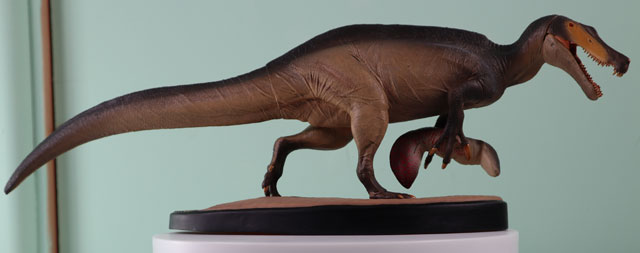
An Everything Dinosaur team member holds the Dino Hazard Irritator challengeri dinosaur model, which in turn is holding in its claws the replica of a lungfish (Equinoxiodus alcantarensis) which is supplied as an accessory with this dinosaur figure. Picture credit: Everything Dinosaur.
William Reviews Irritator
William began his review by explaining that the Dino Hazard brand was the brainchild of the brilliant Brazilian palaeontologist Tito Aureliano who conceived the idea of a group of bold palaeontologists travelling back in time to explore prehistoric South America.
The reviewer also noted that collectors would not have been able to purchase one of these figures without Everything Dinosaur undertaking product safety tests. As far as we and the reviewer are aware, Everything Dinosaur is the only company in the world to have undertaken product testing, obtaining a report on general product safety.
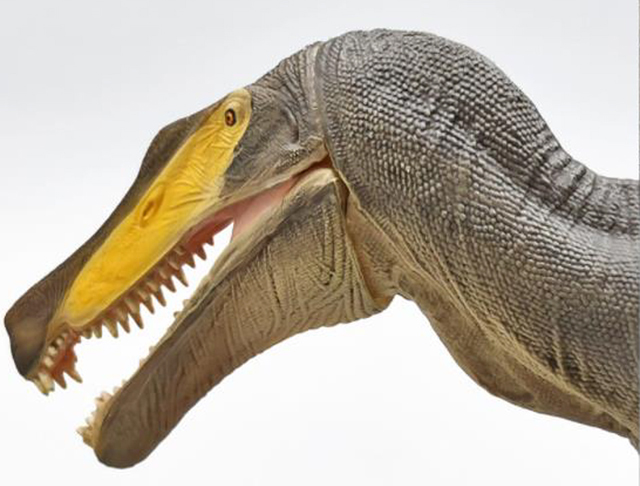
A close-up view of the articulated jaw on the Dino Hazard Irritator dinosaur model.
Dino Hazard Irritator – Head Sculpt
William commented that:
“In my mind’s eye this is how I see the Irritator challengeri and all other Spinosauridae – living animals going about their lives. All the credit and our thanks must be heaped upon Hugo Cafasso the artist and owner of YVY figures, it is he the maestro who created a real theropod.”
He added that there was no shrink wrapping and the replica had a full set of accurate conical Spinosauridae teeth. The ear sculpt was praised and the fully articulated jaw highlighted. The head crest was stated as being “the cherry on top of any Spinosauridae figure.”
An Accurate Slender Skull
The reviewer stated that the slender skull was accurate with its retracted nostrils positioned high on the snout and the red-coloured eyes were singled out for praise.
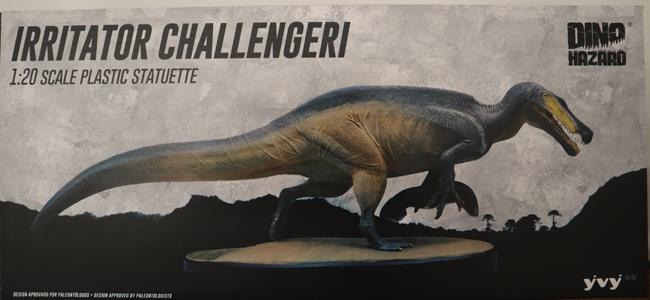
The Dino Hazard Irritator challengeri product packaging.Picture credit: Everything Dinosaur.
The Main Body of the Review
William explains that in his view the designers of the Irritator replica understood the Spinosauridae body plan, although he states that the neural spines would have been more subtle, but the overall impression created is pleasing to the eye. The model has been given a cloaca and the broad tail, reminiscent of recent interpretations of Spinosaurus aegyptiacus is commented upon.
The Model’s Limbs
William states that the forelimbs are positioned correctly and unlike the abelisaurids and tyrannosaurids, the Spinosauridae retained their Megalosauroidea heritage of a three fingered hand with three powerful claws.
He added:
“No worries about hurting yourself or others as the claws are not sharp”.
The defined musculature or the theropod’s legs are highlighted and the hindlimbs are praised for their accuracy.
Summarising the model, William exclaimed:
“With all elements coming together we have very dynamic dinosaur on a dynamic diorama”.
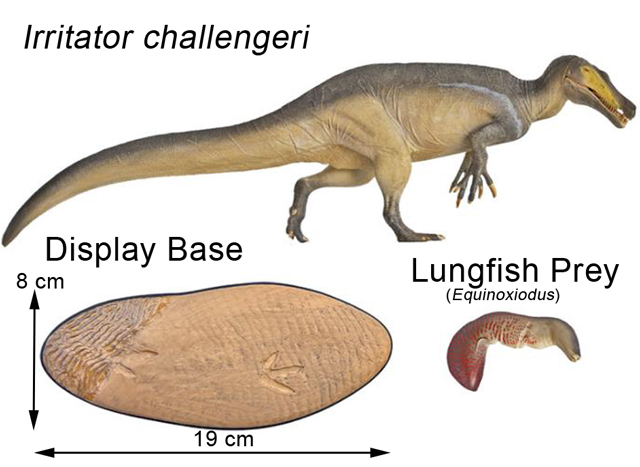
The Dino Hazard Irritator challengeri is supplied with an optional display base and a lungfish prey item.
Irritator challengeri – Colour and Texture
William remarked upon the red eyes, and the facial markings. He praised the muted gunmetal grey wash and the base colouration. He commented that the careful painting of the claws and teeth lent a maturity to the figure.
When discussing the model’s skin texture the reviewer reflected:
“The skin textures are amazing but further heightened by the folds and creases of the skin and the wrinkles from the throat to the ripples in the thigh muscles. The entire figure is masterpiece! You realise how much time, love and effort it takes to create an accurate sculpt of a true likeness of a Spinosauridae.”
As with previous reviews William listed the model’s measurements:
In his detailed model review, William expressed his admiration for the product packaging and explained that the replica and base depicted a dinosaur traversing wet sand. Footprints in the base provided a guide to where the model should be placed.
Sold under the brand Dino Hazard the Irritator challengeri dinosaur model comes complete with an optional display base and a replica of a lungfish. Picture credit: Everything Dinosaur.
He described the lungfish model supplied with the dinosaur as a “little jewel”, commenting that it was highly detailed and a fantastic replica of an Equinoxiodus.
William also provided some details about Irritator challengeri that he had researched.
Time Period: Early Cretaceous 110 Million Years Ago.
Location: North-eastern Brazil (from Santana do Cariri).
William also outlined how this theropod was awarded the genus name “Irritator”, explaining some of the problems associated with the acquisition, preparation and identification of this dinosaur.
He remarked that the specimen number SMNS 58022 became the designated holotype for I. challengeri in February 1996. He added that the holotype material represents a sub-adult animal so size estimates may have to be revised if fossils of a mature, adult animal are found.
William Provides an Estimate for the Size of I. challengeri
He also commented upon the palaeoenvironment describing it as a tropical ecosystem with extensive waterways patrolled by several different kinds of spinosaurids. These animals would have hunted along the banks of the rivers catching fish, but also scavenging carcasses and perhaps catching the occasional pterosaur.
Our thanks to William for providing Everything Dinosaur with a comprehensive dinosaur model review.
To view the Dino Hazard Irritator challengeri figure and to explore the extensive range of prehistoric animal models and figures available from Everything Dinosaur: Dinosaur and Prehistoric Animal Models and Figures.
Everything Dinosaur team members were sent a dinosaur themed banner by our chums at Papo. The French manufacturer emailed over the Papo dinosaurs banner, can you name the trio of dinosaur models featured on the image?
Papo of France kindly sent Everything Dinosaur a dinosaur themed product banner. Can you name the trio of dinosaur models featured in the Papo image?
Papo Dinosaurs and Prehistoric Animal Models
The French manufacturer has spent more than twenty-five years creating an inspirational range of models and figures. In total, Papo currently produces more than six hundred replicas. The company’s prehistoric animals, the “Les Dinosaures” range consists of around fifty figures including the recently released Papo Protoceratops.
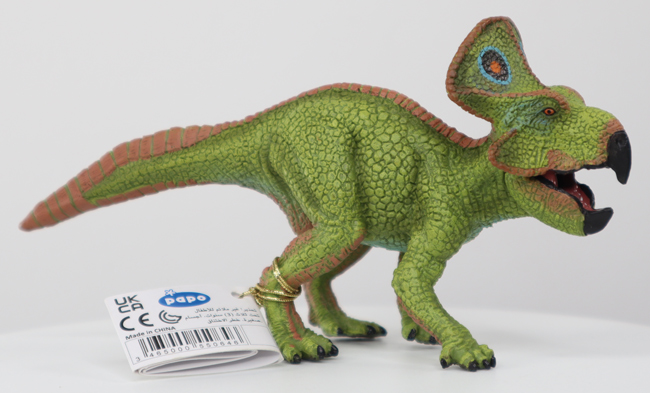
Papo Protoceratops model in lateral view. The Protoceratops figure was the first of the new prehistoric animal models introduced into the “Les Dinosaures” range in 2022.
The Papo Protoceratops Dinosaur Model
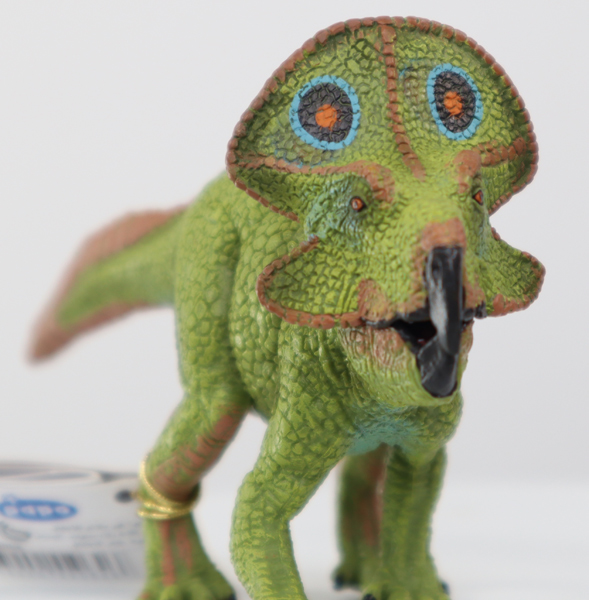
Papo has added several horned dinosaur figures to their model range. The latest addition is a replica of “first horned face” – Protoceratops. The model measures sixteen centimetres in length and the top of that delicately painted neck frill stands some eight centimetres high. The Papo Protoceratops has an articulated jaw.
Papo Protoceratops in anterior view. The attractive and very striking eyespots depicted on the dinosaur’s head shield can be seen when the model is photographed in anterior view.
Protoceratops is one of the most extensively studied of all the dinosaur genera. Ironically, the first fossilised remains of this little plant-eater were found a hundred years ago (1922). It is appropriate for Papo to introduce a replica of “first horned face” to mark the centenary of this dinosaur’s discovery.
Protoceratops (P. andrewsi) was scientifically described in 1923 (Granger and Gregory).
Papo Dinosaur Model Retirements
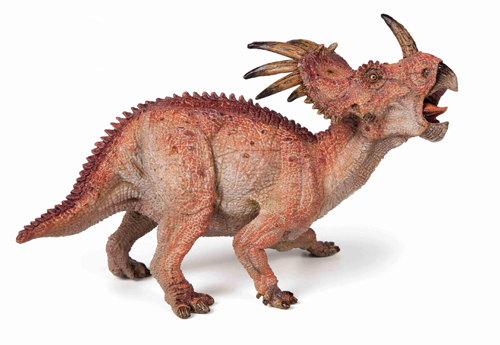
Like all the other model and figure manufacturers, Papo are constantly updating and changing the range of replicas they offer. With the addition of the Papo Protoceratops comes news that another horned dinosaur model, the red Papo Styracosaurus model is being retired and withdrawn from production.
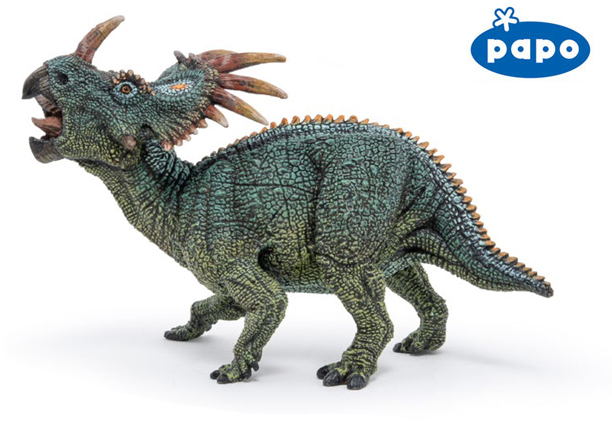
The original Papo Styracosaurus model was released in 2011 and has been officially retired in 2022. It will be replaced by a new, green colour variant of Styracosaurus.
Originally released in 2011, the red Papo Styracosaurus dinosaur model is heading for retirement and is now officially out of production. This figure is due to be replaced by a green colour variant. A spokesperson from Everything Dinosaur confirmed that stocks of the green Papo Styracosaurus would be available shortly.
The new for 2022 Papo Styracosaurus colour variant. The green colour variant will replace the red Styracosaurus dinosaur model, which has now been retired.
Papo Model Fans and Collectors
Papo has built up a strong following within the prehistoric animal model collecting community. There are many Papo model fans and collectors who champion this product range and the prehistoric animal models therein.
Dedicated and enthusiastic field team members led by Dr Julie Bond (University of Bradford) are battling time and tides to document an Iron Age settlement and other important archaeological finds before the elements take their toll.
Dedicated and Enthusiastic Archaeologists
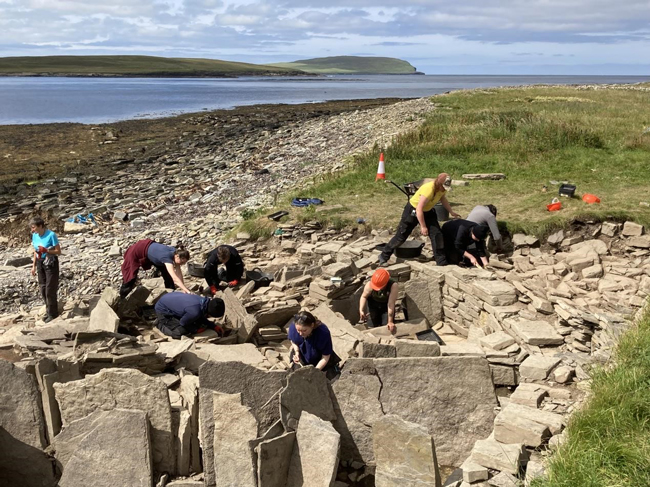
Dr Bond with her colleagues and students studying Archaeological and Forensic Sciences are battling against erosion to uncover artefacts and document the site located on the island of Rousay in the Orkneys (Scotland).
Field workers battle to protect the Iron Age settlement on the Scottish island of Rousay, Orkney. Picture credit: The University of Bradford.
A Large Iron Age Settlement
The site, located at the Knowe of Swandro, on the west coast of Rousay has been occupied from around 1000BC to AD1200. As well as the Iron Age roundhouses, there are the remains of Pict buildings, a Viking settlement and a Norse Long Hall, all of which are threatened by coastal erosion.
The area is considered to be one of the most important locations for documenting the history of Scandinavian settlers in the British Isles.
Honorary Researcher, Dr Steve Dockrill warned that this project is a race against tides and time. Nature will win in the end, but the hardworking team are determined to map and document the site and collect artefacts to preserve evidence of human habitation.
Dr Dockrill stated:
“A substantial Iron Age roundhouse, which forms the focus of a village-like settlement is being eroded by the sea. The large roundhouse had been lived in by generations for a millennium or more, and shows signs of a number of building events modifying the structure.”
Coastal Erosion
Coastal erosion, accelerated by rising sea levels is an increasing threat to sites such as these. The Knowe of Swandro location is providing archaeologists with a unique opportunity to explore the construction of the roundhouse and surrounding buildings.
Dr Dockrill added:
“The site is rich in cultural material and evidence for the use of land and sea in terms of agriculture and fishing. This site is being destroyed by the sea. Over a third of the roundhouse has been lost to coastal erosion. Despite this we are uncovering new evidence for life in the Iron Age and are using the latest technology to record the archaeological evidence before it vanishes”
The University of Bradford-led excavation is working in partnership with the Swandro Orkney Coastal Archaeology Trust, to investigate the site. The Swandro Orkney Coastal Archaeology Trust relies on public donations to fund its work and has HRH Prince Charles as its patron.
To date, the dedicated team have found bone tools, jewellery, shards of pottery and a late Roman coin. A rare Iron Age glass bead has also been uncovered, this could have been part of a piece of jewellery or perhaps a gaming piece.
Students from the University of Bradford on the Archaeological and Forensic Sciences course travel to the Orkneys to gain practical work experience.
Student Michal Szedzielorz commented:
“This is an amazing experience. I have learnt more in 6 weeks than I ever expected. I have learnt so many new practical skills and a better understanding of archaeology.”
A spokesperson from Everything Dinosaur commented:
“Whilst the actions of waves and tides can reveal archaeological and palaeontological treasures, these same forces can destroy, and we wish all the field team members every success with their endeavours.”
Everything Dinosaur acknowledges the assistance of a media release from the University of Bradford in the compilation of this article.
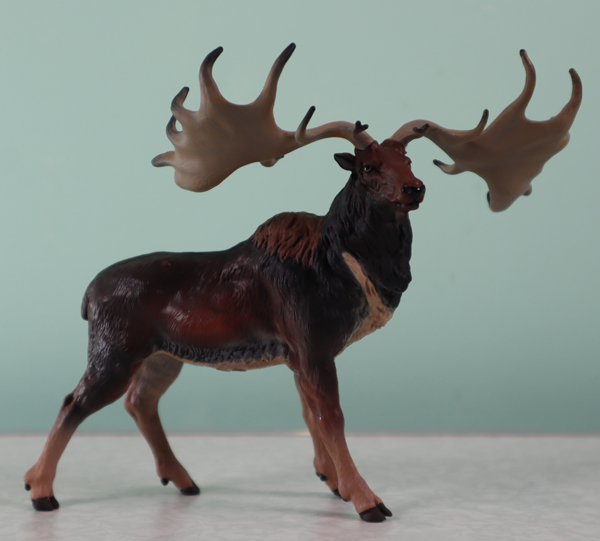
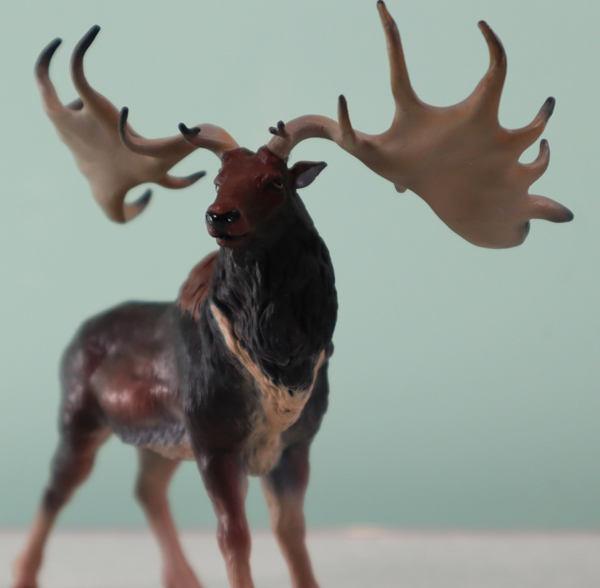
The Papo Megaloceros model was introduced in the autumn of 2020. A stunning model of the majestic member of the Cervidae, which is also referred to as the “giant elk” or the “Irish elk”, the Megaloceros was our favourite new Papo figure that year.
A Papo model fan from Hungary contacted Everything Dinosaur about this prehistoric animal.
Papo Megaloceros model. This figure was one of six new models introduced by Papo in 2020 and the only prehistoric mammal. The models introduced by Papo in 2020 – a Giganotosaurus figure, Chilesaurus, Parasaurolophus and feathered Velociraptor (new colour variants) and a replica of the bone-headed dinosaur Stygimoloch.
Megaloceros – Official Fossil of the Year in Hungary
Our thanks to Valentin from Hungary who emailed Everything Dinosaur to confirm that his Papo Megaloceros model had arrived. It seems that Megaloceros has been declared the official fossil of the year for Hungary (2022). Despite being commonly referred to as the “Irish elk”, Megaloceros its range was not restricted to Ireland, nor was it related to the extant elk (Cervus canadensis) or indeed the modern Moose (Alces alces).
The Megaloceros genus had an extensive geographical range from China to Ireland and several species have been erected.
The new for 2020 Papo Megaloceros figure is looking very regal. Megaloceros has been declared the official fossil of the year (2022) in Hungary.
A Magnificent Ice Age Animal
Valentin emailed Everything Dinosaur stating:
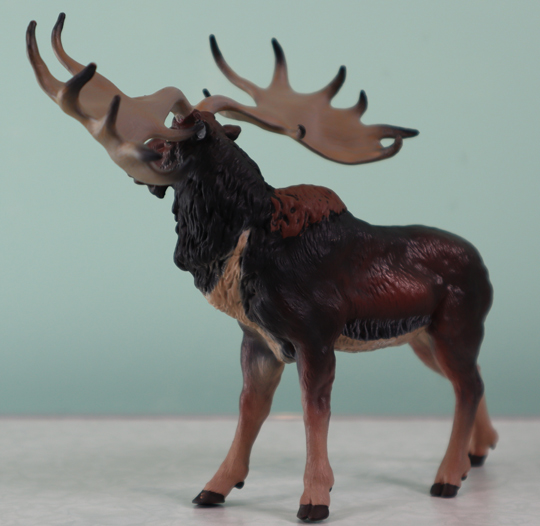
“As far as I know, this is the only model made of this magnificent Ice Age animal – and what a beautiful one it is! The huge antlers of a male Megaloceros give him a really authoritative, majestic appearance, which is perfectly reproduced by this figure. The only thing I would have to complain about is the painting (the brown colour of the hump above his shoulders seemed a little unnatural to me), but apart from this minor flaw, it’s really beautiful. The giant deer became the official Fossil of the Year in Hungary in 2022, so it’s a perfect start to my collection! Totally recommended!”
The Papo Megaloceros figure.
Praise for Everything Dinosaur
Valentin praised Everything Dinosaur commenting:
“And to say a word or two about the delivery itself: my shipment arrived in a few days, fortunately completely intact! Shortly after placing my order, I received an email with a link that I could use to track my package. A good example to follow! Thank you very much, guys!”
Our thanks to Valentin for contacting Everything Dinosaur.
We have spotted our first froglet of 2022 from our office pond. Team members at Everything Dinosaur had been looking out for the first frogs to complete their metamorphosis and we have been taking care not to disturb the pond area, although it does need some tender care and a good clean out.
A photograph of a froglet from the office pond. It is a common frog (Rana temporaria). Picture credit: Everything Dinosaur.
Picture credit: Everything Dinosaur
The picture (above), shows the tiny amphibian (Rana temporaria), clinging to the wall of our pond. It has already had probably, its longest journey of its life. We removed a pot plant choked with Elodea weed and drove a few miles to another location where we could safely plant the pond weed. Whilst inspecting the large hopper we used to transport the plants to the new site, we spotted the froglet. We made sure that it was returned to the pond where it was hatched. Hopefully, this frog will hang around the office pond, and perhaps it will return to it in a few years to spawn.
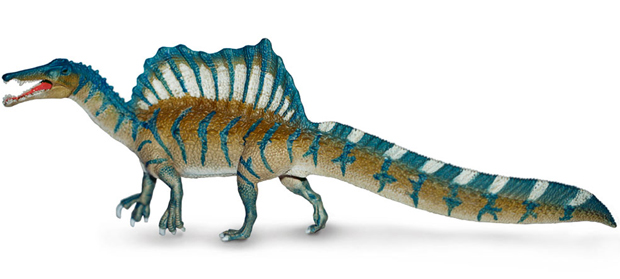
Readers of “Prehistoric Times” magazine have voted the Wild Safari Prehistoric World Spinosaurus model as the best dinosaur toy figure of 2021. Safari Ltd have won this prestigious accolade on several occasions, the Wild Safari Prehistoric World Spinosaurus dinosaur model joins the roll of honour.
The figure represents the largest theropod dinosaur known to science – Spinosaurus aegyptiacus.
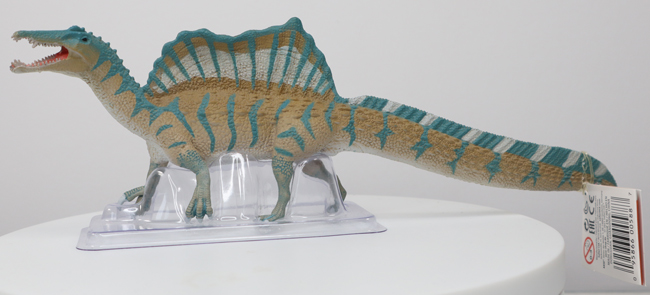
The 2021 Wild Safari Prehistoric World Spinosaurus dinosaur model. It has been awarded the best dinosaur toy figure of 2021 by readers of “Prehistoric Times” magazine.
To view the range of Safari Ltd prehistoric animal figures in stock at Everything Dinosaur including several award-winning models: Wild Safari Prehistoric World Models.
A Popular Spinosaurus Figure
The Spinosaurus replica measures around 22 cm in length and it was one of three dinosaur models (excluding armoured prehistoric animal figures), introduced last year by Safari Ltd. The Spinosaurus replica arrived at Everything Dinosaur’s UK warehouse in the spring of 2021 along with the new for 2021 Safari Ltd Daspletosaurus. The other dinosaur figure introduced by the Safari Ltd team was an updated version of Baryonyx, a dinosaur which was also a member of the Spinosauridae.
Commenting on the award of the best dinosaur toy figure of 2021, a spokesperson from Everything Dinosaur commented:
“The readers of the magazine are very knowledgeable and discerning. The Spinosaurus figure was up against some very tough competition and to win this award is a wonderful affirmation of the dedication and hard work of the Safari Ltd design team.”
Safari Ltd have introduced a variety of Spinosaurus replicas since the company started making dinosaur models back in the late 1980s. Team members at Everything Dinosaur believe that the first Spinosaurus replica to be made by Safari Ltd was introduced in 1992 as part of the now retired Carnegie Collectibles model range.
A farmer’s field in rural Gloucestershire (England), has provided palaeontologists with a remarkable glimpse into an Early Jurassic marine ecosystem.
Underneath a grassy bank, normally grazed by cattle at Court Farm, Kings Stanley near Stroud, lies an exceptional fossil site that contains the remains of fish, ammonites, squid, marine reptiles and other creatures, with many of the specimens preserved in three dimensions.
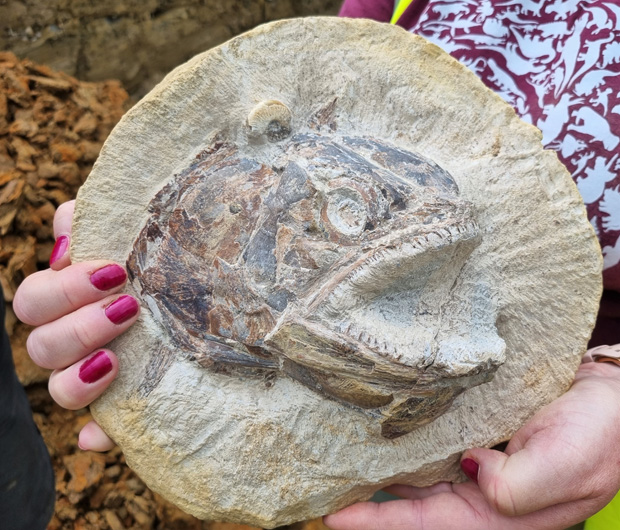
A three-dimensional fish skull (Pachycormus spp.) from a limestone concretion found at Court Farm. Note the small ammonite located in association with the skull. Picture credit: Dean Lomax.
A Toarcian Ecosystem
The clays and hard limestone nodules, many of which contain fossils, were deposited around 183 million years ago (Toarcian stage of the Early Jurassic).
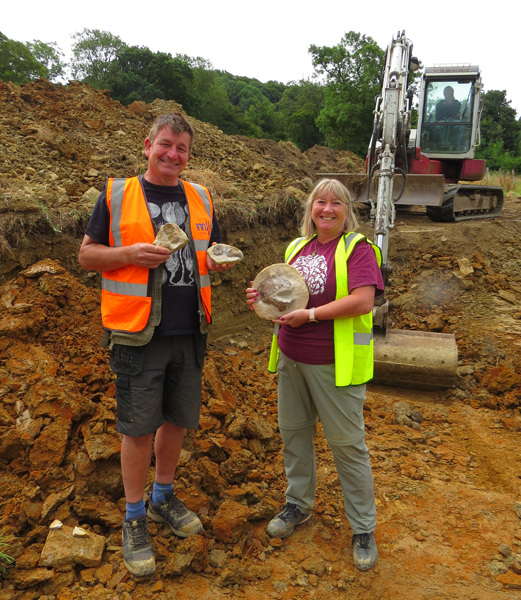
The site was discovered by Sally and Neville Hollingworth, avid fossil collectors who recently uncovered the remains of mammoths in the nearby Cotswold Water Park which was featured in the BBC One documentary “Attenborough and the Mammoth Graveyard” in 2021.
Neville and Sally Hollingworth at the dig site. Picture credit: Nigel Larkin.
Commenting on the significance of this location, enthusiastic fossil hunters Neville and Sally stated:
“These fossils come from the Early Jurassic, specifically a time called the Toarcian. The clay layers exposed at this site near Stroud have yielded a significant number of well-preserved marine vertebrate fossils that are comparable to the famous and exquisitely preserved similar fauna of the Strawberry Bank Lagerstätte from Ilminster, Somerset – a prehistoric site of exceptional fossil preservation. Excavations at Kings Stanley over the last week have revealed a rich source of fossil material, particularly from a rare layer of rock that has not been exposed since the late 19th century.”
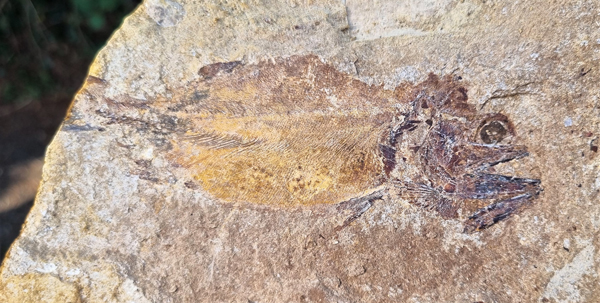
A stunning Early Jurassic Fossil fish from the dig site. Picture credit: Dean Lomax.
Limestone Concretions
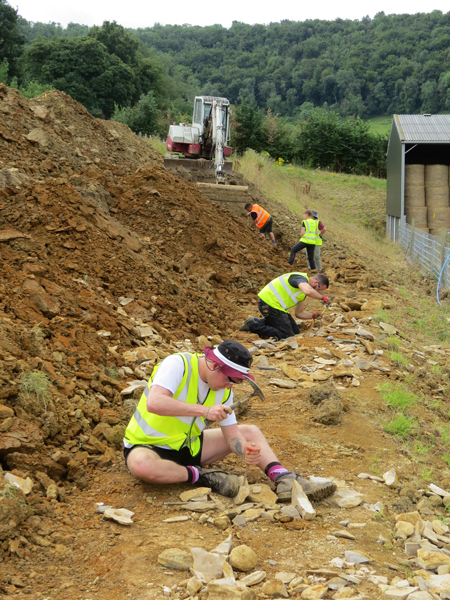
A team of eight scientists spent a total of four days working to clear an area of the bank approximately eighty metres in length. An excavator proved invaluable, but the field team still had to endure record breaking temperatures as they laboured to find and crack open three-dimensionally preserved limestone concretions, many of which contained fossils.
Field team members busy examining and splitting limestone concretions checking for fossils. Picture credit: Nigel Larkin.
Each specimen was carefully logged onto a database and approximately 200 kilograms of clay from around the concretions was also collected and carefully sieved using a state-of-the-art sediment processing machine to help locate microvertebrate fossils such as fish teeth and small bones.
The sediment processing machine used to help retrieve small fossils from the Lower Jurassic strata exposed at Court Farm (Gloucestershire). Note the novel use of two water troughs. Picture credit: Dr David Ward.
Fossils Donated to Local Museum
Many of the fossils found at the site will be donated to the palaeontology collection of a local museum (The Museum in the Park, Stratford Park, Stroud).
Team member and world-renowned, palaeontological conservator Nigel Larkin (Visiting Research Fellow at Reading University) commented:
“Give a person a fish and you feed them for a day. Give a palaeontologist a fossil fish and they will tell you the species, the age of the rock, the climate of the time when the fish was alive plus the water depth and salinity and plenty of other information. This site – already an interesting farm in a beautiful setting – is one big outdoor classroom and the lessons now include geology, palaeontology, evolution and climate change. They tell farmers to diversify but this goes one step beyond!”
Exceptional Fossil Fish Finds
Some of the best finds include fossil fish, so well-preserved that details of the scales, fins and even their eyeballs can be made out. One of the most impressive discoveries was a three-dimensionally preserved fish skull, a Pachycormus, (see first image), a genus of ray-finned fish known from the Toarcian of Europe.
The lack of any signs of scavenging of the corpses and the absence of encrusting animals or burrows in the sediment suggest that the fauna which was frozen in time under a farmer’s field was rapidly buried.
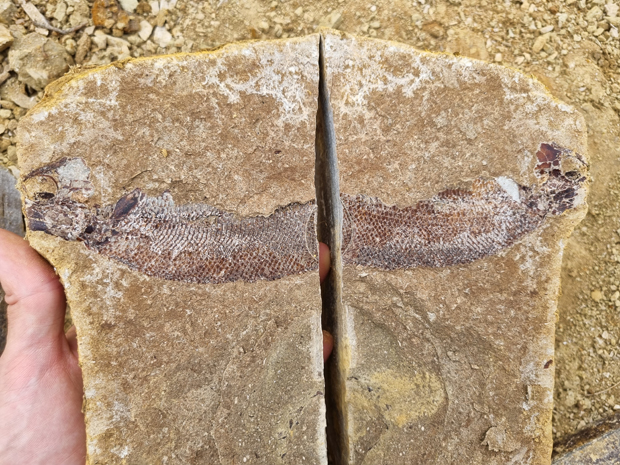
A limestone nodule spilt open reveals the fossilised remains of an Early Jurassic fish (slab and counter slab). Picture credit: Dean Lomax.
Splitting Concretions to Find Fossil Fish and Other Remains
The layered concretions around the organisms formed relatively early before the sediments were compacted, as the original sediment layering is preserved. These concretions prevented further compaction, compression and distortion from the overlying sediments during burial and thus preserved the fossils as three-dimensional time capsules.
Dr Dean Lomax, a palaeontologist and a Visiting Scientist at the University of Manchester, who recently led the excavation of the Rutland ichthyosaur that also dates to the Toarcian geological age, was part of the team he explained:
“The site is quite remarkable, with numerous beautifully preserved fossils of ancient animals that once lived in a Jurassic sea that covered this part of the UK during the Jurassic. Inland locations with fossils like this are rare in the UK. The fossils we have collected will surely form the basis of research projects for years to come.”
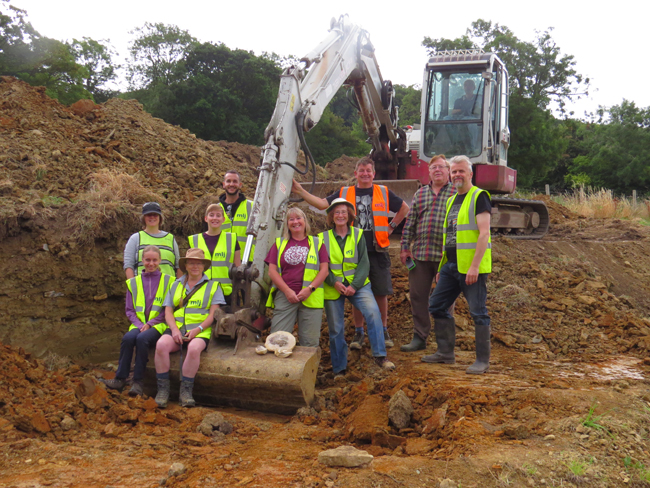
The dig team take a well-earned break, time for a group photograph. Picture credit: Nigel Larkin.
Landowner, Adam Knight, who has seen part of his farm temporarily converted into a real life “Jurassic Park” added:
“I’m delighted that after the initial work that Sally and Nev did over three years ago we now have a full-scale dig on the farm involving a range of fossil experts from The Natural History Museum, University of Manchester, University of Reading and The Open University. On Friday we were also joined by Emily Baldry on a day’s work experience before she goes to university to study palaeontology – it’s wonderful to see her enthusiasm for her chosen profession. It has been a real pleasure to host the dig and I’m excited to see the results of what has been found.”
Important Microvertebrates and Fossil Insects
Dr David Ward (research scientist at the Natural History Museum, London), outlined his contribution to the fieldwork explaining that his role was to collect evidence of all the small creatures that lived alongside the larger vertebrates and invertebrates in the ancient marine ecosystem.
The silty clay found in association with the limestone concretions was carefully washed and pushed through a fine sieve. Dr Ward’s wife Alison played a vital role in the collection process, and she added:
“My specialism is surface picking. This involves finding areas where fossils, particularly small bones and teeth, are naturally concentrated on the surface. Here, once I had collected them, I dug up the surrounding clay and fed it into David’s clay washing machine. The result is a fine concentrate of tiny fish bones and shells which we sort under a microscope.”
The Basis for a PhD
For Open University PhD student Emily Swaby, this fossil site has very special significance. Her PhD research is focused on how insects were affected by dramatic environmental changes that took place during the Toarcian. Fossil insects are extremely rare and although the Court Farm site represents marine deposition, insect fossils are known from such locations.
Emily commented:
“Further research at this site and surrounding Gloucestershire localities might help us to work out the abundance and diversity of insects during this time and help us to understand how this environmental change influenced insects.”
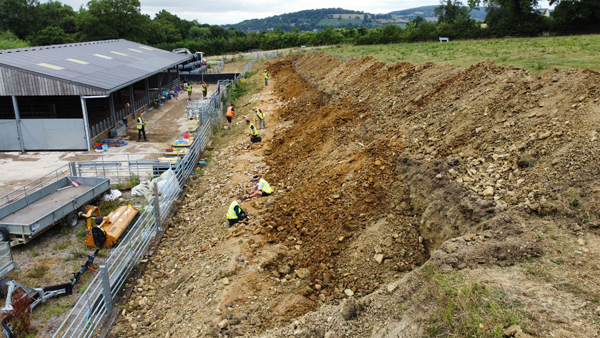
A view of the exposed strata at the Court Farm dig site. Picture credit: Steve Dey.
Everything Dinosaur acknowledges the assistance of a media release from the University of Manchester and additional information supplied by Dr Dean Lomax in the compilation of this article.
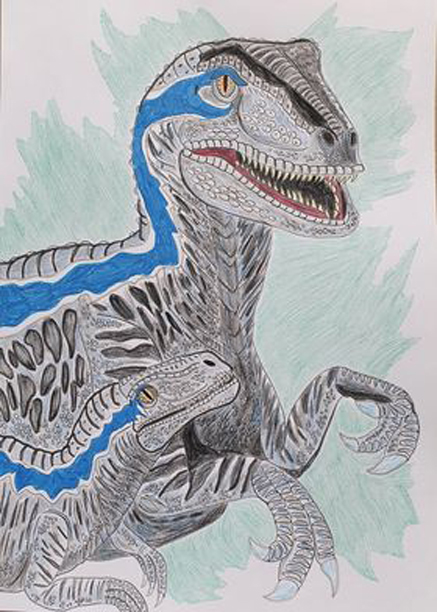
Our thanks to talented, young artist Caldey who sent into Everything Dinosaur an illustration of a mother and baby Velociraptor inspired by the recent film “Jurassic World Dominion”. The skilfully produced drawing features Blue and her offspring Beta from the latest and potentially the last movie in the “Jurassic Park/Jurassic World” franchise.
The beautiful illustration of a pair of “raptors”. The drawing was inspired by the recent (June 2022) movie “Jurassic World Dominion”. The adult Velociraptor Blue and her offspring Beta. Picture credit: Caldey.
A “Raptor” Legacy
Dinosaurs, marine reptiles and pterosaurs roam freely, and human/dinosaur interactions result in inevitable fatalities. The authorities strive to monitor the movements of the genetically engineered prehistoric animals. Blue, one of the Velociraptors trained by Chris Pratt’s character Owen Grady in previous incarnations of the franchise, resides in the Sierra Nevada Mountains, where Owen earns a living helping to capture and relocate stray dinosaurs. Owen discovers that Blue has a juvenile “raptor” with her, this is an asexually reproduced hatchling. The baby Velociraptor is named Beta by Maisie Lockwood (played by Isabella Sermon).
Whilst many different types of prehistoric animal have been depicted in the films, no dinosaur has had as much screen time dedicated to it as the iconic “raptors” which have featured in all the films in the “Jurassic Park/Jurassic World” genre.
A site safety notice at our local cinema spotted at the entrance as team members went to see “Jurassic World Dominion”.
Velociraptor Mother and Baby
A spokesperson from Everything Dinosaur thanked Caldey for her drawing and commented:
“Caldey’s choice of the Velociraptor pair for her illustration is fitting. These dinosaurs have featured in all six of the movies associated with this franchise. It is a wonderful drawing of Blue and Beta”.