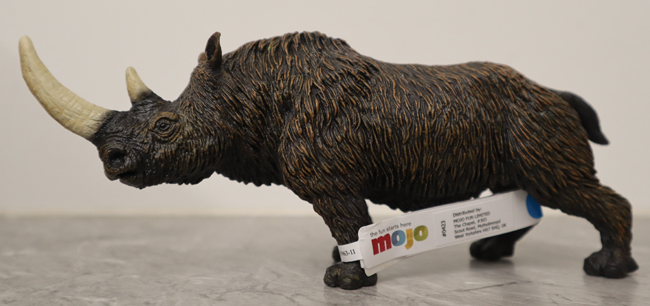
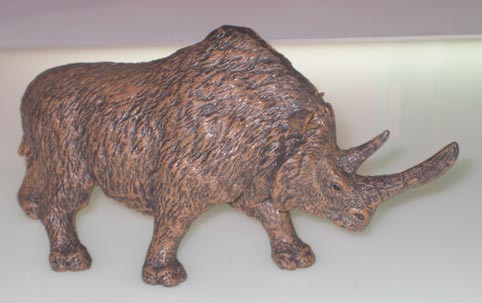
The new for 2023 Mojo Fun Woolly Rhino is in stock at Everything Dinosaur. Team members have been busy contacting all the customers who wanted to be informed about this prehistoric rhino’s arrival. The Woolly Rhino has been eagerly anticipated, it is a beautifully detailed replica of a Coelodonta antiquitatis.
The new for 2023 Mojo Fun Woolly Rhino model has arrived in stock at Everything Dinosaur. Picture credit: Everything Dinosaur.
Picture credit: Everything Dinosaur
The Woolly Rhinoceros (Coelodonta antiquitatis)
It is thought that this ancient rhinoceros evolved in Asia. During the Pleistocene Epoch it had an extensive range.
Fossils of Coelodonta antiquitatis have been found in the London area (Thames River gravels). The scientific name translates as “ancient hollow tooth”. The name derives from the animal’s teeth. Molars associated with this grazer of grasses and sedge have a distinctive cavity.
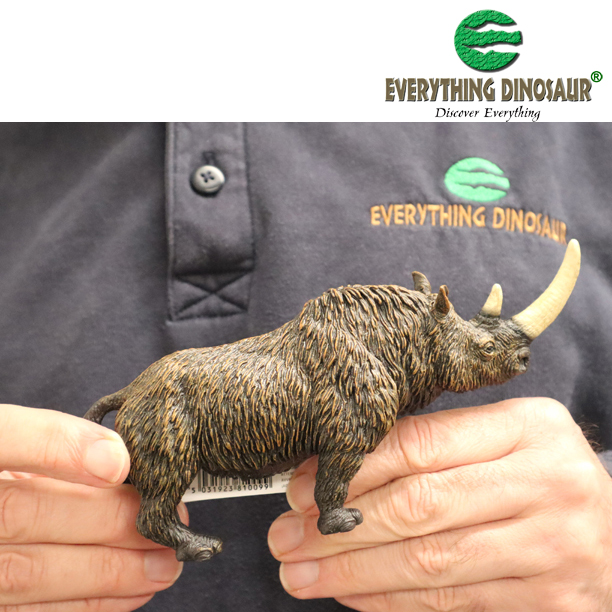
The Mojo Fun Woolly Rhinoceros model measures around 19 cm in length. Everything Dinosaur team members estimate the head height to be around 7 cm.
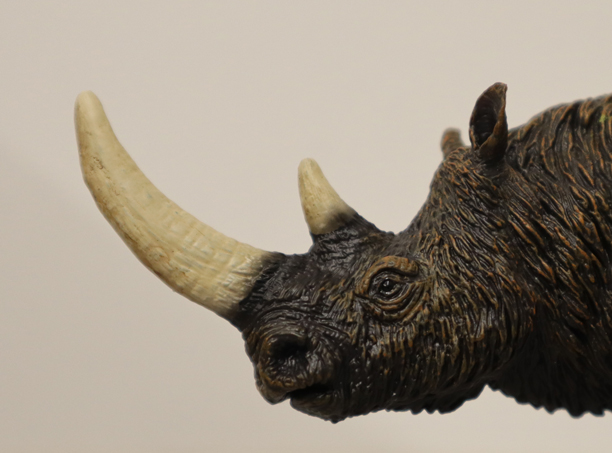
A close-up view of the magnificent Mojo Fun Woolly Rhinoceros model. Picture credit: Everything Dinosaur.
Picture credit: Everything Dinosaur
The Mojo Fun Woolly Rhino Model
A spokesperson from Everything Dinosaur commented:
“This is a spectacular replica of a Woolly Rhino. The model has a superb, tactile coat giving the impression of coarse hair. The two horns are carefully sculpted and even show signs of wear. Our congratulations to the design team at Mojo Fun.”
Proudly holding the new for 2023 Mojo Fun Woolly Rhino figure. Picture credit: Everything Dinosaur.
The last of the Woolly Rhinos are believed to have persisted in Siberia. The genus becoming extinct around 13,000 to 14,000 years ago. A research paper published in 2021 (Wang et al), postulated that some Woolly Rhinos could have survived into the Holocene, with the last of their kind dying out around 9,800 years ago. The conclusions of the study, which was based on the dating of environmental DNA, have been challenged. The environmental DNA could have originated from older sediments and subsequently redeposited into much younger strata.
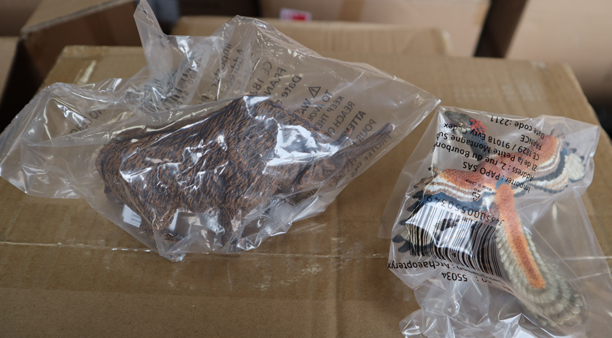
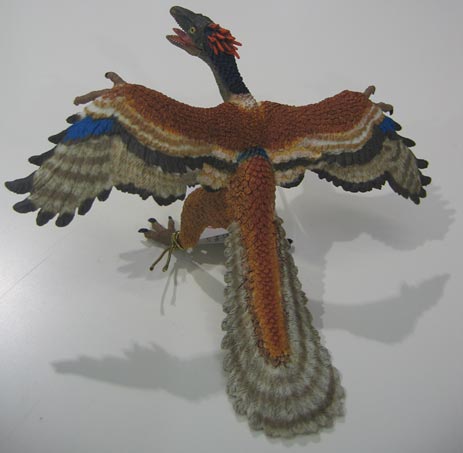
The recently reintroduced Papo Archaeopteryx and Woolly Rhino models have arrived in stock at Everything Dinosaur. The two retired figures are available again. Team members have been busy contacting those customers about the reintroduction of these two prehistoric animal models.
The reintroduced Papo Woolly Rhino model (left) and the Papo Archaeopteryx (right). Picture credit: Everything Dinosaur.
Picture credit: Everything Dinosaur
The picture (above) shows the first of these two figures to be unpacked this morning. A shipment of Papo models arrived including the Papo Archaeopteryx and the Woolly Rhino.
A spokesperson from Everything Dinosaur stated:
“It is great to see these old friends again. We know that many collectors missed out on these two models when they were originally launched. These model fans have the opportunity to complete their Papo collections.”
The Papo Woolly Rhinoceros model was introduced in 2013. It was retired a few years later. The figure has proved popular with collectors. Numerous Woolly Rhino fossils have been found in France and Papo were keen to introduce models of animals reflected in the country’s own extensive fossil record. The Woolly Rhinoceros had a large, keeled front horn. This horn and the model’s shape reflected fossil evidence and the prehistoric drawings found in French caves.
Great care has been taken to depict the anterior horn on the Papo Woolly Rhino model. Picture credit: Everything Dinosaur.
Picture credit: Everything Dinosaur
Papo Archaeopteryx
The Papo “Urvogel” or Archaeopteryx was first introduced into the “Les Dinosaures” range back in 2014. This colourful theropod model was withdrawn in 2019. One of the ways in which manufacturers can engage with their customers is by reintroducing old favourites that had gone out of production. It also provides the manufacturer with a low-cost model. No mould making costs or development costs are associated with a reintroduced figure.
Papo Archaeopteryx “ancient wing” by Papo. Picture credit: Everything Dinosaur.
Picture credit: Everything Dinosaur
The Papo Archaeopteryx and Woolly Rhino Figures
Dinosaur fans and model collectors have already begun to speculate on what other recently retired Papo figures might be returned.
The spokesperson from Everything Dinosaur did confirm that discussions had taken place some years ago about the return of the iconic Papo standing T. rex model (green standing T. rex).
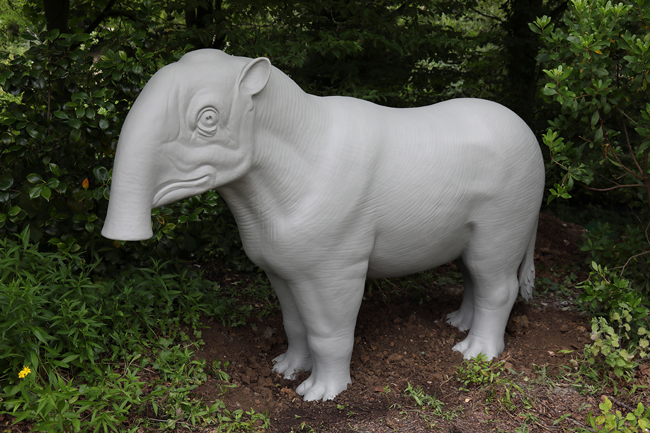
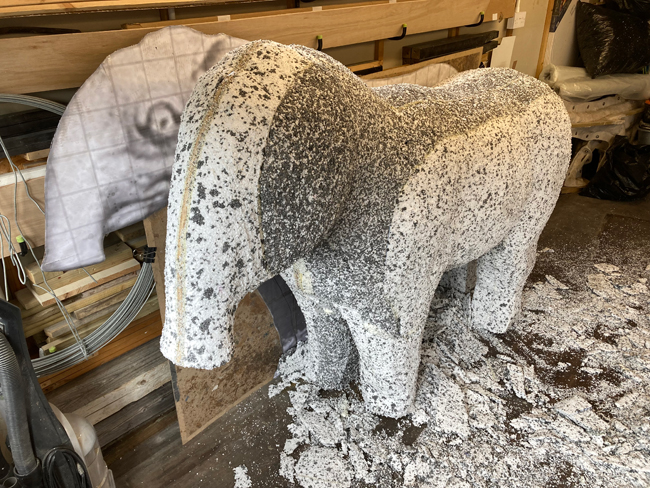
A Victorian-era statue of a Palaeotherium magnum, an ancient mammal distantly related to horses has been rebuilt and installed at Crystal Palace. The original sculpture, designed by Benjamin Waterhouse Hawkins, was lost in the 1960s. Thanks to a dedicated team of historians, palaeontologists and artists Palaeotherium has returned to the famous Crystal Palace Dinosaurs site.
The new Palaeotherium sculpture in situ at the Park. Picture credit; James Balston.
The Crystal Palace Dinosaurs Site
The Crystal Palace Dinosaurs have Grade 1 listed status. The collection consists of around thirty figures and approximately forty geological displays. They were created in the 1850s and represent the world’s first attempt to depict life-size prehistoric animals.
Commenting on the significance of the site, evolutionary biologist at the Natural History Museum and Chair of the Friends of the Crystal Palace Dinosaurs, Elinor Michel stated:
“The sculptures are of huge historic and scientific importance. The display first opened twenty-eight years before the London Natural History Museum and was the first-time models of extinct creatures had been used to engage people with science and geological time. For many visitors, this was their first introduction to the idea of lost worlds of animals and environments that no longer exist.”
Victorian-era Sculptures of Prehistoric Animals
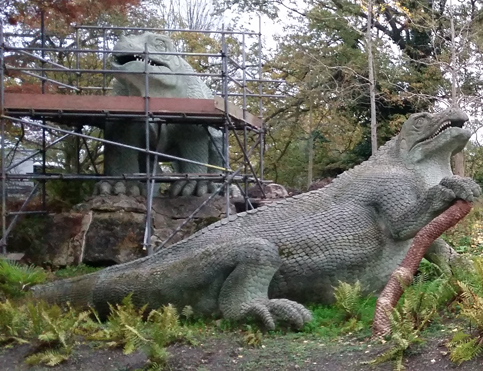
Crystal Palace might be famous for its dinosaur sculptures, but only four of the statues represent members of the Dinosauria. The other figures represent marine reptiles, pterosaurs, crocodilians, amphibians and prehistoric mammals.
A pair of Iguanodons study the Crystal Palace landscape. The Grade 1 listed statues have been undergoing extensive conservation. Picture credit: Everything Dinosaur.
Picture credit: Everything Dinosaur
The building of a life-size Palaeotherium magnum was a task taken up by Britain’s leading palaeo artist and chum of Everything Dinosaur Bob Nicholls. Friends of the Crystal Palace Dinosaurs, staff from the Natural History Museum and researchers from the University of Portsmouth supervised the project.
Building the Palaeotherium statue, an image of the original sculpture can be seen in the background. Picture credit: Bob Nicholls.
This is the first attempt in twenty years to replace a lost sculpture at Crystal Palace. The resurrection of Palaeotherium emphasises the importance of the work to document the changes that have taken place within the grounds.
Palaeotherium magnum
Professor Adrian Lister (London Natural History Museum) commented:
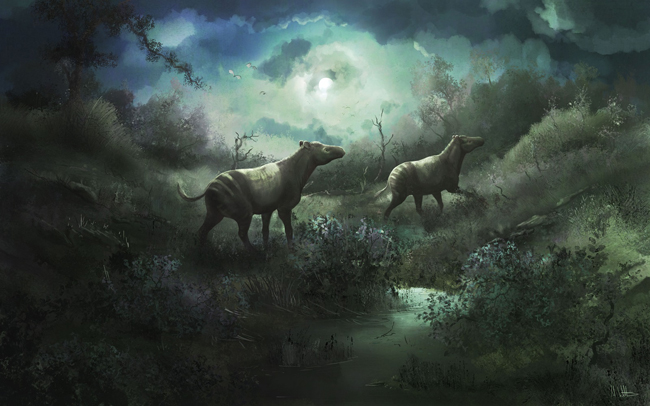
“Palaeotherium magnum is the largest among a group of five mammal species represented in the Park that lived in the Eocene some 44.5 to 33.5 million years ago when Britain was clothed in tropical forest. The size of a small, chunky pony, it was a browsing mammal some 2 metres long and 1.3 metres high.”
A life reconstruction of Palaeotherium magnum. Picture credit: Mark Witton.
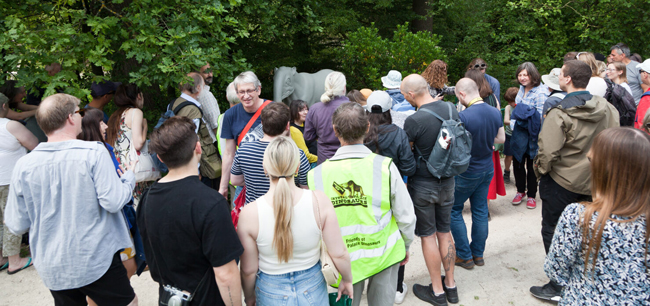
The restored sculpture was unveiled at a special ceremony at Crystal Palace Park today (2nd July, 2023). As part of the events to commemorate the return of Palaeotherium, visitors were offered a conducted tour of the site.
A big crowd gathered to witness the Palaeotherium unveiling. Picture credit: Neil Scott-Sills.
Palaeotherium Project is Part of a Wider Initiative
The Palaeotherium project is part of a wider initiative to revive and conserve the Crystal Palace Dinosaurs site. Friends of Crystal Palace Dinosaurs, Historic England, the new Crystal Palace Park Trust and Bromley Council have been working together to develop a plan to protect the site. The resurrection of Palaeotherium magnum highlights a more optimistic, entertaining and enlightening future for one of the UK’s most iconic greenspaces.
Everything Dinosaur acknowledges the assistance of a media release from the London Natural History Museum in the compilation of this article.
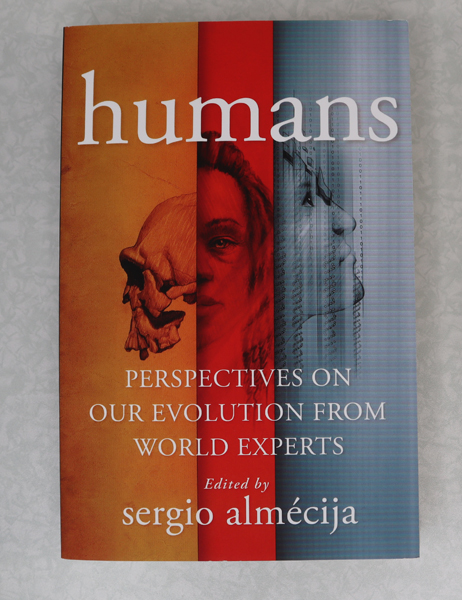
How did our species evolve? What does our evolutionary history tell us about being human? These questions and many more are posed in a fascinating new book edited by a leading researcher at the American Museum of Natural History. Entitled “Humans Perspectives on our Evolution from World Experts”, this new publication provides an insightful analysis into the origins and the future of our species.
Research scientist Sergio Almécija has compiled an eminent list of contributors. These experts, drawn from a variety of academic fields, share their insights on the study of human evolution. Leading figures in palaeontology, primatology, archaeology, genetics and anthropology reflect on some of the most profound questions centred around being human.
The front cover of the recently published book “Humans – Perspectives on our Evolution from World Experts”. Picture credit: Everything Dinosaur.
Picture credit: Everything Dinosaur
The Evolution of Homo sapiens
Sergio Almécija has been fascinated by the multiple narratives surrounding our origins, behaviours and the prospects for our future. He has taken an innovative approach to his subject. A list of questions was compiled and then he contacted leading academics and researchers and recorded their thoughts.
Some of the questions included are:
Which discovery, research study, or book would you highlight as a “game changer” in the way we look at our own evolution? How did it influence your career or life?
If you had a one-shot round trip in a time machine, to which specific time period—past or future—would you go and why?
What will be shaping human evolution in the future? What will humans look like in 100, 100,000, or 1 million years?
How did our species evolve? Why us and not other hominids? What does it mean to be human? A new book examining human evolution with contributions from over a hundred leading academics and experts. Picture credit: Everything Dinosaur.
Picture credit: Everything Dinosaur
Perspectives on our Evolution
The eminent and accomplished cast of contributors to this new book includes Kay Behrensmeyer, Frans de Waal, Nina Jablonski, Mike Benton, Richard Leakey, Robert Sapolsky, and Ian Tattersall. In total, there are contributions from over a hundred distinguished scientists and researchers.
Published by Columbia University Press, “Humans Perspectives on our Evolution from World Experts”, is a remarkable book. It has been designed to permit the reader to dip in and out of it, to explore a variety of topics and to gain fresh insights and perspectives.
A spokesperson from Everything Dinosaur commented:
“Highly respected researchers at the very top of their game provide an insightful and informative examination of what it is like to be human. It is a very fitting compendium that caters for an essential human characteristic – our curiosity.”
“Humans Perspectives on our Evolution from World Experts” – The Details
Published by Columbia University Press. Available in both paperback, e-book and hardcover. ISBN (Paperback) = 9780231201216. Pages = 520.
Search for the author (Sergio Almécija) or by book title.
Contributors opine on the fundamental relationship our species has with the natural world and remark upon the key moments in time that have driven human evolution. In addition, many contributors provide invaluable advice for those members of our species considering embarking on similar careers.
The Everything Dinosaur spokesperson added:
“This book allows the reader to explore a cornucopia of ideas about humanity, our past, present and future. It is an engaging publication, a book that will leave you with a deep sense of wonder.”
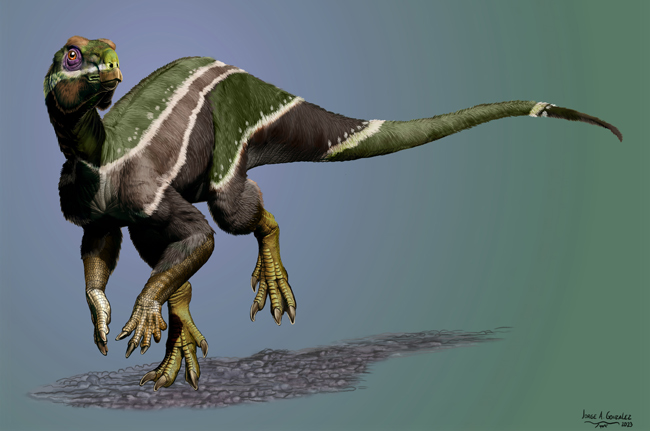
A newly discovered ornithopod dinosaur is helping to document faunal turnover in the early Late Cretaceous of North America. The dinosaur, named Iani smithi has been classified as a basal member of the Rhabdodontomorpha. This type of dinosaur is distantly related to the duck-billed dinosaurs (Hadrosauridae), which were to become extremely common by the Late Cretaceous.
The plant-eating I. smithi lived when the Earth was undergoing an intensive period of climate change. Global populations of dinosaurs were changing. Many long-established clades were dying out, being replaced with different types of dinosaur that were to dominate terrestrial environments until the end of the Mesozoic.
A life reconstruction of a juvenile Iani smithi. I. smithi an ornithopod from the Cedar Mountain Formation of Utah. Picture credit: Jorge Gonzalez.
Iani smithi
Described from fossils excavated in 2014 from a quarry within the lower Mussentuchit Member of the Cedar Mountain Formation (Utah), the single specimen is thought to represent a juvenile. The fossil material consists of a disarticulated skull, vertebrae, limb elements, parts of the pectoral and pelvic girdles and ribs.
Researchers estimate that Iani lived approximately 99 million years ago (Cenomanian faunal stage of the Late Cretaceous). The Earth was rapidly warming due to increased concentrations of carbon dioxide in the atmosphere. Sea levels were rising and this dramatic period of climate change, known as the Cretaceous Thermal Maximum (KTM), led to extensive faunal turnover.
In North America, sauropods became rarer and eventually extinct (probably). Smaller ornithischian dinosaur clades began to dominate terrestrial environments. Spinosaurids and carcharodontosaurids were in decline. These theropods were eventually replaced by tyrannosaurs and abelisaurids.
This dramatic faunal turnover is reflected in the dinosaur’s name. The genus honours Janus – the two-faced Roman god of change.
The species name honours Joshua Aaron Smith. It is in recognition of his contribution to the discovery and conservation of paleontological resources in Utah.
A Rarity in North America
Iani smithi will help palaeontologists to better understand the transition of the Ornithopoda from Early Cretaceous groups to those bird-hipped dinosaurs that dominated Late Cretaceous terrestrial environments. Early rhabdodontomorphs such as Iani are exceptionally rare in the North American fossil record.
Corresponding author of the scientific paper, Lindsay Zanno (North Carolina State University) commented:
“Finding Iani was a streak of luck. We knew something like it lived in this ecosystem because isolated teeth had been collected here and there, but we weren’t expecting to stumble upon such a beautiful skeleton, especially from this time in Earth’s history. Having a nearly complete skull was invaluable for piecing the story together.”
A Phylogenetic Assessment of Iani smithi
Zanno and her team used the well-preserved skeleton to analyse the evolutionary relationships of Iani and were surprised, and at first sceptical of their findings.
Associate research professor Lindsay Zanno explained:
“We recovered Iani as an early rhabdodontomorph, a lineage of ornithopods known almost exclusively from Europe. Recently, palaeontologists proposed that another North American dinosaur, Tenontosaurus – which was as common as cattle in the Early Cretaceous – belongs to this group, as well as some Australian critters. If Iani holds up as a rhabdodontomorph, it raises a lot of cool questions.”
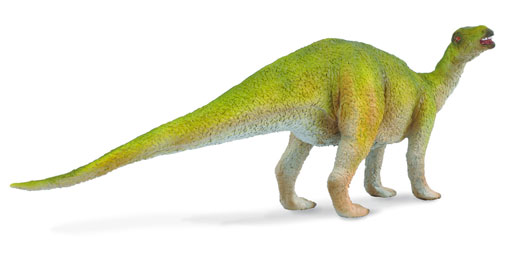
The CollectA Age of Dinosaurs Tenontosaurus model.
The picture (above) shows a model of Tenontosaurus from the CollectA Age of Dinosaurs Popular range.
The research team speculate that Iani could be the last of its line. Studying this fossil specimen, in the context of environmental and biodiversity changes during the Cretaceous will provide insight into the history of our planet.
Lindsay Zanno added:
“Iani may be the last surviving member of a lineage of dinosaurs that once thrived here in North America but were eventually supplanted by duckbill dinosaurs. Iani was alive during this transition, so this dinosaur really does symbolise a changing planet.”
Everything Dinosaur acknowledges the assistance of a media release from the North Carolina State University in the compilation of this article.
The scientific paper: “An early-diverging iguanodontian (Dinosauria: Rhabdodontomorpha) from the Late Cretaceous of North America” by Lindsay E. Zanno, Terry A. Gates, Haviv M. Avrahami, Ryan T. Tucker and Peter J. Makovicky published in PLoS One.
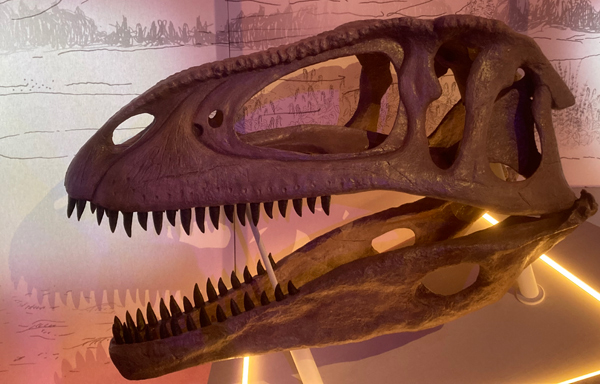
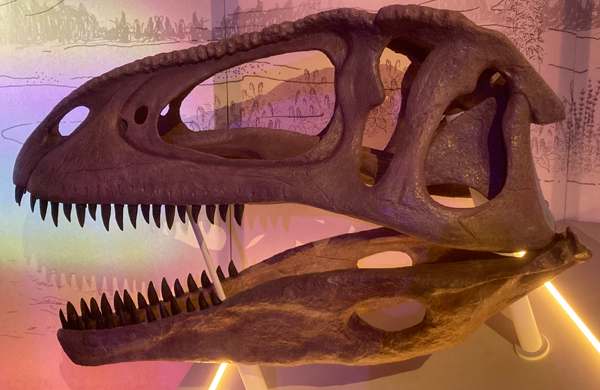
Amongst the many exhibits at the “Titanosaur: Life as the Biggest Dinosaur” exhibition is a theropod replica skull. Team members visited the exhibition and marvelled at the dinosaur’s model skull. If we recall correctly, it was a replica of a Mapusaurus fossil skull. The “Titanosaur: Life as the Biggest Dinosaur” exhibition is currently at the London Natural History Museum.
A view of the Mapusaurus replica skull on display at the London Natural History Museum (Patagotitan exhibition). In this view the skull looks narrow and elongated. Picture credit: Everything Dinosaur.
Picture credit: Everything Dinosaur
Mapusaurus roseae
Mapusaurus (M. roseae), has been classified as a member of the Carcharodontosauridae family. More specifically, this huge theropod is regarded by many palaeontologists as a sister taxon to Giganotosaurus. As such, it has been classified in the tribe Giganotosaurini alongside Giganotosaurus carolinii.
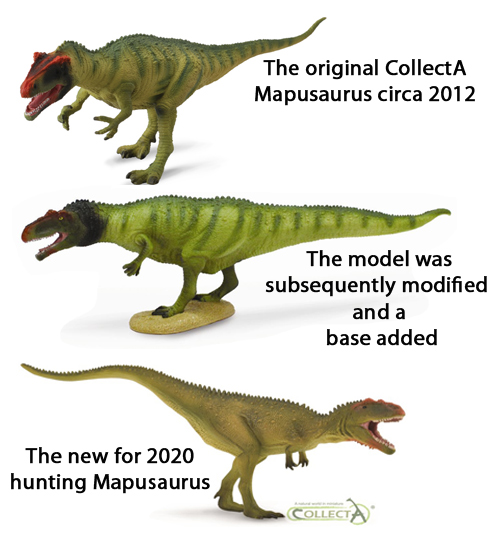
The changing Mapusaurus models 2012 – 2020 (CollectA).
The picture (above) shows how Mapusaurus models have changed over the last few years as more carcharodontosaurid fossils have been found. These models are all CollectA replicas.
Palaeontologists know that large carcharodontosaurids coexisted with titanosaurs like Patagotitan (P. mayorum). It has been postulated that theropods did hunt titanosaurs. Perhaps carnivores mobbed sick, old or juvenile members of the herd. It is hard to imagine a single 13-metre-long carnivore being able to subdue an adult Patagotitan that measured more than 30 metres in length.
A carcharodontosaurid skull is included in the exhibit. We think this is a replica of the skull of Mapusaurus roseae. Mapusaurus is geologically younger than Patagotitan. The dating of volcanic ash layers associated with the Patagotitan deposits suggest that this dinosaur lived approximately 100 million years ago.
The Mapusaurus skull replica looks shorter and broader when viewed from 90 degrees. Compare this view with the Mapusaurus skull photograph at the top of the article. Picture credit: Everything Dinosaur.
Picture credit: Everything Dinosaur
M. roseae fossils are associated with the Huincul Formation, these are younger strata than the rocks associated with Patagotitan fossil material. Mapusaurus lived approximately 96-94 million years ago.
To read Everything Dinosaur’s earlier blog post looking at a trio of carcharodontosaurid dinosaurs: A Trio of Carcharodontosaurids.
There is a carcharodontosaurid that comes from the same Member of the Cerro Barcino Formation as Patagotitan. This dinosaur is Tyrannotitan chubutensis, another giant member of the Giganotosaurini tribe. Tyrannotitan may have hunted and attacked Patagotitan.
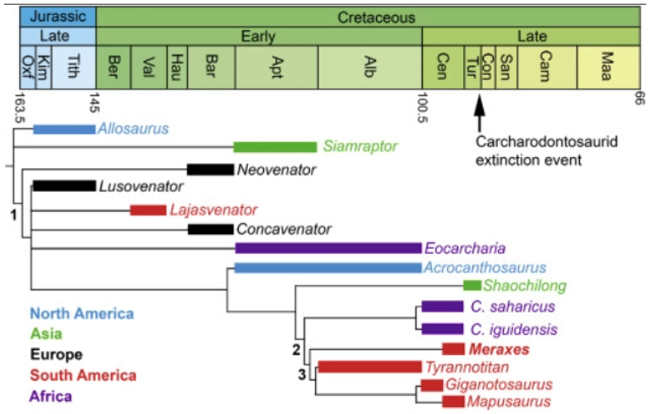
Cladogram depicting the temporal and geographical distribution of the Carcharodontosauridae family of theropod dinosaurs. At the time of their extinction these meat-eating dinosaurs seem to have been at their peak diversity. Picture credit: Canale et al.
The cladogram (above) shows the estimated temporal range for several theropod dinosaurs associated with the carcharodontosaurid lineage. Tyrannotitan was not contemporaneous with Mapusaurus.
What is Everything Dinosaur’s favourite dinosaur? This question was asked recently and although we are fascinated with lots of prehistoric animals, a quick discussion revealed that our favourite dinosaur is Protoceratops.
Palaeontologists can study Protoceratops (there are now two recognised species) at various growth stages from embryos in eggs to extremely old, mature adults.
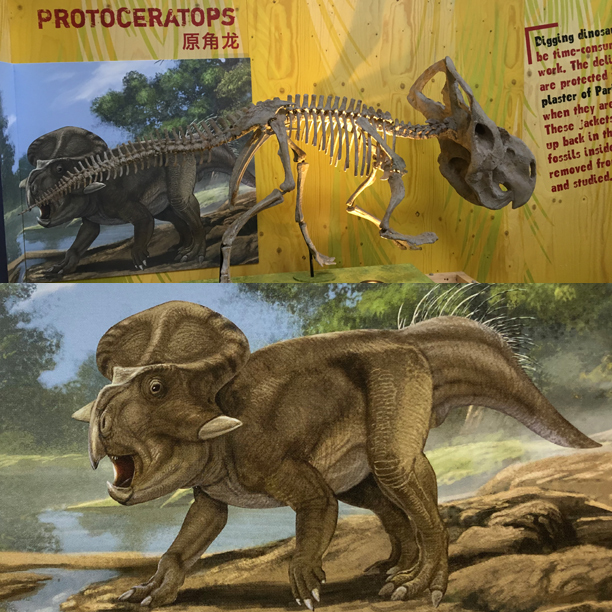
The “sheep of the Cretaceous”. Protoceratops replica fossil skeleton (top) and (bottom) a life reconstruction of this small ceratopsid. Picture credit (top): Everything Dinosaur. Picture credit (bottom): Zhao Chuang.
The “Sheep of the Cretaceous”
Nicknamed the “sheep of the Cretaceous” due to the relatively abundant fossil material. This dinosaur, distantly related to Triceratops and Styracosaurus was formally described 100 years ago (Granger and Gregory,1923). Two species are recognised Protoceratops andrewsi and P. hellenikorhinus (Lambert et al 2001).
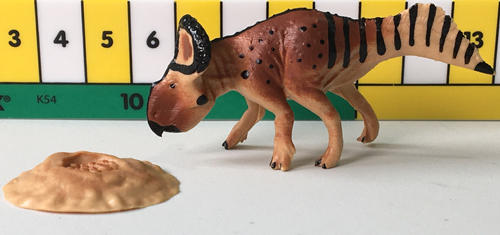
The Wild Past Protoceratops (P. andrewsi) next to a geology ruler to show scale. Picture credit: Everything Dinosaur.
Picture credit: Everything Dinosaur
The picture (above) shows the Wild Past Protoceratops dinosaur model. It is a small figure, but it does come supplied with a nest and an Everything Dinosaur fact sheet.
We have learned a lot about dinosaurs thanks to Protoceratops. It may not be the biggest dinosaur, but this herbivore has played a significant role in helping us to understand more about the Dinosauria and as such we will always regard this animal as something special.
If you visit a Natural History Museum, chances are that somewhere in the dinosaur gallery you will find Protoceratops. It is usually tucked away and it’s never going to attract the visitors like a T. rex, or a Triceratops (distantly related to Protoceratops), but go take a look, as I promise, you will probably learn something new about dinosaurs that you didn’t know before.
New research using complex mathematical models has proposed that placental mammals co-existed with dinosaurs during the Late Cretaceous. Using sophisticated Bayesian statistical analysis an international team of researchers have estimated that placental mammals originated during the Late Cretaceous. However, it was only after the extinction of the non-avian dinosaurs that modern, recognisable lineages of placentals were able to diversify.
Debate has long raged amongst researchers over whether placental mammals were present alongside the dinosaurs before the mass extinction, or whether they only evolved after the non-avian dinosaur extinction. Fossils of placental mammals are only found in rocks younger than 66 million years old, after the end-Cretaceous extinction event. This suggests that the group evolved after the demise of the non-avian Dinosauria. However, molecular clock data indicates that placental mammals originated earlier.
When Did Placental Mammals Evolve?
Writing in the academic journal “Current Biology”, a team of researchers including palaeobiologists from the University of Bristol, the University of Fribourg (Switzerland) and scientists from Sweden used a complex statistical analysis to confirm placental mammals co-existed the dinosaurs.
Lead author of the study Emily Carlisle (School of Earth Sciences at the University of Bristol) commented:
“We pulled together thousands of fossils of placental mammals and were able to see the patterns of origination and extinction of the different groups. Based on this, we could estimate when placental mammals evolved.”
PhD student Emily Carlisle (University of Bristol), the lead author of the paper. Picture credit: Emily Carlisle.
Co-author Daniele Silvestro (University of Fribourg) explained:
“The model we used estimates origination ages based on when lineages first appear in the fossil record and the pattern of species diversity through time for the lineage. It can also estimate extinction ages based on last appearances when the group is extinct.”
Placental Mammals Co-existed with Dinosaurs
The analysis indicates that primates (the ancestors of humans) probably evolved just before the K-Pg mass extinction event. In addition, the Lagomorpha (rabbits and hares) and the Carnivora were shown to have evolved when non-avian dinosaurs still roamed. The Carnivora is an extremely diverse Order of placental mammals. It includes cats, dogs, hyenas, civets, mongooses, bears, raccoons, pinnipeds (seals) and the mustelids (weasels, otters and their relatives).
Co-author Professor Phil Donoghue (School of Earth Sciences, University of Bristol) added:
“By examining both origins and extinctions, we can more clearly see the impact of events such as the K-Pg mass extinction or the Palaeocene-Eocene Thermal Maximum (PETM).”
Everything Dinosaur acknowledges the assistance of a press release from the University of Bristol in the compilation of this article.
The scientific paper: “A timescale for placental mammal diversification based on Bayesian modelling of the fossil record” by Emily Carlisle, Christine M. Janis, Davide Pisani, Philip C. J. Donoghue and Daniele Silvestro published in Current Biology.
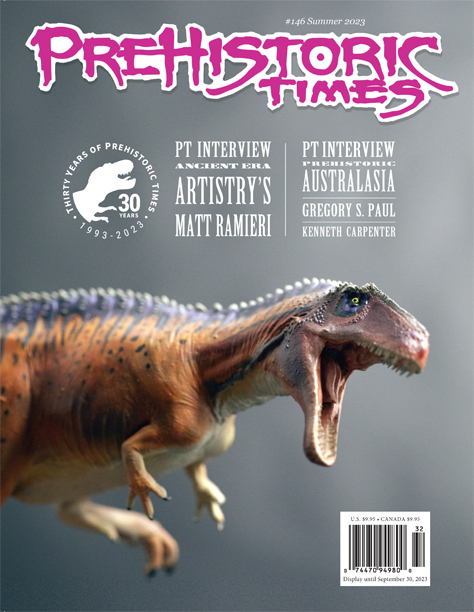
Our thanks to editor Mike Fredericks who sent into Everything Dinosaur an image of the front cover of the next edition of “Prehistoric Times” magazine. The next issue (summer 2023) is due to be despatched to the printers tomorrow.
The front cover of the next issue of Prehistoric Times magazine (issue 146 – summer 2023). Picture credit: Mike Fredericks.
“Prehistoric Times” Magazine
This quarterly magazine is extremely popular with dinosaur fans and prehistoric animal model collectors. Each issue features lots of amazing reader submitted artwork. The two prehistoric animals to be reviewed by Phil Hore are Tullimonstrum and Thescelosaurus.
In his email to Everything Dinosaur, editor Mike Fredericks stated:
“The new issue goes to the printer tomorrow. I think it will be an extra special issue. I interview a guy that creates 3D printed dinosaur models, and I interview the writers and artist of the beautiful new book Prehistoric Australasia.”
The magazine has been published for more than thirty years. It has thousands of subscribers all over the world. Produced in the USA “Prehistoric Times” has a worldwide customer base. It has thousands of readers in the UK, Australia, New Zealand and it is extremely popular amongst Canadian dinosaur fans.
Issue 146 (Summer 2023)
Issue 146 (summer 2023) will include regular features such as news updates, model reviews and book launches. Expect more from Tracy Lee Ford in the excellent how to draw dinosaurs series. In this issue, Greg Paul provides his views on the influential artist Zdeněk Burian and Kenneth Carpenter tells of a new prehistoric national monument. In a few short weeks, the next issue will be landing in mailboxes.
Readers can expect prehistoric animal model reviews and an update on rare collectables from Randy Knol.
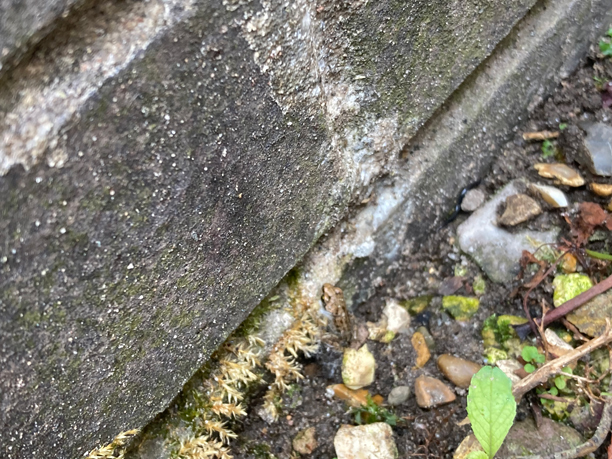
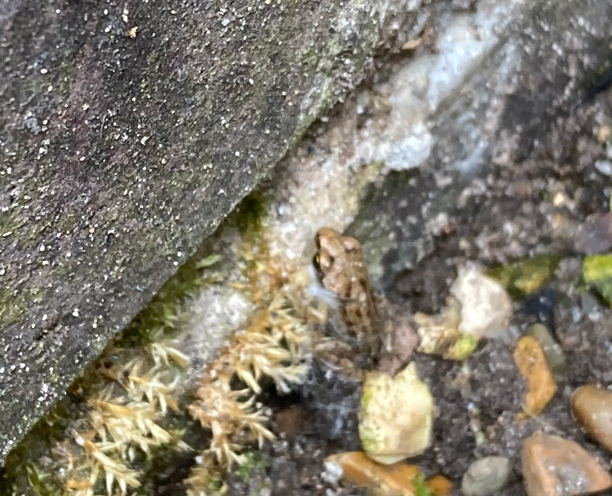
A baby frog spotted by an Everything Dinosaur team member close to the company’s office pond. This is the first frog observed from this year’s breeding season. The tiny frog (Rana temporaria) was observed in a small patch of gravel. This area has been left and weeds allowed to grow, thus providing shelter and habitat for animal’s leaving the pond.
Can you spot the frog? The baby frog that recently emerged from the office pond. Picture credit: Everything Dinosaur.
Picture credit: Everything Dinosaur
Baby Frog Spotted (Rana temporaria)
The frog is a Common Frog (Rana temporaria). In common with all British amphibians this frog is protected under the Wildlife and Countryside Act, 1981. Garden ponds are an increasingly important habitat for them. In return, they help keep slug and snail numbers down. In short, amphibians like the Common Frog are the gardener’s friend.
The first batch of frogspawn was laid in the office pond on February 28th. This is the earliest recorded date for frogs spawning in our pond. We suspect that the spotting of a baby frog on the evening of 24th June is the earliest recorded date for observing a frog from that year’s breeding season.
A close-up view of the tiny, baby frog spotted near to the office pond. Picture credit: Everything Dinosaur.
Picture credit: Everything Dinosaur
Doing Our Bit for Conservation
A spokesperson from Everything Dinosaur commented that team members had been busy looking after the office pond and removing excessive algae on a regular basis. The water level is quite low, but the pond is being carefully monitored to ensure it remains an attractive habitat for fauna and flora.
Recently, some oxygenating hornwort (Ceratophyllum demersum) was introduced to the pond. This plant will grow rapidly and help to combat the excessive growth of any algae. It is hardy, tough and fast growing. Hopefully, the introduction of this oxygenator will help to keep the pond in good condition and encourage lots of wildlife.
The spokesperson added:
“We like doing our bit for conservation. Many ponds around us have been filled in and we are pleased that our little pond is helping to maintain the local frog population. We shall keep observing the pond area, we might spot more baby frogs.”
Visit Everything Dinosaur’s user-friendly and award-winning website: Everything Dinosaur.