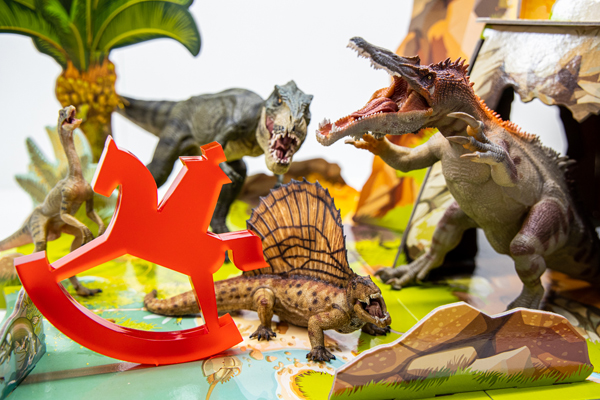
An eagle-eyed Everything Dinosaur team member spotted a photograph showcasing some of the Papo prehistoric animal models at the recent Nuremberg Spielwarenmesse in Germany. The Toy Fair organisers had taken pictures of various product displays at the exhibition over the course of a few days and some of the Papo prehistoric animals had obviously caught the eye of the trade show photographer.
Papo Prehistoric Animal Models
Some Papo Prehistoric Animal Models are Showcased at the Nuremberg Spielwarenmesse 2020
Papo models are showcased at the 2020 Nuremberg Toy Fair. Four Papo models are featured can you name them all?
The photograph shows four prehistoric animals in close proximity to the Nuremberg Spielwarenmesse logo.
The Nuremberg Spielwarenmesse
A spokesperson from Everything Dinosaur commented:
“With thousands of Papo models in our warehouse, our team members get to see Papo prehistoric animal models every day. However, for a photographer at a huge exhibition such as the Nuremberg Spielwarenmesse, which is, we believe to be the largest toy fair in Europe, they may not have been all that aware of the Papo range. Having come across the Papo trade stand, the photogenic qualities of the models and figures, attracted a lot of attention and hence the resulting photograph came about.”
The four Papo figures certainly look impressive and whilst at the event, Everything Dinosaur took the opportunity to take some photographs of their own, focusing on the new for 2020 Papo prehistoric animal models such as the magnificent Megaloceros figure.
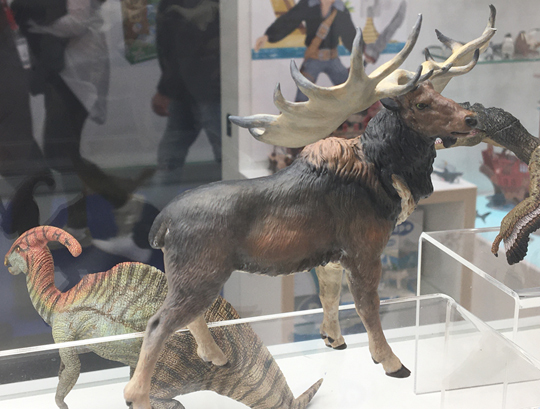
The Papo Megaloceros Model on Display at the Trade Fair (Nuremberg Spielwarenmesse)
A pre-production Papo Megaloceros model on display at the Nuremberg Spielwarenmesse 2020. The Megaloceros is one of six new Papo prehistoric animals to be introduced later this year – Chilesaurus, Stygimoloch, Giganotosaurus, new colour variant feathered Velociraptor (seen far right of the photograph) and a new colour variant Papo Parasaurolophus (background).Picture credit: Everything Dinosaur.
A student from Bristol University has carried out a study into the armour on the tail of an aetosaur. The study, published in the Scottish Journal of Geology, has provided fresh information on how these large, lumbering herbivores kept themselves safe from ancient predators. Emily Keeble, a recent graduate from the palaeobiology programme at Bristol University carried out the study under the supervision of Professor Mike Benton (School of Earth Sciences). CT (computerised tomography), scans were undertaken, the first time this scientific method has been employed to better understand how the armour of an aetosaur functioned.
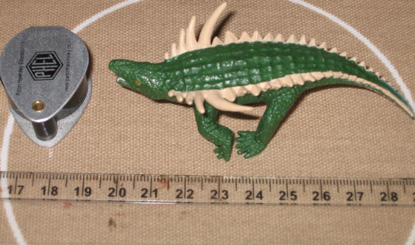
A Model of a Typical Aetosaur.
A model of an aetosaur (ruler provides scale). Although these tetrapods looked formidable with their spikes and their body armour they were herbivores.Picture credit: Everything Dinosaur.
Picture credit: Everything Dinosaur
The picture (above) depicts an aetosaur figure (Desmatosuchus haploceras) from Safari Ltd.
Aetosaurs were heavily armoured, herbivorous archosaurs that were geographically widespread during the Middle and Late Triassic. The term “aetosaur” is from the Greek and it means “eagle lizard”, when scientists first examined the skulls of these animals, their superficial resemblance to the skulls of eagles was remarked upon. The fossil specimens used in this research were collected from a sandstone quarry near the town of Elgin in north-eastern Scotland. They had been donated to the nearby Elgin Museum, where staff members Janet Trythall and Alison Wright were able to identify what they were and arrange for the scanning in Bristol.
Professor Benton explained:
“Aetosaurs were first identified from an Elgin specimen in 1844, but at that time people thought they had found a giant fish. The first specimen showed a number of rectangular scales, arranged in a closely overlapping, regular pattern, and it was called Stagonolepis, meaning drop-shaped scale.”
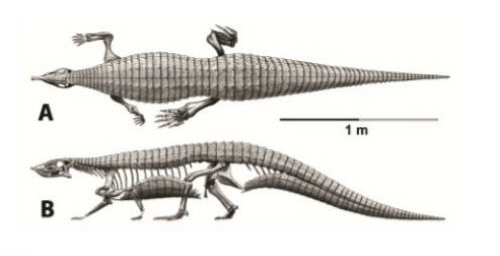
Dorsal and Lateral Views of the Scottish Aetosaur Stagonolepis
The Scottish aetosaur Stagonolepis (A) dorsal and (B) lateral views. Note scale bar = 1 metre.
Picture credit: Bristol University (illustration by Jeffrey Martz after work by Alick Walker)
CT Scans Provide Details on Aetosaur Osteoderm Structure
The fossilised tail bones were subjected to high resolution CT scans, this permitted the researchers to see surface details and the texture of the bones and related armour plates.
Emily Keeble added:
“What had been identified as giant fish scales are actually armour plates, or osteoderms, made of plates of bone and embedded in the skin, just like in modern crocodiles.”
Two specimens were studied, both associated with caudal vertebra and possibly from the same animal, but they do not fit together. Each fossil shows a complete circle of osteoderms around the tail, two above, two on each side, and two below.
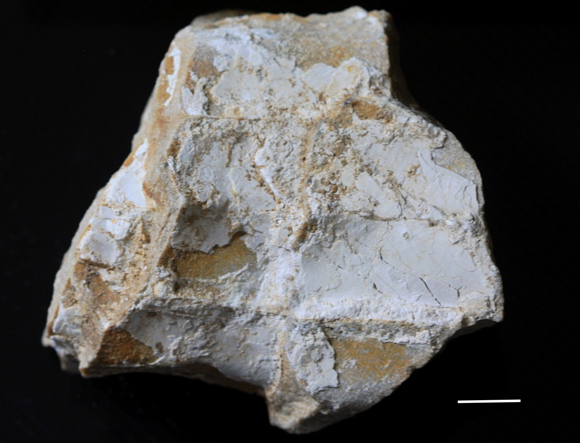
Caudal Specimen of Stagonolepis robertsoni Used in the Fossil Study
Stagonolepis robertsoni, ELGNM 2018.6.1 one of the aetosaur caudal vertebra specimens used in the study. Scale bar = 1 cm.
Picture credit: Bristol University
Regular Rows of Osteoderms
The researchers discovered that the rows of osteoderms were very regular and in life covered the entire body from the back of the small head, over the neck, down the back and along the tail. Osteoderms also covered the flanks and underneath. There were even small osteoderms over the fleshy parts of the arms and legs.
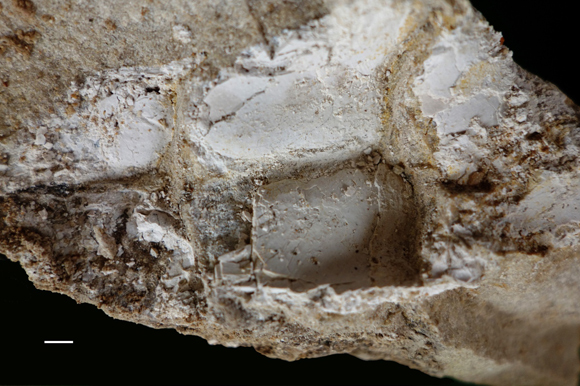
The Second Stagonolepis robertsoni Fossil Specimen Used in the Research
Stagonolepis robertsoni ELGNM 2018.6.2 showing internal impressions of the caudal osteoderms in articulation. Note scale bar = 1 cm.
Picture credit: Bristol University
Aetosaur Armour Makes an Effective Defence Against Predators
This study suggests that the armour of these herbivores wrapped around them completely and would have made an effective defence against predators such as rauisuchians and ornithosuchids.
Emily Keeble added:
“Vertebrae of the tail are preserved inside the ring of osteoderms, and these show the specimens were only slightly squished during the preservation process. We could also see how the osteoderms overlap like roof tiles, the osteoderm in front slightly overlapping the one behind. They were linked with connective tissue so the armour overall was flexible, but tough and could probably protect the animal from the fierce predators of its day.”
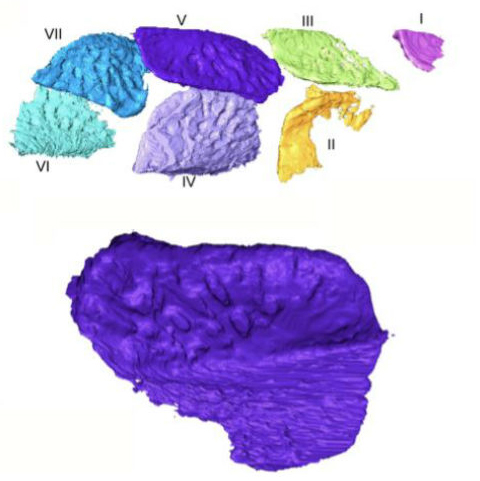
A Colourised Image of Aetosaur Osteoderms and a Single Scale Shown in More Detail
Reconstructed segment of the aetosaur tail armour and a single osteoderm in more detail.
Picture credit: Emily Keeble (Bristol University)
Everything Dinosaur acknowledges the assistance of a press release from Bristol University in the compilation of this article.
The scientific paper: “Three-dimensional tomographic study of dermal armour from the tail of the Triassic aetosaur Stagonolepis robertsoni” by E. Keeble and M. Benton published in the Scottish Journal of Geology.
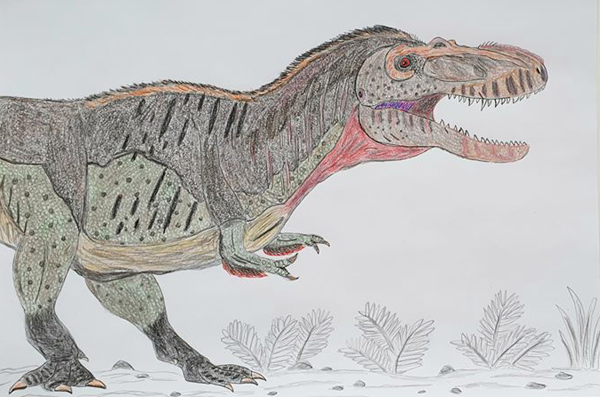
Our thanks to Caldey for sending into Everything Dinosaur a beautiful illustration of the recently described Canadian tyrannosaur Thanatotheristes degrootorum. Caldey was inspired by the media coverage of this new theropod dinosaur, perhaps she even read our blog post about this large carnivore from the Foremost Formation of Alberta.
Described from fragmentary remains, the fossils of T. degrootorum represent the earliest known evidence of diagnostic tyrannosaurid material to have been discovered in Canada. It roamed northern Laramidia around 80.1 to 79.5 million years ago, as such it is (for the moment at least), both Canada’s oldest and newest tyrannosaur.
The Illustration of Thanatotheristes degrootorum by Caldey
Thanatotheristes degrootorum illustration by Caldey, a drawing of a newly described theropod dinosaur from Alberta (Canada).
Picture credit: Caldey
Everything Dinosaur receives lots of illustrations of prehistoric animals. Our team members view them all and we are grateful for everyone that we get sent to us.
Thanatotheristes degrootorum the “Reaper of Death”
Closely related to Daspletosaurus, Thanatotheristes, which means the “reaper of death” in Greek, has been placed within a newly erected tribe within the Tyrannosauridae family. This tribe, named the Daspletosaurini consists of T. degrootorum, Daspletosaurus torosus along with Daspletosaurus horneri and an as yet not formally described tyrannosaurid from the Dinosaur Park Formation of Alberta (specimen number FMNH PR308).
Our thanks to Caldey for sending into Everything Dinosaur her fantastic dinosaur drawing.
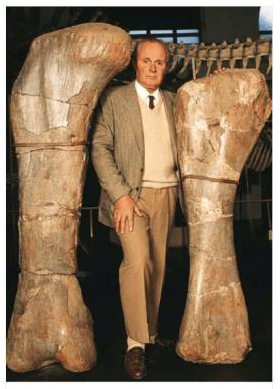
Today’s blog post is dedicated to José Bonaparte, one of the greatest palaeontologists of the 20th century and regarded as the “Father of Argentinian Palaeontology”, who has passed away. He died yesterday (18th February), at the age of 91. Social media has been filled with tributes to this dedicated, passionate and influential scientist, who was such an inspiration to a whole generation of palaeontologists.
José Fernando Bonaparte (1928-2020)
José Bonaparte (1928-2020).
Picture credit: Museo Argentino de Ciencias Naturales “Bernardino Rivadavia”
El Padre de la Paleontología en la Argentina
Respected and admired by many professional palaeontologists, the self-taught José Bonaparte was regarded as a workaholic and a tough taskmaster, but perhaps, he more than anybody else is responsible for introducing the remarkable vertebrate fossils found in Argentina to the rest of the world. Dinosaur palaeontologist Peter Dodson stated that “almost single-handedly he’s responsible for Argentina becoming the sixth country in the world in kinds of dinosaurs”.
His legacy will live on and his contribution will continue to be recognised, for example, last year alone there were something like ten new genera of non-avian dinosaurs described from fossil remains found in Argentina.
Bonaparte, who spent the majority of his career as head of the Vertebrate Palaeontology Division of the Museo Argentino de Ciencias Naturales “Bernardino Rivadavia”, in Buenos Aires was responsible for, or at least played a significant role in the study of iconic dinosaurs – famous animals such as Carnotaurus, Amargasaurus, Abelisaurus, Argentinosaurus, Noasaurus and numerous others. He made many other hugely important discoveries such as the finding of the first fossilised remains of Mesozoic South American mammals and he was amongst the first scientists to lead the “dinosaur revolution” inspired by Ostrom in the 1970s.
The “Master of the Mesozoic”
Robert Bakker nicknamed Bonaparte the “Master of the Mesozoic” (Maestro del Mesozoico). He was responsible for training a generation of palaeontologists, many of which are now regarded as leaders in the field – scientists such as Luis Chiappe, Rodolfo Coria, Agustín Martinelli, Fernando Novas, Jaime Powell, Guillermo Rougier, Leonardo Salgado, Sebastián Apesteguía and many others.
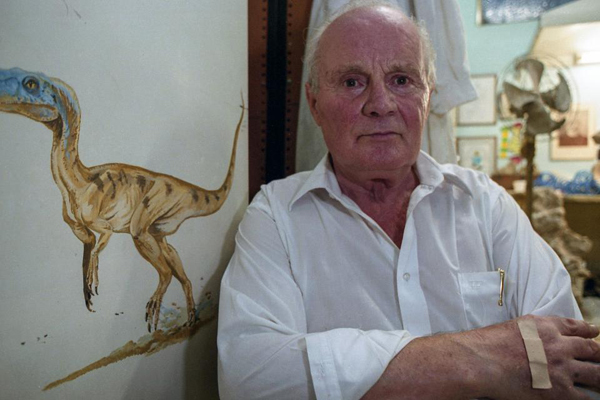
El Maestro del Mesozoico – José Bonaparte (1928-2020)
José Bonaparte (1928-2020) the “father of Argentinian palaeontology”
Picture credit: Télam
Everything Dinosaur acknowledges the assistance of a media release from the Museo Argentino de Ciencias Naturales “Bernardino Rivadavia” in the compilation of this article.
CollectA and a Prehistoric Giant from Poland – Lisowicia bojani
To celebrate the production of the CollectA Deluxe 1:20 scale model of Lisowicia bojani, a prehistoric animal from Poland, Everything Dinosaur has prepared a special blog post in Polish for all our Polish customers and friends.
Lisowicia bojani
Those clever and talented people at CollectA have created the biggest dinosaur line in the world, but they don’t just make models of dinosaurs, there are lots of other prehistoric animals too and later on this year (mid 2020), Polish model collectors will be able to get their hands on their very own Polish prehistoric animal model. A figure that represents one of the most important discoveries made in Europe by vertebrate palaeontologists this century.
CollectA will be introducing a 1:20 scale replica of Lisowicia bojani, a giant herbivore that roamed Silesia, southern Poland, more than 200 million years ago.
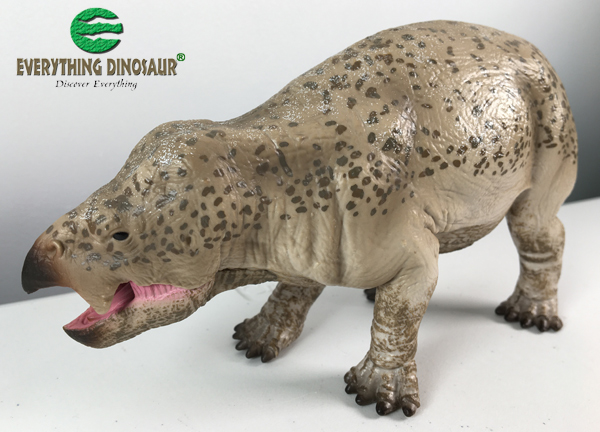
A Photograph of One of the Production Figures of the CollectA Deluxe Lisowicia bojani Model
A clay pit (the Lipie Śląskie clay pit), close to the village of Lisowice, has provided scientists with thousands of fossil bones to study. The fossils represent a wide variety of vertebrates including predatory dinosaurs, pterosaurs and large amphibians that once lived in a low-lying, wetland environment.
Polish scientists have played a prominent role in excavating the site and describing the fossil discoveries. When giant limb bones were unearthed, researchers thought that they had found the remains of a long-necked, plant-eating dinosaur (sauropod), but it was soon realised that these colossal and robust bones came from an enormous dicynodont (die-sigh-no-dont), an animal more closely related to us (Homo sapiens), than to any dinosaur!
The CollectA Deluxe 1:20 Scale Lisowicia bojani Model
CollectA Deluxe Lisowicia bojani model. Like most dicynodonts, Lisowicia was toothless and it had a large beak for cropping vegetation. The articulated jaw on the CollectA Deluxe model helps to show these features.Picture credit: Everything Dinosaur.
Picture credit: Everything Dinosaur
Defining Dicynodonts
Dicynodonts are a group of extinct quadrupeds which are distantly related to modern mammals. They first evolved in the Permian geological period, more than 70 different genera have been named and described. Although the strata in which the fossils of Lisowicia were found have proved very difficult to date, they could be at least 10 million years younger than any previously described dicynodont fossil material known to science.
Not only was Lisowicia bojani one of the last dicynodonts to have roamed our planet, it was by far the biggest. Scientists have estimated that Lisowicia measured 4.5 metres long and had a hip height in excess of 2 metres. Lisowicia is believed to have been at least 40% bigger than any other known dicynodont. Intriguingly, this elephant-sized animal was the largest animal known from the Late Triassic of Poland, and to date, no fossils of big, plant-eating dinosaurs have been found in this part of Europe, although their fossils have been found in similarly aged rocks elsewhere.
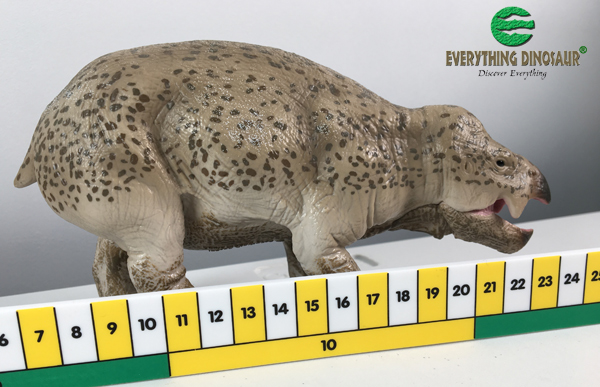
A Geological Ruler Helps to Show the Size of the CollectA Deluxe Lisowicia Model
The ruler helps to show the size of the CollectA Lisowicia model. The CollectA Deluxe Lisowicia measures just under 20 cm long.Picture credit: Everything Dinosaur.
Formally named and described in 2018, the genus name honours the Polish village of Lisowice, whilst the species name honours the German-born comparative anatomist Ludwig Heinrich Bojanus.
A spokesperson from Everything Dinosaur commented:
“It is great to have a model of a Polish prehistoric animal such as Lisowicia bojani added to the CollectA Deluxe model range. We are sure that collectors in Poland are going to be delighted with this new replica, the beautiful and very detailed model depicts an extinct, giant dicynodont that is known only from Poland. It is a model of an animal that was a large as an elephant, a long extinct creature that has helped palaeontologists to better understand Late Triassic ecosystems of Europe.”
To view the range of CollectA Deluxe prehistoric animals and dinosaurs available from Everything Dinosaur: CollectA Deluxe Prehistoric Life.
New Papo Prehistoric Animal Model Measurements (Part 2)
Everything Dinosaur recently published the official measurements for two of the brand new prehistoric animal models from Papo. Today, we conclude our blog posts in relation to the measurement of the brand new Papo prehistoric animal figures and our comments on scaling these models by publishing the official measurements for the Papo Stygimoloch dinosaur model and the Papo Megaloceros.
Papo Prehistoric Animal Figures
Whilst Papo may not produce scale models of prehistoric animals, we know how keen dinosaur fans and model collectors are for any guidance as to the approximate scale of a replica. To this end we have put together this short blog posts that concludes our foray into this area.
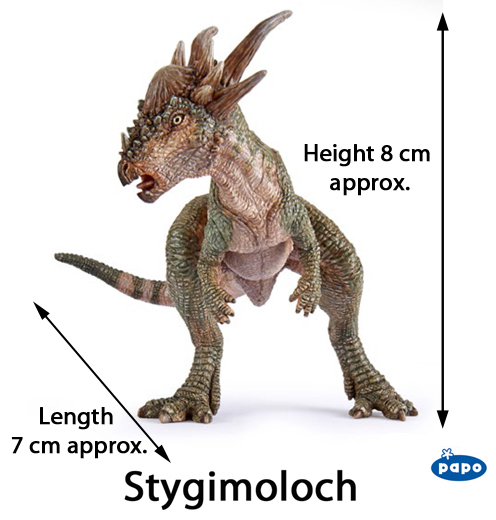
The Official Model Measurements for the New Papo Stygimoloch Dinosaur Model
The official measurements for the new for 2020 Papo Stygimoloch dinosaur model.Picture credit: Everything Dinosaur.
Picture credit: Everything Dinosaur
Papo Stygimoloch – Tale of the Tape
Everything Dinosaur has been informed that this new model stands around eight centimetres tall and that it is approximately seven centimetres in length. Calculating the scale for this pachycephalosaur (bone-headed) dinosaur is a little tricky, as most palaeontologists believe the fossils ascribed to Stygimoloch (S. spirifer), actually represent, juvenile, immature specimens of Pachycephalosaurus wyomingensis.
Dracorex (D. hogwartsia) and Stygimoloch (S. spirifer) are regarded as “nomina dubia“, that is to say, that the validity of both these two genera are now in doubt.
The Dracorex and Stygimoloch Debate
The reasons for the uncertainty of the Dracorex and Stygimoloch taxa can be summarised as follows:
In 2007, at the annual meeting of the Society of Vertebrate Paleontology (SVP), palaeontologist John R. Horner (Jack Horner), presented evidence that the holotype Dracorex specimen might represent Stygimoloch. He further proposed that Dracorex and Stygimoloch represented juvenile or possible female P. wyomingensis specimens.
In 2009, Horner in collaboration with Mark Goodwin, published further evidence suggesting that the cranial spikes and bumps on the skulls of these three dinosaurs showed considerable variation but within a range expected for a single species. In addition, they concluded that whilst P. wyomingensis was known from adult specimens, both Dracorex and Stygimoloch fossil material represent juveniles. As all three “species” are known from the Hell Creek Formation, then all the pachycephalosaur fossils could be associated with a single genus. As these types of dinosaurs grew and matured they lost their spikes and developed thick, dome-shaped skulls.
More recently, other scientific papers have been published that conclude that the so-called “unique” characteristics of Stygimoloch and Dracorex are morphologically consistent traits that would be expected if a Pachycephalosaurus growth curve was plotted.
Calculating the Scale for the Papo Stygimoloch Model
If it is proposed that Stygimoloch represents a juvenile specimen of Pachycephalosaurus wyomingensis, then what growth stage does this model represent? If we assume that the Papo figure represents a half-grown animal, then we can speculate that the body length would be around two to three metres. Based on these assumptions, a model that is seven centimetres long would be in scale 1:28.5 for a two-metre-long animal or approximately 1:42 scale for a three-metre-long animal.
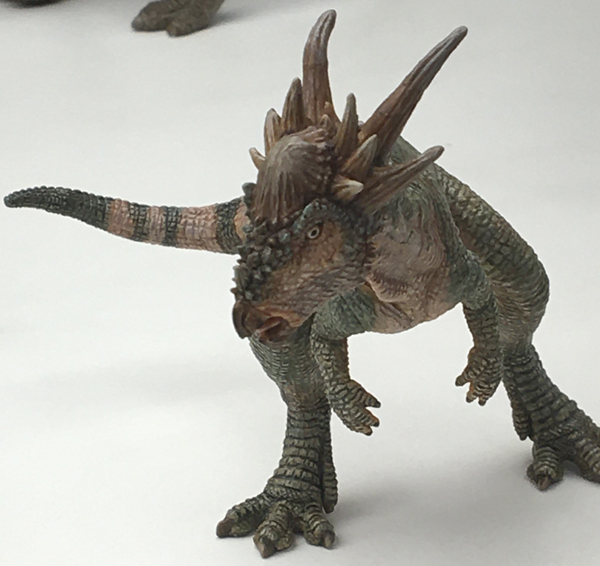
One of the Prototype Production Models (Papo Stygimoloch)
A view of one of the production prototypes of the Papo Stygimoloch dinosaur model.Picture credit: Everything Dinosaur.
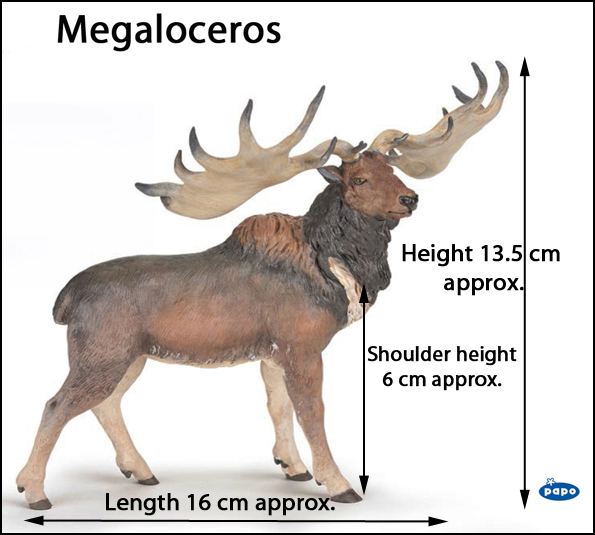
The Official Model Measurements for the Papo Megaloceros Model
The official measurements for the new for 2020 Papo Megaloceros prehistoric animal model.Picture credit: Everything Dinosaur.
Picture credit: Everything Dinosaur
Papo Megaloceros Model – Tale of the Tape
The Papo Megaloceros model is the only non-dinosaur figure to be introduced by Papo in 2020. The information received by Everything Dinosaur indicates that this figure will measure some 16 centimetres in length, stand around 6 cm high at the shoulders with an overall height of 13.5 cm. When all the new Papo figures are in stock, Everything Dinosaur team members will carefully measure each model and publish the details in the “additional information” section of the relevant product pages.
If it is assumed that this figure represents an example of the largest species of Megaloceros (M. giganteus), then with the type species having an estimated body length of 3.2 metres this figure could be in 1:20 scale.
A Papo Megalosaurus Figure on Display
A pre-production Papo Megaloceros model.Picture credit: Everything Dinosaur.
Picture credit: Everything Dinosaur
Delays in Production due to the COVID-19 Outbreak
As Papo’s production is based in China, the company is currently experiencing difficulties scheduling manufacturing due to the continuing COVID-19 (Coronavirus) outbreak. Everything Dinosaur will keep social media followers and our blog readers informed of developments and when more information becomes available regarding the availability of these models, we will publish it.
Official Measurements for the Papo Chilesaurus and the Papo Giganotosaurus Models
Everything Dinosaur has published details of the official measurements for the four, brand new prehistoric animal figures expected later in the year from Papo. In today’s blog post, we will provide information on the Chilesaurus and Giganotosaurus figures, a second post will follow which will provide measurement details of the other new dinosaur replica (Stygimoloch) as well as the eagerly anticipated Papo Megaloceros.
Papo Prehistoric Animal Model Measurements
Although Papo does not produce scale models, our team members have provided an approximation of scale for each of these figures in order to assist dinosaur fans and collectors with their prehistoric animal collections.
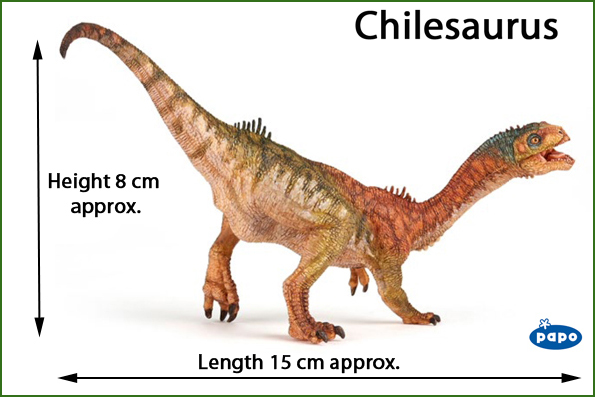
The Official Model Measurements for the Papo Chilesaurus Model
The official measurements for the new for 2020 Papo Chilesaurus dinosaur model.Picture credit: Everything Dinosaur.
Picture credit: Everything Dinosaur
Papo Chilesaurus – Tale of the Tape
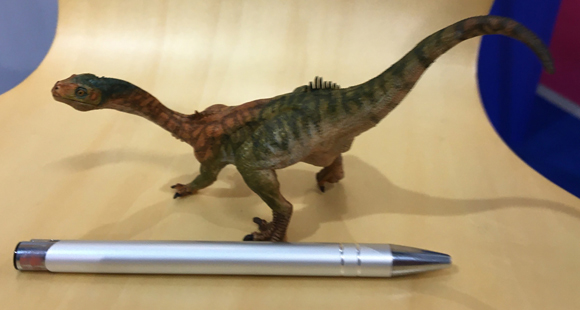
The Papo Chilesaurus figure measures around fifteen centimetres in length and the tail is approximately eight centimetres off the ground.
A Photograph of One of the Production Figures (Papo Chilesaurus)
The New for 2020 Papo Chilesaurus dinosaur model (the pen helps to show the size of this replica). Picture credit: Everything Dinosaur.
Picture credit: Everything Dinosaur
With an estimated adult animal total length of 3 to 3.2 metres, Everything Dinosaur team members estimate that this figure is in approximately 1:20 to 1:22 scale.
The Official Measurements for the New for 2020 Papo Giganotosaurus Dinosaur Model
The official measurements for the new for 2020 Papo Giganotosaurus dinosaur model.Picture credit: Everything Dinosaur.
Picture credit: Everything Dinosaur
The Papo Giganotosaurus Dinosaur Model
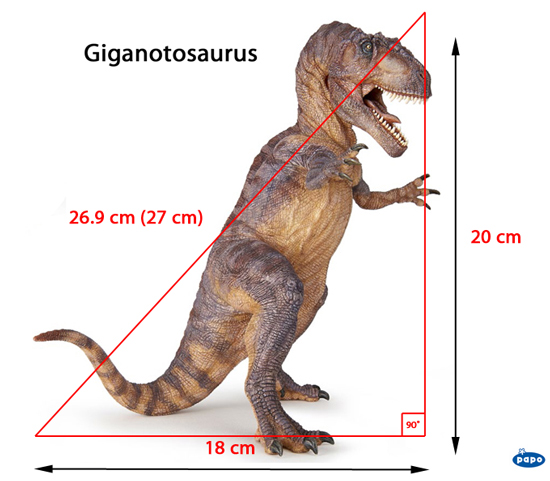
The official measurements for the Giganotosaurus model are length eighteen centimetres, with an overall height of twenty centimetres. The unorthodox pose of this figure makes an assessment of scale quite a challenge for this particular model. However, if we apply the Pythagoras theorem which states that the square of the length of the hypotenuse is equal to the sum of squares of the lengths of other two sides of a right-angled triangle, (a² + b² = c²), we can approximate the length of the head, body and tail if the model was put in a more anatomically correct pose.
By drawing a right-angled triangle over the body plan of the figure, an approximation for the length of the head, body and the tail can be calculated.
Team members calculated the length of the hypotenuse to be approximately 27 cm, which, when compared to the estimated length of the adult dinosaur at around 13.2 metres, equates to a 1:48 scale figure.
Estimating the Scale of the Papo Giganotosaurus Figure
Estimating the approximate scale of the new for 2020 Papo Giganotosaurus dinosaur model using Pythagorean theorem.Picture credit: Everything Dinosaur.
Due to the Coronavirus outbreak in China, there has been an unavoidable delay on the production of these new Papo models. Everything Dinosaur will, of course, keep our blog readers and social media followers updated and provide further information as and when we receive it.
A spokesperson from Everything Dinosaur commented:
“Whilst there is a lot of uncertainty with regards to the production of the new models and figures, Everything Dinosaur has built up considerable stock of Papo models and we are confident that the vast majority of the Papo figures, including some quite rare and retired replicas will still be available from us for a considerable time to come. If a model should be temporarily unavailable, customers always have the option to join a waitlist. As and when we receive updates on Papo prehistoric animal production, we will provide this information to our social media followers and blog post readers.”
New Study Suggests Climate Change Could Reduce Lifespan Amongst Hundreds of Species
Researchers from Queen’s University Belfast and Tel Aviv University (Israel), have carried out one of the most comprehensive studies to date to better understand what affects life expectancy among all living vertebrates in the world. The study’s conclusions not only challenge a long-accepted theory about the lifespan of organisms, but also provide a new perspective on climate change – that global warming could have a huge impact on the life expectancy among ectothermic animals such as reptiles and amphibians.
Amphibians such as Frogs Could Be Exceptionally Vulnerable to the Consequences of Global Warming
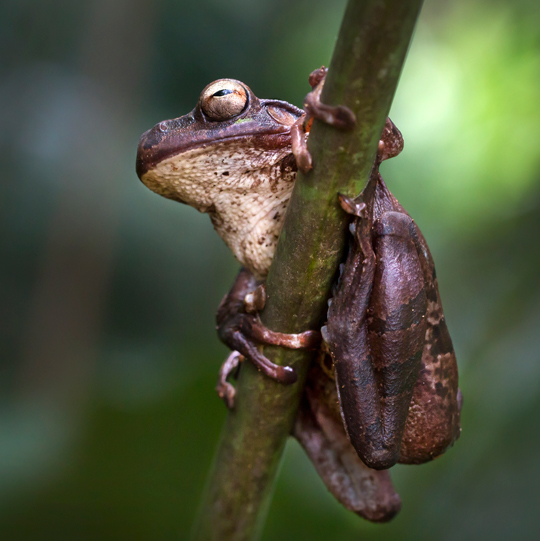
Cold-blooded animals such as frogs may be exceptionally vulnerable to climate change.
Picture credit: Queen’s University Belfast
Global Warming
The “rate of living” theory has long been accepted as an explanation as to why organisms age. According to this theory, the faster the metabolic rate the shorter the lifespan. Live fast and die after a relatively short period, in other words the “faster” the species lives in terms of the speed of its internal body functions and how quickly they start to reproduce, or how “slowly” in terms of these internal body functions and of lower reproductive rates, will determine the lifespan.
Research into How Organisms Age
This hypothesis helps to explain why some vertebrates such as frogs and reptiles may only live for a few months, whilst other species such as elephants, the Greenland shark and turtles can live for a very long time.
Giant Tortoises Can Live for Over a Hundred Years
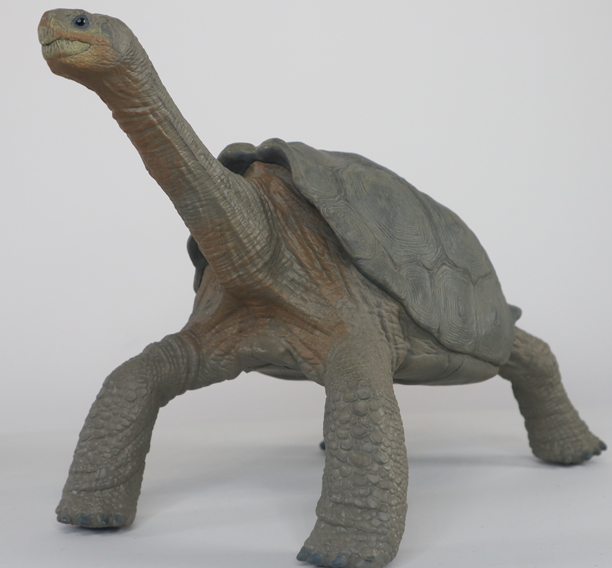
The Rebor 1:6 scale Pinta Island tortoise “Lonesome George” in oblique lateral view. Picture credit: Everything Dinosaur.
Picture credit: Everything Dinosaur
The image (above) shows the Rebor 1:6 scale giant tortoise model “Lonesome George”.
The Hotter the Environment – The Faster the “Rate of Living”
Until now the theory had not been tested at a global scale with all land vertebrates and there were limitations with the range of species the theory was tested on. The scientists from Queen’s University and Tel Aviv University analysed data from over 4,100 land vertebrate species from across the planet to test the prevailing “rate of living” theory.
They discovered that “rate of living” does not affect aging rates, rejecting the previously accepted link between lifespan and metabolism.
Writing in the academic journal “Global Ecology and Biogeography”, the researchers found that rates of aging in cold-blooded organisms (ectotherms), including amphibians and reptiles are linked to high temperatures. These findings led the scientists to put forward an alternative hypothesis: the hotter the environment is, the faster the rate of living that in turn leads to more accelerated aging and a shorter lifespan.
Critical Implications
Commenting on the significance of this new study, co-author Dr Daniel Pincheira-Donoso, (School of Biological Sciences at Queen’s University Belfast) stated:
“Our findings can have critical implications for our understanding of factors that contribute to extinctions, especially in modern times when we are facing a worldwide decline of biodiversity, with cold-blooded animals being particularly endangered. Now we know that the life-expectancy of cold-blooded vertebrates is linked to environmental temperatures, we could expect to see their lifespans further reduced as temperatures continue to rise through global warming.”
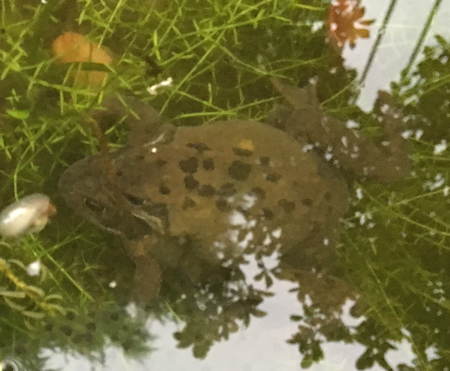
A Pair of Common Frogs Mating (Rana temporaria)
A pair of mating frogs (2017). The long-term outlook for many species of amphibian including the Common frog (Rana temporaria) is not good.Picture credit: Everything Dinosaur.
Picture credit: Everything Dinosaur
Amphibians the Most Threatened Class of the Animalia
According to date from the International Union for Conservation of Nature Red List (IUCN), some 30,000 species are currently threatened with extinction. This figure represents around 27% of all the species assessed. Amphibians are, on average, the most threatened Class, with 41% of species threatened. A press release from the Queen’s University Belfast states that nearly one in five of the world’s estimated 10,000 species of lizards, snakes, turtles, crocodiles and other reptiles are threatened with extinction.
PhD student, Gavin Stark, the lead author of the study (Tel Aviv University), explained:
“The link between lifespan in cold-blooded animals (amphibians and reptiles) and ambient temperatures could mean that they are especially vulnerable to the unprecedented global warming that the planet is currently experiencing. Indeed, if increasing ambient temperatures reduces longevity, it may make these species more prone to go extinct as the climate warms.”
Dr Pincheira-Donoso added:
“We need to further develop our understanding of this link between biodiversity and climate change. Only armed with knowledge will we be able to inform future policies that could prevent further damage to the ecosystem.”
The Scientific Paper
The paper entitled, “No evidence for the “rate-of-living” theory across the tetrapod tree of life” is published in the journal Global Ecology and Biogeography. Manuscript ID GEB-2019-0279.R4.
Everything Dinosaur acknowledges the assistance of a media release from Queen’s University Belfast in the compilation of this article.
Everything Dinosaur has teamed up with those clever, creative people at Mojo Fun and to celebrate the roll out of the new for 2020 Mojo Fun dinosaurs, Everything Dinosaur is giving away two very special Mandschurosaurus models.
We have one of the production models for the new Mojo Fun Mandschurosaurus, the one that collectors will find in the new Mojo Fun 2020 catalogue AND a second Mojo Fun Mandschurosaurus, the original prototype figure, one with a different colour scheme.
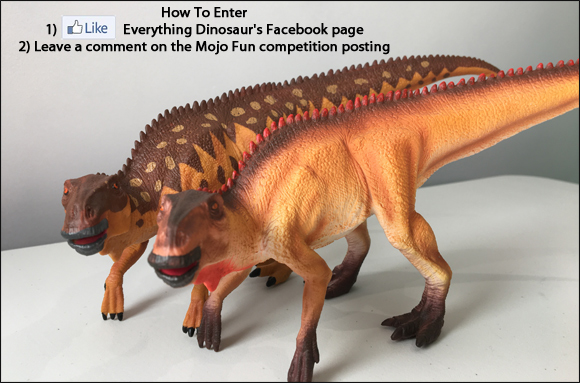
A Pair of Mojo Fun Mandschurosaurus Dinosaur Models to Give Away
Mojo Fun Mandschurosaurus dinosaur model giveaway. A pair of Mojo Fun Mandschurosaurus dinosaur models to give away- courtesy of Everything Dinosaur.Picture credit: Everything Dinosaur.
Picture credit: Everything Dinosaur
Win the two marvellous Mandschurosaurus models in Everything Dinosaur’s Competition.
All you have to do is “Like” Everything Dinosaur’s FACEBOOK page, then comment on the “Mojo Fun Competition” picture, perhaps you could tell us your favourite dinosaur, or maybe suggest a name for these two rare figures and we will enter you into our free prize draw.
We will draw the lucky winners at random and the “Mojo Fun Mandschurosaurus” competition closes on midnight Friday 28th February. Good luck, we hope you win this pair of highly sought after dinosaur models.
The genus Mandschurosaurus was erected ninety years ago, the species name Mandschurosaurus amurensis translates as “Chinese lizard from the Amur River”, given the current difficulties in China due to the COVID-19 outbreak it seems appropriate to express our support and sympathy for all those people affected and to celebrate the Mojo Fun factory’s excellent production values by giving away these two very special dinosaur models.
Win the Pair of Special Mojo Fun Mandschurosaurus Dinosaur Models
Win the pair of special Mojo Fun Mandschurosaurus dinosaur models.Picture credit: Everything Dinosaur.
Picture credit: Everything Dinosaur
Terms and Conditions of the “Everything Dinosaur Mojo Fun Mandschurosaurus” Competition
Automated entries are not permitted and will be excluded from the draw
Only one entry per person
The prize is non-transferable and no cash alternative will be offered
The “Everything Dinosaur Mojo Fun Mandschurosaurus” competition runs until midnight Friday 28th February 2020.
Winner will be notified by private message on Facebook.
Prize includes postage and packing
This giveaway is in no way sponsored, endorsed, administered by or associated with Facebook
Everything Dinosaur acknowledges a complete release of Facebook by each entrant/participant
By Mike|2024-01-17T07:49:26+00:00February 14th, 2020|Categories: General Teaching|Comments Off on New Research Suggests Climate Change Could Adversely Affect Amphibians and Reptiles
New Research Suggests Climate Change Could Adversely Affect Amphibians and Reptiles
Researchers from Tel Aviv University (Israel) and Queen’s University Belfast have carried out one of the most comprehensive studies to date to better understand what affects life expectancy among all living vertebrates in the world. The study’s conclusions not only challenge a long-accepted theory about the lifespan of organisms, but also provide a new perspective on climate change – that global warming could have a huge impact on the life expectancy among cold-blooded animals such as reptiles and amphibians.
Studying Reptiles and Amphibians
With many schools having ponds in their grounds and wildlife areas, it is important to emphasise how crucial these habitats are for many animals, particularly frogs, toads and newts as the spawning season gets underway.
Forty-one Percent of All Amphibian Species Assessed to Date* Are Threatened with Extinction
Cold-blooded animals such as frogs may be exceptionally vulnerable to climate change.
Picture credit: Queen’s University Belfast
* International Union for Conservation of Nature Red List Data.
The “Rate of Living” Theory
Some animals with backbones, such as some species of frog, can live for less than a year. Whilst other animals such as elephants and turtles can live for a very long time. The “rate of living” theory has long been accepted as an explanation as to why organisms age. According to this theory, the faster the metabolic rate the shorter the lifespan.
The scientists from Queen’s University Belfast and Tel Aviv University looked at data from over 4,100 land vertebrate species from across the planet to test the prevailing “rate of living” theory. They found that ‘rate of living’ does not affect aging rates, rejecting the previously accepted link between metabolism and lifespan.
Identifying Extinction Factors for Reptiles and Amphibians
The study, published today (Friday 14 February), in the journal Global Ecology and Biogeography, found that rates of aging in cold-blooded organisms including amphibians and reptiles are linked to high temperatures. These findings led the scientists to propose an alternative hypothesis: the hotter the environment is, the faster the rate of living that in turn leads to more accelerated aging and a shorter lifespan. Dr Daniel Pincheira-Donoso, co-author and Lecturer in Evolution & Macroecology at the School of Biological Sciences at Queen’s University Belfast, explained:
“Our findings can have critical implications for our understanding of factors that contribute to extinctions, especially in modern times when we are facing a worldwide decline of biodiversity, with cold-blooded animals being particularly endangered. Now we know that the life-expectancy of cold-blooded vertebrates is linked to environmental temperatures, we could expect to see their lifespans further reduced as temperatures continue to rise through global warming.”
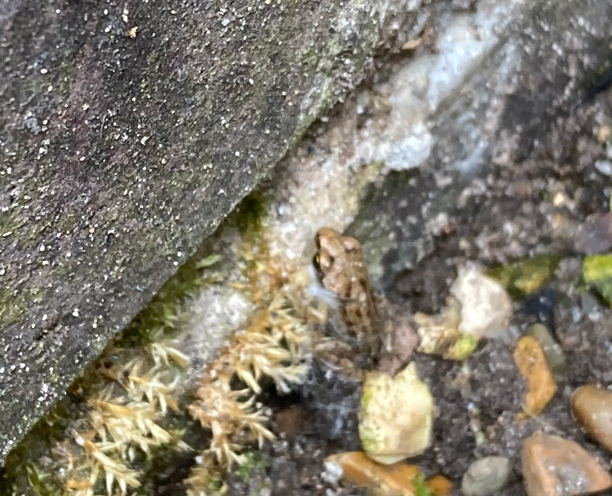
A Tiny Frog Emerging from a Pond
A close-up view of the tiny, baby frog spotted near to the office pond. Picture credit: Everything Dinosaur.
Providing suitable habitats for animals such as frogs, newts and toads is essential. School wildlife areas, especially those with a body of water can play a vital role in helping to sustain local populations, as well as providing schoolchildren with an opportunity to study wildlife at close quarters. Teaching teams can then use these resources to help link learning to key elements of the science curriculum.