All about dinosaurs, fossils and prehistoric animals by Everything Dinosaur team members.
26 08, 2013

Pterosaurs by Mark P. Witton – A New Book Review

By |2024-05-01T14:42:02+01:00August 26th, 2013|Categories: Book Reviews|1 Comment

Pterosaurs Reviewed

Amongst the myriad of books published on the subject of long extinct creatures, it is the dinosaurs that seem to have had the lion’s share of the limelight, their Mesozoic contemporaries the pterosaurs, have largely been overlooked.

However, this new publication, written by palaeontologist and science writer Mark Witton entitled “Pterosaurs” goes a long way to redressing this imbalance.  These “winged lizards”, as that is what the term pterosaurs means once translated from Greek, were the first vertebrates to develop powered flight, nothing like them exists today but thanks to Mark’s skilful writing accompanied by a number of his own original paintings and some exquisite close up shots of these enigmatic animal’s beautifully preserved fossil remains, the reader is rapidly brought up to date with developments in flying reptile research.

Pterosaurs by Mark Witton

The book is essentially split into three distinct parts.  The first nine chapters are dedicated to providing a broad understanding of pterosaur evolution, the fossil evidence, their flight abilities and locomotion.  If you have ever wondered how an animal as tall as a giraffe could possibly get off the ground, or where the Pterosauria fit into the Sauropsida (reptiles and birds) family tree, then these pages will go a long way to providing you with the answers.

The bulk of the rest of the book is then dedicated to introducing and discussing the numerous pterosaur groups currently recognised by the majority of “Pterosaurologists” and what a bizarre, eclectic collection the pterosaurs prove to be.  From the stout jawed, long-tailed Dimorphodontidae, through to the flamboyant Tapejaridae culminating in those giraffe-sized azhdarchids, Mark attempts to introduce each group roughly in chronological order, focusing first on the earliest types of pterosaurs and concluding with the very last of their kind.

Flying Reptiles

Most members of the public can recognise one or two types of flying reptile, thanks largely to their role as flying terrors in films, on television and the ubiquitous use of Pteranodon as a flying reptile model included in most dinosaur toy sets.  By the end of chapter twenty-five, the reader has been given a comprehensive run down of the cast of characters that currently make up the Pterosauria Order.

Pterosaurs – Natural History, Evolution, Anatomy by Mark P. Witton
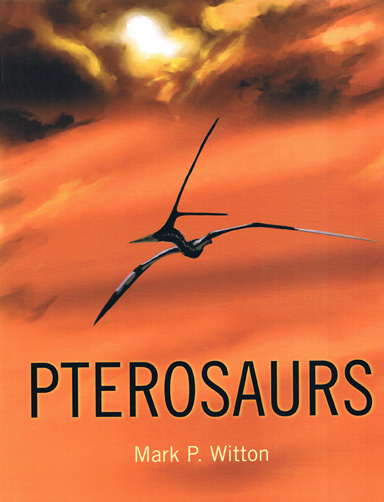
A very well researched and documented publication from an authority on the Pterosauria.

A very well researched and documented publication from an authority on the Pterosauria.

Picture credit: Mark Witton

The picture above shows the front jacket illustration, the pterosaur featured is the “antler crested” Nyctosaurus (chapter 18).

Pterosaur Fossils and Discoveries

Some knowledge of biology, anatomy and scientific terminology would be useful, but to Mark’s credit he works hard to simplify and explain the nuances of these bizarre creatures in a language that enables the lay person to follow the points that are being made without necessarily dumbing down the scientific tone of the book.  From our own perspective, with some knowledge of vertebrate palaeontology already, we found some of the details on the latest fossil discoveries, most notably from the Crato Formation (Brazil) and China’s Jiufotang Formation truly enlightening.

In each chapter dedicated to a specific type of pterosaur, Mark provides a skeletal reconstruction and life restoration of a typical member of this part of the pterosaur family tree.  This permits the reader to flick backwards and forwards thus comparing the different anatomical features of each type of pterosaur with relative ease.  A personal bugbear of ours, a fault found in many a technical tome on palaeontology that attempts to reach out to a wider audience, that of having illustrations supporting points made in the text, placed on subsequent pages and not adjacent to the text that the illustration refers to, is largely avoided.

The excellent drawings and diagrams, including a number of Mark’s own paintings help to explain some of the more complex points made.

How Did They Fly?

One diagram that we found ourselves constantly referring to occurs in chapter six, the part of the book that attempts to answer the most fundamental questions regarding the Pterosauria, why did they fly and were they any good at it?

The author has very helpfully reproduced a graphical representation that compares and contrasts pterosaur wing loadings and aspect ratios with modern fliers (birds and bats).  From this single graph, the reader is given the opportunity to view the different morphologies of pterosaurs in terms of their adaptations to certain types of aerial activity.  Thus, one can see at a glance those members of the Pterosauria that most likely filled an ecological niche similar to some of today’s sea-birds as marine soarers as well as those flying reptiles more adapted to inland, arboreal habitats where they filled an ecological niche similar to extant aerial predators.

A Curious Sordes pilosus investigates a Late Jurassic land snail
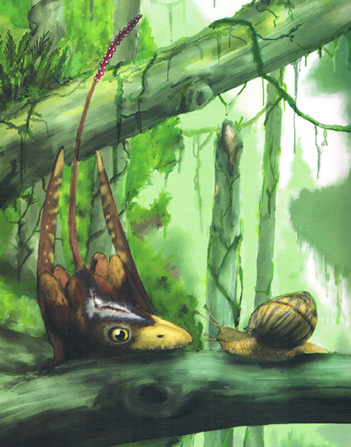
Eyeing up a potential meal?

Eyeing up a potential meal?

Picture credit: Mark Witton

The book has an extensive reference section, inviting the reader to explore the world of the Pterosaurologist further.  A couple of small quibbles on our part, a glossary of terms at the back of the book would have been helpful as would a Pterosauria pronunciation guide but apart from these ever so minor points, Mark is to be congratulated for casting a comprehensive spotlight onto these remarkable reptiles.

The last chapter of “Pterosaurs” deals with the decline and final extinction of these leathery-winged creatures, although a little brief, it does leave the reader with a real sense of loss.  These were not the misfits of vertebrate evolution, not simply a stop-gap before the Aves could step into their flying boots and dominate the skies, the book does much to change attitudes towards the Pterosauria.  Yes, they were bizarre, but as a group they persisted for something like 150 million years, a lot longer than us hominids and that’s a sobering thought.

Highly recommended.

For models and replicas of pterosaurs and other ancient creatures: Wild Safari Prehistoric World Models.
25 08, 2013

New Papo Dimetrodon Prehistoric Animal Model Reviewed

By |2024-05-01T14:42:23+01:00August 25th, 2013|Categories: Everything Dinosaur Products, Product Reviews|0 Comments

A Review of the Papo Dimetrodon (Pelycosaur) Model

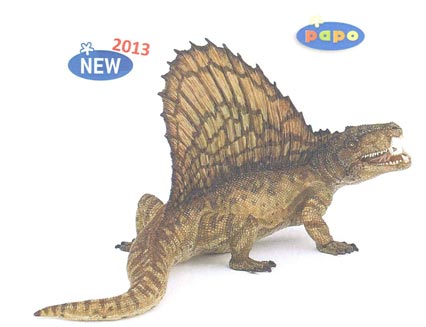
The last of Papo’s 2013 releases in the company’s prehistoric animal model range is Dimetrodon, Papo’s first model of a animal that lived before the dinosaurs existed.   Dimetrodon is not even closely related to the Dinosauria, it is a synapsid, a member of the pelycosaur group of reptiles.  Models of this sail-backed reptile have appeared very frequently in dinosaur model ranges and this is Everything Dinosaur’s review of the Papo Dimetrodon replica.

Dimetrodon Prehistoric Animal Model

Why Dimetrodon should be so strongly associated with the Dinosauria alludes us, but a few years ago team members at Everything Dinosaur wrote a short article about this: Why is Dimetrodon regarded as a Dinosaur?

The Papo Dimetrodon Model

Fearsome sail-backed reptile, with exquisite detail.

Fearsome sail-backed reptile, with exquisite detail.

Picture credit: Everything Dinosaur/Papo

A Large Predator

Dimetrodon was a large predator of the Permian geological period, a number of species are known, one of the largest of which, Dimetrodon grandis measured over 3.5 metres in length and would have weighed up to 200 kilogrammes when fully grown.  The genus Dimetrodon was named by the American Edward Drinker Cope, it is one of over 1,000 prehistoric animals that this famous palaeontologists named in his lifetime.

The most prominent feature of Dimetrodon is its enormous sail which stretched across the animal’s back.  This sail was supported by spines and the sail was actually quite thin.  Papo have taken care to depict the spines and thin sail very carefully on their replica.  This structure was most likely used to help regulate body temperature, although it may also have a played a role in courtship displays or other forms of visual communication between individuals, this perhaps helps to explain the patterning that the Papo design team have given the sail on their model.

Fantastic Detail on the Skin

The detailing on the skin is exquisite with individual scales clearly picked out.  The presence of skin folds and the detailed scaling gives this model a very lizard-like appearance.  The Papo Dimetrodon has a relatively long tail, early reconstructions of Dimetrodon showed this reptile with a short, stubby tail, but palaeontologists now know that this pelycosaur did indeed have a long tail.

The lower jaw is articulated and Papo have been careful to depict the different sized teeth in the jaws with a reasonable degree of accuracy, the prominent notch in the upper jaw is present, providing a space for the oversized teeth in the lower jaw to fit into when the mouth is closed.  Like the rest of the model, the head is very well painted and there is lots of detail to admire.

Model Measurements

This new Dimetrodon model measures  approximately 16.5 centimetres in length.  If we assume that this is a model of Dimetrodon grandis, then we can conclude that this replica is in approximately 1:21 scale.  Although, we are not aware of any scaling actually being stated by the manufacturer, this model would work well with any other replicas produced in a 1:20 scale format.

To view Papo models available at Everything Dinosaur: Papo Dinosaurs and Prehistoric Animal Figures.

Intriguingly, Papo have chosen to give their Dimetrodon model only four toes on the hind feet.  We think that this reptile had five toes on its feet, the front limbs of the model do have five digits which is correct.  Trackways, trace fossils assigned to the Dimetrodon genus, showing a large animal with five digits on each foot have been discovered in North America.

All in all, this is an excellent Dimetrodon model and one that is a welcome addition to the Papo range of replicas.  Perhaps, Papo will be encouraged to introduce other non-dinosaurian models into their prehistoric animal model series.

24 08, 2013

Beautiful CollectA Pachycephalosaurus Dinosaur Model Reviewed

By |2024-05-01T14:42:50+01:00August 24th, 2013|Categories: Everything Dinosaur Products, Product Reviews|0 Comments

A Review of the Pachycephalosaurus Model from CollectA

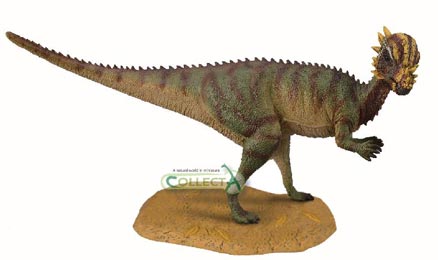
The pachycephalosaurs, often referred to as the “bone-headed dinosaurs” due to their greatly thickened skulls are a group of ornithischian dinosaurs known almost exclusively from Upper Cretaceous deposits of North America and northern Asia.  Although the majority of this group are only known from fragmentary fossil remains, most notably frontal and parietal bones of the skull,  a number of pachycephalosaur models have been made and this is a review of the Pachycephalosaurus dinosaur model manufactured by CollectA.

Pachycephalosaurus Dinosaur Model

No complete skeleton of Pachycephalosaurus has been found, so interpretations of this dinosaur, the largest of the “bone-headed dinosaurs” discovered to date, are usually based on a scaled up version of the pachycephalosaur known as Stegoceras.  CollectA have depicted their Pachycephalosaurus in a bipedal pose with strong hind legs, five fingered hands and with a tail a fraction longer than the length of the shoulder girdle to the pelvis, although the actual body proportions are unknown.

The CollectA 2013 Pachycephalosaurus Dinosaur Model

A lithe Pachycephalosaurus dinosaur model.

A lithe Pachycephalosaurus dinosaur model.

Skull Fossil Fragments

Skull fossil fragments ascribed to Pachycephalosaurus are known from Canada and the western United States, mainly from the Province of Alberta and the states of Wyoming and Montana. The thickened skull dome is over 25 cm thick on larger specimens, exceptional protection for what was a relatively small brain inside the skull.   The model makers at CollectA have elected to give their Pachycephalosaurus a more rounded skull, rather than the very domed shape seen in some reconstructions.

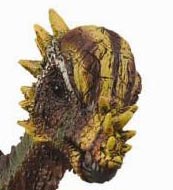
The skull dome was edged with a number of bony protrusions and spikes, these were most prominent towards the back of the skull.  The muzzle was relatively short and it ended in short beak,  in the CollectA replica, the beak is ever so slightly pointed and can be clearly made out on the model.  The spikes and bony projections have been painted a bright yellow colour which contrasts nicely with the muted, camouflaged tones of the body.

 The CollectA Pachycephalosaurus Viewed Close Up

A close up of the lovely detail on the head.

A close up of the lovely detail on the head.

Picture credit: Everything Dinosaur

Model Measurements

The model measures a little over ten centimetres long, although the size of this dinosaur is not certain from the fossil evidence, based on a 4.6-metre-long adult animal we estimate that this Pachycephalosaurus is in approximately 1:46 scale.

The replica has a row of prominent, triangular spikes running from the base of the skull to the almost the very tip of the tail, a single line of spikes is also depicted on the neck, presumably providing some protection from attack and to protect the soft tissue of the neck when browsing on thorny plant material.

The neck looks quite long and stiff. The total number of vertebrae is unknown for any member of the pachycephalosaur family, indeed how the neck bones articulated with the skull of Pachycephalosaurus is open to speculation.  It had been thought that the thickened skulls and stiffened dorsal vertebrae of this type of dinosaur were adaptations for head-butting contests between individuals, although recent studies and biomechanical analysis of the skull domes have led to this form of intra-specific conflict being disputed.

To read more about the disputed theory regarding head-butting Pachycephalosaurs:

Evidence for head-butting dinosaurs: Head-Butting Dinosaurs After All.

Contrasting evidence, pachycephalosaurs may have used their reinforced skulls in different ways: Bone-headed Dinosaurs “bashed” in Different Ways.

This model is supplied on a base, this prevents the feet from having to be oversized and the effect is to depict Pachycephalosaurus as an agile, strong-running dinosaur.  The number of fragments of skull bone found in locations such as the Dinosaur Provincial Park Formation of Alberta suggest that pachycephalosaurs were the most common, small-bodied dinosaurian herbivores in those ecosystems where their fossils have been found.

This is a fascinating re-creation of Pachycephalosaurus and an excellent addition to the CollectA range of prehistoric animal models.  The Pachycephalosaurus replica and the rest of the CollectA prehistoric life range is available from Everything Dinosaur, the UK based retailer of dinosaur models, toys and games that is staffed by parents, teachers and real dinosaur experts.

To view Everything Dinosaur’s range of CollectA models: CollectA Prehistoric World/Prehistoric Life.

23 08, 2013

Important Dinosaur Fossil Site Threatened by Floods

By |2023-02-22T07:50:10+00:00August 23rd, 2013|Categories: Dinosaur and Prehistoric Animal News Stories, Geology|0 Comments

Dinosaur Fossil Sites in Heilongjiang Province Flooded

The important dinosaur excavation sites located at the foot of mountains in Jiayin County, Heilongjiang Province (north-eastern China), are in danger of being irreparably damaged as flood waters have covered much of the area where palaeontologists and field scientists have been working.  All four dinosaur dig sites have been immersed in flood waters since the Heilong river burst its banks last week.  The water levels, a record high for this part of China, could damage the delicate fossil material, cause exposed fossils to break up and others to be washed away in sediments.

Dinosaur Fossil Site

The strata in this part of China has revealed a number of important Mesozoic vertebrate fossils, some found nowhere else on Earth.  A fossil record of a rich ecosystem could be seriously damaged, with much material lost forever.

Ironically, much of the fossil material was deposited in the region as a result of the action of river water and periodic flooding, now nature seems bent on taken back what it once gave.  A spokes person has stated that the losses caused by the flooding would be “inestimable”.

Investment in Flood Defences

Over the last few years, the state has invested in a number of flood defences and water management systems near the fossil sites, but dikes built to arrest any flood waters have not been able to cope with the volume of water.  Flooding has also inundated the nearby Heilong River Basin Museum.  Water first entered the building on Saturday August 17th and parts of the first floor of the museum are now under over a metre of water.  Staff and volunteers have been working hard to remove artefacts and specimens to the second floor in order to prevent further damage.

The museum was built on an island in the river, but no one envisaged such high water levels.  Some parts of the Heilong River Basin are now covered in several metres of water and the authorities are concerned that water levels could rise further leading to more damage to the Province’s infrastructure and the important fossil rich strata of the area.

Floods and Typhoon Hit China

Chinese state media has reported that at least 105 people have died and a further 115 are missing after floods and a typhoon hit parts of China.  Heavy rain in the north-east of the country has been falling since Wednesday of last week and this has caused substantial flooding and devastation.  Typhoon Utor hit southern China, making landfall in Guangdong Province and this has caused devastation and at least a further 22 people have lost their lives.

Described as some of the worst flooding seen in living memory, volunteers, officials and state workers are working hard to strengthen flood defences in those parts of the country affected.

22 08, 2013

The Search for Dinosaur DNA – New BBC2 Horizon Programme Explores the Seemingly Impossible

By |2024-05-01T14:43:15+01:00August 22nd, 2013|Categories: Dinosaur and Prehistoric Animal News Stories, Dinosaur Fans|12 Comments

Dinosaurs – The Hunt for Life

Horizon, the documentary series regarded by many as the flagship science programme for the BBC is venturing into the world of the dinosaurs once again with a programme dedicated to the remarkable work of Dr Mary Schweitzer and her colleagues.  Scientists have had the fossilised bones of dinosaurs to study and over the last one hundred and eighty years or so much has been learned about these long extinct reptiles, but could there be more than just permineralised, long-dead material present in the fossils of dinosaurs?  Could biological material such as cells, soft tissue, blood and possibly DNA from dinosaurs still exist?

The Hunt for Dinosaur DNA

The hunt for Dinosaurian DNA

The hunt for dinosaurian DNA.

Picture credit: Everything Dinosaur

Dinosaur DNA

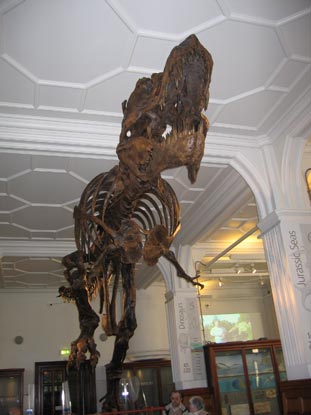
On Monday 26th September at 9pm (BST) on BBC2, Horizon will focus on the work of Dr Schweitzer who believes that soft tissues and other organic material has been recovered from deep inside the long, dead bones of iconic animals such as Tyrannosaurus rex.  Perhaps the idea of a Jurassic Park such as the one envisaged by the author Michael Crichton will one day be more than fiction, could the research carried out by scientists such as those at the North Carolina State University lead to the resurrection of some members of the Dinosauria?

DNA Defined

DNA is deoxyribonucleic acid, a molecule of genetic material that determines the inherited characteristics of most living organisms.  The vast majority of examples of the DNA molecule consist of a double helix made up of two long chains which are made up of nucleotides, these in turn are made up from 4 proteins referred to as nucleobases (thymine, guanine, adenine and cytosine) represented by the letters T, G, A, and C.  Almost every cell of every organism from many viruses, amoebas, dinosaurs and humans has its own set of molecular instructions.  The function of each cell is encoded in the chromosomes, these carry the hereditary data in the form of genes.

On this blog, team members at Everything Dinosaur have reported on a number of studies that claim that organic material has been recovered from the fossil record, although many scientists have been sceptical about such research.  Mary made the initial discovery of T. rex soft tissue remains back in 2005, since then she has argued that organic material may actually be relatively common in well-preserved, robust fossils, but since very few people expected to find such material, it has been rather overlooked.  Mary and her team are not alone when it comes to exploring the soft tissues of extinct animals.

Montana State University has pioneered research into ancestral DNA through the study of bird embryos, confirming a now, well established view that Aves (birds) and the Dinosauria, especially Theropoda are very closely related.

One of Dr Schweitzer’s co-authors on a number of soft tissue studies, Assistant Professor of Medicine at Harvard Medical School John Asara agrees with Mary, that there may be more organic material awaiting discovery.  He has been working on a number of projects related to the study of fossilised proteins, which have reaffirmed the dinosaurs close affinity to the birds.

To read a short article on this work: Are You Going to Call T. rex Chicken?

Scientists Challenge the Findings

A number of scientists and other academics have challenged these studies.  It had been thought that DNA could not survive more than 10,000 years.  It, like all other organic material would be rapidly degraded and broken down unless it was subjected to a very unusual manner of preservation, such as being entombed in ice, for example in the case of Woolly Mammoth remains from Siberia.  In 2012, Everything Dinosaur reported on a piece of highly controversial research carried out on the fossilised bones of the Moa (a giant, flightless bird that once inhabited New Zealand).

Analysis of the robust bones of three extinct species of New Zealand Moa by a team of international researchers led to the publication of the estimated half-life of DNA.  Under the very best conditions for preservation, it was calculated that the proteins that make up DNA could persist in the fossil record and permit detectable traces still to be found in fossils as old as 6.8 million years.

Controversial research suggests a half-life for DNA: Calculating the Half-life of DNA using Moa Fossils.

Still to recover DNA from a Tyrannosaurus rex would require DNA to remain preserved, uncontaminated and viable for nearly ten times as long.  After all, the last T. rex went extinct around sixty-five million years ago.

Could what the suggests have found preserved in the fossilised bones of dinosaurs, be organic material from another source?  Tests have shown that some of the material recovered reacts in the same way as organic material from birds.  Is there contamination?  How can the delicate organic material such as blood, collagen and proteins be preserved for so long?  Do the tiny, microscopic fragments recovered really represent organic material from a long dead dinosaur?

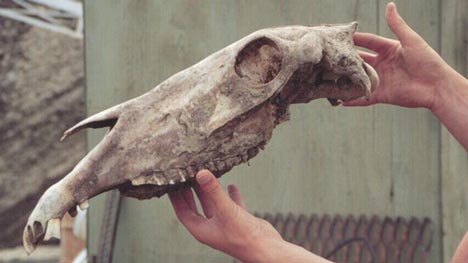
Intriguingly, animals very far removed from Tyrannosaurus rex have lent support to Schweitzer’s and Asara’s claims.   Researchers from the University of Copenhagen (Denmark), co-authored a paper that was published in the journal “Nature” about a study to sequence a portion of the ancestral horse genome from an equine fossil that was more than 700,000 years old.  The research dramatically extended the limit for viable DNA survival in the fossil record.  Recently, a fragment of a tibia (lower leg bone), recovered from 3.5 million year old deposits on Ellesmere Island (Canada) was proved to belong to an ancient camel, thanks to collagen finger printing carried out by University of Manchester scientists.

Recently Published Studies Push Back the Date of Viable Genetic Material from the Fossil Record

700,000 year old genetic material recovered from a fossil bone.

700,000 year old genetic material recovered from a fossil bone.

Picture credit: D.G. Froese/Nature Journal

The horizon programme will focus on the research into dinosaur DNA, however, the implications of this soft tissue recovery will have far reaching consequences and may well lead to a reappraisal of what we do and don’t know about a whole host of extinct fauna.

Watch and enjoy.

To read a related article on the extraction of dinosaur proteins from an ornithischian dinosaur: The Search for Proteins in the Femur of a Duck-Billed Dinosaur.

21 08, 2013

New Study of Neanderthal Hand Axes Suggests Two European Neanderthal Cultures

By |2024-05-01T14:43:42+01:00August 21st, 2013|Categories: Dinosaur and Prehistoric Animal News Stories|0 Comments

Design of Hand Axes Reveals Distinctive Neanderthal Cultures

A study by a postgraduate researcher at the University of Southampton has found that Neanderthals were more culturally complex than previously acknowledged.  Two cultural traditions existed among Neanderthals living in what is now northern Europe between 115,000 to 35,000 years ago.  Dr Karen Ruebens from the Centre for the Archaeology of Human Origins (CAHO) and funded by the Arts and Humanities Research Council examined the design of 1,300 stone tools originating from eighty Neanderthal sites in five European countries; France, Germany, Belgium, Britain and the Netherlands.

Neanderthal Study

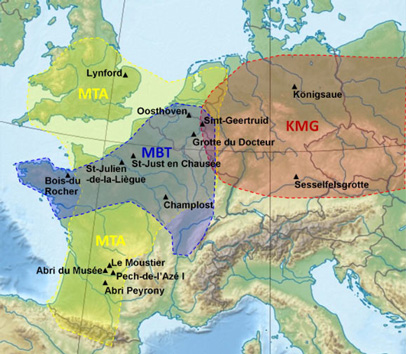
Her investigations uncovered new evidence that two separate hand axe traditions or designs existed – one in a region now spanning south-western France and Britain – the other in Germany and further to the East.  In addition, she found an area covering modern day Belgium and the Netherlands that demonstrates a transition between the two.  Two separate hand axe traditions or designs that have been identified by this analysis are, firstly the Mousterian of Acheulean Tradition (MTA on the map below), in a region now spanning south-western France and Britain and the Keilmessergruppen Tradition (KMG on the map below), in Germany and further to the East.

Evidence for Regionality in Neanderthal Cultures

Distinct cultures identified with a transitional zone.

Distinct cultures identified with a transitional zone.

Picture credit: Dr Karen Ruebens

Different Neanderthal Cultures

The map above marks the approximate boundaries of the different cultures with a transitional zone which features Mousterian with Bifacial tools (marked MBT) between the two distinct tool making cultures.  Please note, the English Channel did not exist during the time of the Neanderthals.  Low sea levels at this time in Earth’s history permitted the United Kingdom to remain part of the European mainland, the UK did not become an island until about 8,000 years ago.

Dr Ruebens commented:

“In Germany and France there appears to be two separate hand axe traditions, with clear boundaries, indicating completely separate, independent developments.  The transition zone in Belgium and Northern France indicates contact between the different groups of Neanderthals, which is generally difficult to identify but has been much talked about, especially in relation to later contacts with groups of modern humans.  This area can be seen as a melting pot of ideas where mobile groups of Neanderthals, both from the eastern and western tradition, would pass by – influencing each other’s designs and leaving behind a more varied record of bifacial tools.”

Neanderthal Hand Axes

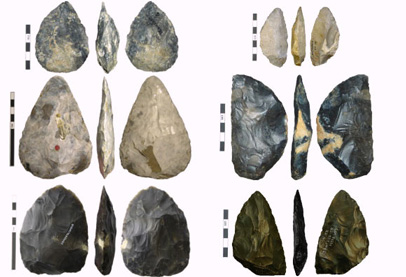
The University of Southampton research has revealed Neanderthals in the western region made symmetrical, triangular and heart-shaped hand axes, while during the same time period, in the eastern region, they produced asymmetrically shaped bifacial knives.

This research has been published shortly after another paper shed further light on the culture of Neanderthals.  A study of Neanderthal bone tools found in France and published in the Proceedings of the National Academy of Sciences (USA) suggested that Neanderthals developed specialised tools for working animal skins many thousands of years before such tools became associated with our own species.

To read more about this research: Neanderthals Made the First Specialised Bone Tools in Europe.

Dr Ruebens went onto add:

“Distinct ways of making a hand axe were passed on from generation to generation and for long enough to become visible in the archaeological record.  This indicates a strong mechanism of social learning within these two groups and says something about the stability and connectivity of the Neanderthal populations.  Making stone tools was not merely an opportunistic task.  A lot of time, effort and tradition were invested and these tools carry a certain amount of socio-cultural information, which does not contribute directly to their function.”

The study’s extensive analysis also shows other factors which could have influenced hand axe design, such as raw material availability to Neanderthals, the function of their sites, or the repeated reuse and sharpening of tools – did not have an impact in this instance.  This research provides a new perspective on the regionality of the Neanderthal population of western Europe.

Examples of the Different Types of Hand Axe

Examples of hand axes used in the study.

Examples of hand axes used in the study.

Picture credit: Dr Karen Ruebens

Key to the hand axes in the picture above:

Left: Mousterian of Acheulean Tradition hand axes, from top to bottom – cordiform hand axe from Le Moustier, France; triangular hand axe from St. Just en Chaussée, France; hand axe from Lynford, UK (Karen Ruebens). Right: Keilmessergruppen Tradition hand axes, from top to bottom – keilmesser from Sesselfesgrotte, Germany; keilmesser from Abri du Musée, France; faustkeilblatt from Königsaue, Germany.

Intriguingly, this study suggests that those Neanderthals that went on to live in Britain, have closer affinities to those Neanderthals from south-western France than they do to Neanderthal populations from Germany, central and western France as well as central Europe.

Everything Dinosaur acknowledges the help of the University of Southampton in the compilation of this article.

20 08, 2013

Papo Dimetrodon – A Video Review

By |2023-02-22T07:38:45+00:00August 20th, 2013|Categories: Everything Dinosaur Products, Everything Dinosaur videos, Product Reviews|3 Comments

Everything Dinosaur Reviews the Papo Dimetrodon Model

The last of the 2013 model releases in Papo’s prehistoric animal range of replicas is the Dimetrodon.  It has been worth the wait, as this is a wonderful model of this Permian predator.  Dimetrodon may have existed long before the Dinosauria evolved, but for some reason this sail-backed reptile is synonymous with dinosaur model collections.

Papo Dimetrodon Model

Papo, as a French company refer to their range of prehistoric animal replicas as “Les Dinosaures”, this can be a little confusing as it now includes a mammal-like reptile, one that is only very distantly related to that part of the reptile family tree that gave rise to the dinosaurs.

Team members at Everything Dinosaur have made a short video review of the model.  In this video, it lasts around 5 minutes, we look at the model in detail, highlight some features and discuss fossil evidence that relates to the Dimetrodon genera.

Everything Dinosaur’s Video Review of the Papo Dimetrodon Model

Video credit: Everything Dinosaur

Papo Prehistoric Animal Figures

Earlier in the year, Papo added a Carnotaurus and a Woolly Rhino model replica to their prehistoric animal model range.  Only one of the models introduced this year is actually a dinosaur.  It is good to see the design team at Papo working on a variety of prehistoric creatures.  We know that plans are progressing well with regards to new model introductions for 2014, from the reviews we have received so far for the 2013 models, Papo will have to work hard to maintain their high standards.

Papo models available at Everything Dinosaur: Papo Models and Figures.

19 08, 2013

Fruit Eating Crocodiles Identified in New Research

By |2024-05-01T14:44:15+01:00August 19th, 2013|Categories: Animal News Stories|0 Comments

New Study Shows that a Number of Crocodilians Eat Fruit

They may have a blood thirsty reputation, after all, a number of species are man-eaters and all crocodiles have strong jaws and a powerful bite but a new study has revealed that a significant proportion of crocodilians eat fruit.  Nile crocodiles (Crocodylus niloticus) consume fruit as does the American alligator (Alligator mississippiensis), both species are dangerous and are known to attack people.  Surprising revelations, but it turns out that these reptiles are not entirely carnivorous.  In a study by the Wildlife Conservation Society, one that no doubt involved studying lots of crocodile poo as well as reviewing a substantial amount of literature, it seems that more than dozen crocodile species enjoy an occasional taste of fruit to go along with their normal diets of fish, mammals, amphibians, other reptiles and birds.

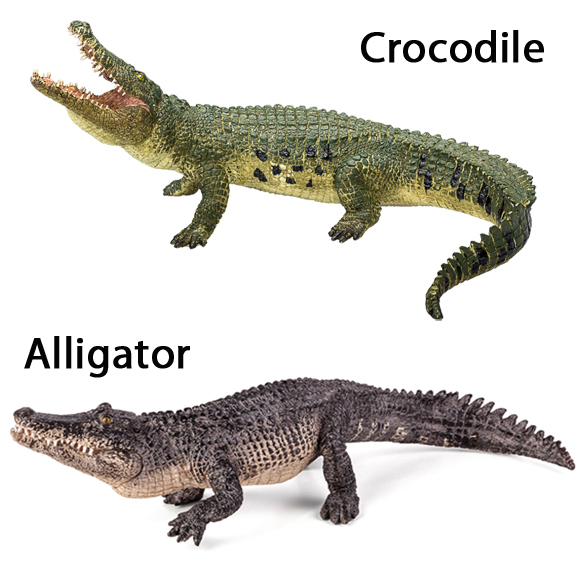
The Difference Between a Crocodile and an Alligator

Crocodile and Alligator comparison.

Crocodile (top) and Alligator (bottom).

Crocodiles Dispersing Seeds

This research, which has been published in the academic publication the Journal of Zoology,  provides new insight into the possible role that crocodilians, some of which have large territories, may play in forest regeneration through digesting and passing seeds from fruits.  Some seeds and nuts are regurgitated whilst others pass through the digestive tract.  Those seeds that do and get deposited after being passed through a crocodile’s stomach and intestines, even get supplied with their very own nutrient rich pile of dung.

Chemical and mechanical scarification of seeds probably occurs in the stomach, but what effects these processes have on seed viability is unknown. Because crocodilians have large territories and undertake lengthy movements, seeds are likely transported well beyond the parent plant before being voided.  Little is known about the ultimate fate of seeds ingested by crocodilians, however, deposition sites could prove suitable for seed germination.

Eighteen Species Studied

The researchers looked at eighteen species of crocodilian ranging from the American alligator to the ferocious Nile crocodile and found thirteen of the species consumed some form of fruit and vegetable matter including a variety of berries, legumes, nuts, and grains.  Some of the plant material ingested, may have been involuntary, incidental and as a consequence of capturing and eating herbivores, however, evidence was gathered to show that plant matter was deliberately consumed and occasionally in surprisingly large quantities.

Fruit Eating Crocodiles

Despite having remained virtually unchanged since the time of the dinosaurs, much remains to be learned about how crocodilians process carbohydrates and other plant-based nutrients.  Fruit eating and the consumption of plant matter must yield some nutritional rewards for crocodilians.

Seed dispersal by reptiles is known as saurochory and it had been thought that these carnivores were incapable of digesting vegetable proteins.  However, evidence of fruit eating (frugivory), was found in more than seventy percent of the species for which there was dietary information available.  Thirty-four families and forty-six plant genera were consumed by crocodilians, the majority were fleshy fruits, how crocodiles find fruits to consume is poorly understood, but crocodiles probably find plant food by a combination of airborne and waterborne cues.  Large fruits falling into water and making a splash may also prompt crocodiles to investigate the disturbance and feed.

Probably Underreported

Commenting on the research, lead author Steven Platt of the Wildlife Conservation Society stated:

“Although underreported, fruit eating appears widespread among crocodilians.  Given the biomass of crocodiles in many subtropical and tropical wetlands and their capacity for ingesting large numbers of fruits, we consider it likely that crocodilians function as significant seed dispersal agents in many freshwater ecosystems.”

A spokes person from Everything Dinosaur suggested that seed dispersal could have been a role carried out by prehistoric crocodiles.  During the Cretaceous, Crocodyliformes and even champsosaurs could have carried out a similar function.

The spokes person said:

“This study shows that more than half the crocodilian species alive today consume fruit and other vegetable matter, it just goes to show how remarkable these reptiles are and how important these apex predators might be to the maintenance of diversity of both fauna and flora in their habitats.”

18 08, 2013

Tracing the Origins of the Multituberculates

By |2023-02-21T21:26:17+00:00August 18th, 2013|Categories: Dinosaur and Prehistoric Animal News Stories|0 Comments

Earliest Complete Fossil of a Multituberculate Found

The Mesozoic might be referred to as the “Age of Reptiles” but scurrying around the dinosaurs was a very wide variety of early mammals, descendants of which are familiar to us as placentals, monotremes or marsupials.  The problem with studying primitive mammal fossils from the Mesozoic is that for much of the time when dinosaurs roamed, mammals remained small and their delicate, light bones did not fossilise well.  The study of early mammal specimens is exceptionally difficult due to the paucity of fossil remains.

Multituberculate Mammal

Any small mammal that died, was likely to be scavenged long before fossilisation could possibly take place.  Much of what we know about Jurassic and Cretaceous mammals, for example, comes from the study of faecal remains (coprolites).  Indeed, many mammals lived in environments where fossilisation was very unlikely to occur.

The remains of mammals either hunted and killed or scavenged would sometimes be left in droppings and these could perhaps fossilise  thus preserving the undigested remains of the animal.  The fossil record of small mammals is thus made up mostly of fragments of jawbones, and teeth and it is from these tiny remains that palaeontologists have been able to piece together the story of mammalian evolution.

Chinese Fossil

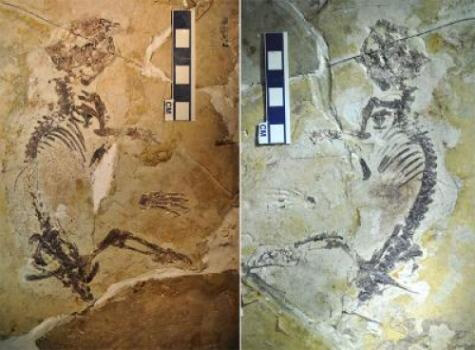
However, a team of researchers writing in the academic journal “Science” have published a report on a 160-million-year-old fossil multituberculate, found in China.  This is one of the earliest examples of a multituberculate mammal known to science and indicates that these small, chisel-teethed creatures existed for over 125 million years, making them the most successful mammalian group in terms of longevity.

The New Fossil Discovery (Rugosodon eurasiaticus)

160 million year old multituberculate fossil

160-million-year-old multituberculate fossil.

Picture credit: University of Chicago and Chinese Academy of Sciences

Rugosodon eurasiaticus

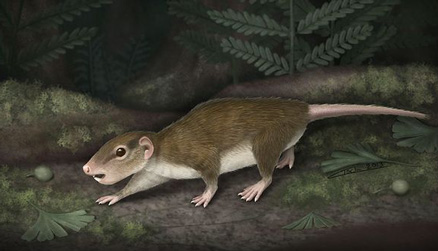
The fossil of Rugosodon eurasiaticus is preserved in two shale slabs in part (left) and counterpart (right).  The animal is estimated to have weighed 80 grammes when alive.  The sediments at the site of discovery are lake sediments with embedded volcanic layers.  The fossil assemblage of Rugosodon also includes a number of feathered dinosaur and pterosaur remains.

The distinctive of multituberculate teeth have tiny bumps on the molars, similar in habit and size to today’s rodents, these furry creatures were probably the most abundant mammal around during the time of the dinosaurs.  Although, a very successful group, their fossil remains are extremely fragmented, but now scientists have a beautifully, near complete specimen to study.

Commenting on the discovery, which was made in the finely grained strata of Liaoning Province (China), Professor Zhe-Xi Luo (University of Chicago) stated:

“Now we finally have a compelte skeletal fossil that allows us to paint a coherent picture of the evolutionary origin of these prolific and important ancient mammals.”

Slab and Counter Slab Studied

The animal has been named Rugosodon eurasiaticus, the slab and counter slab of the fossil specimen have allowed palaeontologists to examine some of the anatomical adaptations that may have helped this group become so successful. For instance, scientists were already aware that around sixty-five million years ago, there were a number of multituberculate species that could hyper extend their ankles.  This would have made them very fast and agile.

The remains of R. eurasiaticus reveal mobile and flexible ankle bones too, although the fossil is nearly one hundred million years older.  According to the research team, the flexible ankles and its small size could have helped this group of early mammals adapt to a wide range of environmental niches, including tunnel digging and living in trees.

Scurrying Around a Jurassic Lakeside

An illustration of an ancient mammal.

An illustration of an ancient mammal. An illustration of R. eurasiaticus.

Picture credit: University of Chicago/April Isch

Examining the Teeth

By the dental features, Rugosodon eurasiaticus closely resembles the teeth of some multituberculate mammals of the Late Jurassic of Western Europe, suggesting that Europe and Asia had extensive mammal faunal inter-changes in the Jurassic.

Examination of the small teeth preserved in the delicate jaws of this seventeen centimetre long specimen indicate that it was an omnivore, probably hunting at night along the large lakes of this part of Jurassic China, catching worms, insects, amphibians as well as eating ferns and mosses.  This specimen is important as it suggests that later herbivorous multituberculates were descended from omnivores.

Professor Luo added:

 “Essentially, multituberculates were the first important mammal group to occupy an herbivorous niche.  They were able to exploit a part of the ecosystem that was not accessible to many other vertebrates, including other Mesozoic mammals.  This superb feeding function, together with versatile locomotor adaptations, explains why multituberculates were so successful and diverse.  Now we have a sense of what they started off with, thanks to the discovery of Rugosodon.”

For models and replicas of Jurassic prehistoric animals and other creatures: CollectA Age of Dinosaurs Models.

17 08, 2013

Step Forward the Pachyrhinosaurs – Stars of Forthcoming Dinosaur Film

By |2023-02-21T20:52:21+00:00August 17th, 2013|Categories: Dinosaur Fans|0 Comments

 Details of the Plot of the Eagerly Awaited “Walking with Dinosaurs in 3-D”

The film “Walking with Dinosaurs in 3-D” is due to have its premier on December 20th this year, team members at Everything Dinosaur have reviewed the trailer and now we can reveal the basic storyline. Get ready to join a herd of pachyrhinosaurs on their long migration and battle for survival in the Late Cretaceous.  The film, which has involved the BBC and a number of other commercial partners, features the stories of three pachyrhinosaurs, Patchi, his brother Scowler and a female called Juniper.

The Trials and Tribulations of Pachyrhinosaurs

From the hazards of hatching through to surviving into adulthood and the challenges of becoming herd leader, the movie features a host of CGI created prehistoric animals that lived in North America in what is termed the Maastrichtian faunal stage of the Late Cretaceous.

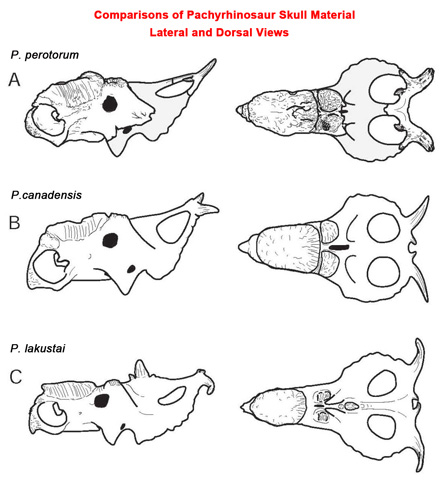
Three species of pachyrhinosaur are currently recognised, the first of which P. canadensis was named and described back in 1950.  A member of the horned dinosaurs group, there was a substantial ridge of bone above the nose (a boss).  Some scientists have suggested that this ridge supported a single horn, a trait seen in other centrosaurines, however, despite many fossil finds including almost complete individuals, no evidence of an actual nose horn has been found to date.  This ridge of bone gives this genus its name, Pachyrhinosaurus means “thick-nosed lizard”.

Three Species of Pachyrhinosaurs have been Described to Date

Three species of Pachyrhinosaur have been described to date.

Three species of Pachyrhinosaurus have been described to date.

Walking with Dinosaurs

The film makers have opted to give their CGI created pachyrhinosaurs no nose horn although the prominent boss is present and to our eyes it seems that the pachyrhinosaur species featured is P. canadensis.  The  promoters of the movie have created the strapline “the biggest 3-D event in 100 million years”, not accurate, as the action takes place around 70 million years ago, the strapline’s chronological error being most likely attributed to the needs of marketing overriding and concerns for palaeontology.  After all, this is entertainment, although a number of palaeontologists and other academics have acted as scientific consultants to the production crew.

Sceptics have already dubbed this “March of the Penguins meets Bambi”, but no matter, the film will make millions for all those associated with it including 20th Century Fox.

Telling Pachyrhinosaurs Apart

One of the problems the story tellers encountered was how to make the hero Patchi stand out from the rest of the pachyrhinosaur herd.  An early dromaeosaur attack gives our horned-headed hero a deformed frill, the right fenestra was damaged and the covering of skin lost, so that our protagonist can be easily spotted – he’s the one with a hole in his head – literally.

Palaeontologist Scott Sampson, who advised on the film commented:

“This is Pachyrhinosaurus’ chance to shine.  It’s an ornate and just phenomenal creature.   A lot of other dinosaurs haven’t had the exposure that T. rex or Triceratops get.   So it’s nice to see some others become part of the dinosaur iconography.”

Gorgosaurus

Along with the ceratopsians, expect to see fearsome tyrannosaurs, (the villain of the piece is a ferocious Gorgosaurus called Gorgon), armoured dinosaurs, hadrosaurs and giant azhdarchid pterosaurs, some of which attempt to make a baby Pachyrhinosaurus a tasty snack.

Co-director Barry Cook explained that the story unfolds with the help of a narrator called Alex, one of the Alexornis birds.  Birds were a very common sight in the Late Cretaceous of North America.  This narration is supplemented with in-the-moment voice-overs from the main characters “as if we are hearing their thoughts”, according to Barry.

Pachyrhinosaurus Get Star Billing

An adult Pachyrhinosaurus surveys the situation.

An adult Pachyrhinosaurus surveys the situation.

Picture credit: 20th Century Fox

The film makers have not used any puppetry, unlike the seminal BBC television series “Walking with Dinosaurs” which first aired in 1999.  Close up shots of the prehistoric animals in this iconic series were achieved by the use of sophisticated marionettes.   These days, advanced computer imagery means that the dinosaurs are all created using software, there are no strings or glove puppets to be seen.

The film does have one thing in common with the original BBC series, it proved very hard to find suitable locations in which to place the CGI dinosaurs.  In the end, the production team chose to film in Alaska (rugged mountain shots) and New Zealand.  Ironically, pachyrhinosaurs would have felt very much at home in Alaska, the fossils of one of the recently discovered species of pachyrhinosaur (P. perotorum) were discovered in Alaska.

To read about this fossil find: New Species of Pachyrhinosaur Announced.

The film is going to get a lot children (and their parents) very excited on its release in just under four months time.

Go to Top