All about dinosaurs, fossils and prehistoric animals by Everything Dinosaur team members.
23 10, 2010

Attenborough’s Journey – A New BBC Television Documentary Series

By |2024-04-20T07:53:15+01:00October 23rd, 2010|Categories: Dinosaur and Prehistoric Animal News Stories, Famous Figures, Main Page, TV Reviews|4 Comments

David Attenborough’s Journey a Prelude to the new BBC Documentary Series

On Sunday at 8pm (GMT), BBC Two will show the one hour television documentary called “Attenborough’s Journey”, the prelude to the new BBC natural history series “First Life” that tells the story of how the first animals and plants evolved.  “First Life” charts the origins of life on Earth and combines visits to some of the world’s most important fossil locations with ground-breaking CGI footage to bring long extinct animals such as trilobites and Anomalocaris back to life.

“Attenborough’s Journey” is a documentary about the making of the “First Life” series it follows Sir David Attenborough as he travels the world to film this new set of television programmes.  As Sir David (aged 84), journeys to the parts of the world that have had a special meaning to him in his fifty or so years of broadcasting.  He visits his childhood home in Leicestershire where he first collected fossils, including ammonites and trilobites.  He then travels onto Morocco’s arid deserts, again onward to the glaciers of Canada, before visiting Australia’s Great Barrier Reef.

Attenborough’s Journey

As an introduction to the “First Life” series of documentary programmes, “Attenborough’s Journey” provides a unique insight into the mind and character of one of the world’s most famous and well-travelled broadcasters.  This documentary combines recent footage shot on various locations with archive footage from Sir David’s five decades of television programme making.

When Sir David was asked about how he keeps going, despite being 84 years young, he commented that, although he has a few aches and pains there was no point worrying about it.

He said in an interview before his 84th birthday:

“My legs don’t work and people say, ‘You should have a knee replacement’, but when you are 83 there would be another year or 18 months of pain and stuff, and by that time you are 85, 86.  Come on!  We are mortal and you cannot make yourself a 26-year-old again.  You might as well cope with it the way it is going.”

We can’t wait for the TV programmes to be aired and I know a couple of my colleagues have already requested the book that accompanies the “First Life” series be added to their Christmas lists.

For models and replicas of many of the Palaeozoic invertebrates to be featured in the television series: CollectA Age of Dinosaurs Popular Range.

22 10, 2010

Another Request for Placerias from an Enthusiastic Collector

By |2024-04-19T20:33:40+01:00October 22nd, 2010|Categories: Everything Dinosaur News and Updates, Everything Dinosaur Products, Main Page|0 Comments

Placerias – Popular with Walking with Dinosaur Fans

Model collectors request Placerias.

Although it is over ten years since the ground breaking “Walking with Dinosaurs” documentary series first aired on television, we still receive lots of requests for models of the prehistoric animals featured in the six programmes.  This is because the series is frequently repeated but also we think it is a testament to the quality of the programmes made.

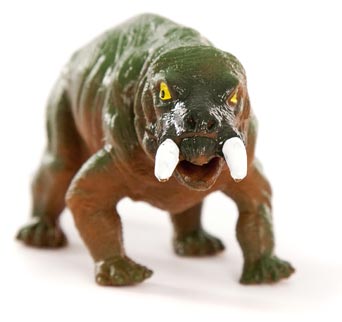
We get requests for models of Postosuchus and Scutosaurus, although Scutosaurus did not appear in the original “Walking with Dinosaurs”, it appeared in the later “Walking with Monsters”, that dealt with evolution up until the beginning of the Mesozoic.  It seems that the most frequently requested model is that of a Placerias – fortunately, our experts are on hand to help out.

We have a wonderful model of this therapsid, it looks very similar to the animals seen in the television series and its size helps it to fit in with other scale models of Triassic prehistoric animals.

Everything Dinosaur’s Placerias Model

Picture credit: Everything Dinosaur

Our model of this one tonne “tusker” has been used in various museum and school displays, best of all as it is part of our range of prehistoric animal models it is extremely cheap!

To view the extensive range of dinosaur and prehistoric animal themed toys and gifts visit Everything Dinosaur’s award-winning website and view the models section: Dinosaur and Prehistoric Animal Models.

Our team of specialist are always on hand to advise and make suggestions, all part of our mission statement to try to make dinosaur fans happy.

21 10, 2010

Famous Palaeontologist Awarded Special Honour

By |2024-04-19T15:04:13+01:00October 21st, 2010|Categories: Dinosaur and Prehistoric Animal News Stories, Famous Figures, Main Page, Palaeontological articles|0 Comments

Professor Philip Currie Awarded Prestigious Accolade

World famous palaeontologist, Philip Currie has been inducted into the prestigious Alberta Order of Excellence, the highest award the Canadian province of Alberta can give to a citizen.

Professor Currie is normally found either immersed in his work at the Dept. of Biological Sciences at the University of Alberta or involved in fieldwork digging up fossils including many dinosaurs.  He is just one of eight people to receive this prestigious accolade this year.  He shares this honour with former premier Ralph Klein and another esteemed member of the University of Alberta academic staff, Professor Emeritus Bob Steadward.  The awards were made in a special ceremony, held yesterday at Government House, Edmonton.

Famous Palaeontologist

A committee of volunteers, led by Alberta’s lieutenant governor Donald Ethell, considers a list of nominated citizens and the award is given to those individuals who can show a record of long service to the people of the province and for the impact their work has on people across the whole of Canada.  Another important criterion for being inducted into the Order is for that person’s work to have stood the test of time.

For Phil Currie, responsible for naming and describing something like 25 new genera of dinosaurs, and with his leading role at the Royal Tyrrell Museum (Drumheller, Alberta), his work passes the time test with flying colours.

Commenting on his award, Phil Currie stated:

“I could not be happier because this award is a milestone for palaeontology in Alberta.  There aren’t many places in the world where a government would recognise dinosaur fossils as resources that we should continue to study and develop.”

For Professor Currie, the tuxedo will have to come off and be put back safely in the cupboard, as shortly he is due to leave for Antarctica to take advantage of the Southern Hemisphere’s summer to help excavate and study a new dinosaur dig site on that frozen continent.

It is such a pleasure to hear of this award, on behalf of everyone at Everything Dinosaur we want to add our congratulations to Professor Currie, to his university colleague Bob Steadward, and to those other new members of this highly respected and select Order.

To view models and replicas of many of the prehistoric animals that Professor Currie has researched: Dinosaur and Prehistoric Animal Models.

20 10, 2010

Playing Around with Facebook

By |2023-01-13T19:35:59+00:00October 20th, 2010|Categories: Everything Dinosaur News and Updates, Main Page, Press Releases|0 Comments

Updating the Everything Dinosaur Facebook Page

We at Everything Dinosaur have been reliably informed that something like 500 million people have a Facebook account, that by our calculations is approximately one person in every fourteen on the planet.  That is a lot of people and as a result we have started to develop our own Facebook presence, providing hints, tips, dinosaur themed recipes, party ideas and such like.  Yes, good news for fans of dinosaur models, they can catch up with Everything Dinosaur on Facebook!

Everything Dinosaur on Facebook

We have a long way to go and much more work to do, but our intention is to integrate all our social media sites including this web log (now at very nearly 1,200 articles), into one linked on-line presence.  So far so good, just put up some of our cake and dinosaur biscuit pictures on our Everything Dinosaur Facebook page.

Why not look up Everything Dinosaur on Facebook to see more pictures, information and stories about prehistoric animals.  Simply click on the Facebook link below to find Everything Dinosaur on Facebook.

Everything Dinosaur on Facebook

Everything Dinosaur on Facebook.

Visit Everything Dinosaur on Facebook to catch up with all the dinosaur and prehistoric animal model news. Please give our Facebook page a “Like”.

Visit Everything Dinosaur’s Facebook page: Everything Dinosaur on Facebook.

19 10, 2010

New Research Suggests Cannibalism in Tyrannosaurus rex

By |2024-04-20T07:53:51+01:00October 19th, 2010|Categories: Dinosaur and Prehistoric Animal News Stories, Main Page|0 Comments

New Study Suggests that Tyrannosaurs such as T. rex were Cannibals

Scientists have long suspected that apex predators such as Tyrannosaurus rex may have predated upon their own kind.  After all, this behaviour is widespread in the animal kingdom today.  Both crocodiles and Komodo dragons, for example, kill and eat members of their own species.  For a  predator, this makes biological sense as it reduces competition as well as providing a source of food.

A new study published in the on line journal PLoS ONE (Public Library of Science); suggests that top Late Cretaceous predators such as Tyrannosaurus rex may also have been cannibals.

T. rex the Cannibal?

Gashes and gouges preserved in the fossilised bones of Tyrannosaurus rex suggest that other tyrannosaurs may have fed on the carcases of their own kind, perhaps, they even hunted and killed them.

Vertebrate palaeontologist Nicholas Longrich of Yale University had discovered gashes and marks on a large theropod bone, some of which were over a centimetre deep.  Noting the strata from which the fossil bone had been found; he concluded that the deep grooves in the fossilised bone was evidence of a Tyrannosaurus rex feeding.  However, he was to discover later that this fossilised bone actually belonged to a T. rex.  This is evidence of T. rex cannibalism, but does this also mean that these large meat-eaters actively hunted and killed their brethren?

Tyrannosaurus rex

Longrich and research colleague Dr Michael Ryan of Cleveland Museum had been studying a Canadian fossil collection for evidence of feeding behaviour in Late Cretaceous  mammals, indeed evidence of “gnawed” bones were found.  However, these deep gashes in the fossil bones could only be attributed to a T. rex or similar sized carnivorous dinosaur.

To read more about the research into the feeding and gnawing behaviour of early mammals: The Whole Tooth and Nothing But the Tooth.

Commenting on the large marks found in the fossil bone, Nicholas stated:

“They are the kind of marks that any big carnivore could have made, but T. rex was the only big carnivore in western North America sixty-five million years ago.”

After studying a number of tyrannosaur bones, Longrich concluded that a T. rex arm bone and three foot bones, including two toe bones (pedal phalanges) showed evidence of Tyrannosaurus rex feeding.  A case of one T. rex cannibalising another T. rex.

He went onto state:

“It’s surprising how frequent it appears to have been.  It could mean that they [T. rex] were really thorough at cleaning up after animals died in their environment.  Or it could mean that they were killing and eating each other fairly often.”

A study of the pathology on Tyrannosaurus fossils suggests that these 13-metre-long carnivores lived short, violent lives.  For example, the gracile T. rex skeleton known as “Stan” – museum specimen BHI3033, suffered a bite to the back of its head.  This wound could only have been inflicted by a bigger T. rex.

Do Tyrannosaurus rex Bones show signs of Tyrannosaurus Predation?
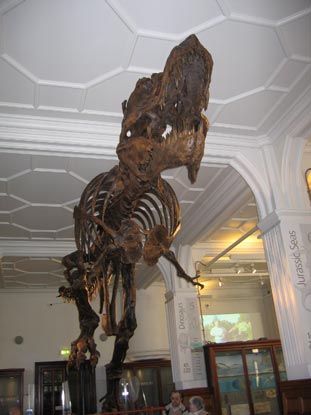
Picture credit: Everything Dinosaur

The U-shaped and V-shaped grooves and gouges are the kind that a T. rex would have left in the bone when it was stripping meat from a carcase, the marks appear to have been made post-mortem, indicating that the animal was dead before the T. rex fed.  Perhaps the cannibalistic tyrannosaur might have picked at the smaller foot and arm bones after eating most of the meat off the more accessible parts of the corpse.  Alternatively, the T. rex could have used its powerful sense of smell to detect a rotting corpse, one that had already been extensively scavenged and this T. rex only had a few strips of meat on some of the smaller bones to pick at.

Photographs show two pedal phalanges (toe bones) of Tyrannosaurus, photographs A2 and B2 reveal deep gouges, perhaps indicative of Tyrannosaurus cannibalism.

However, Longrich agrees that the current evidence is not strong enough to suggest that tyrannosaurs battled to the death with the victor feeding on the body of the dead combatant.

When asked about whether tyrannosaurs fought and killed each other, Longrich stated:

“Modern carnivores do this all the time.  It is a convenient way to take out the competition and get a bit of food at the same time.  Cannibalism is widespread in the animal kingdom.”

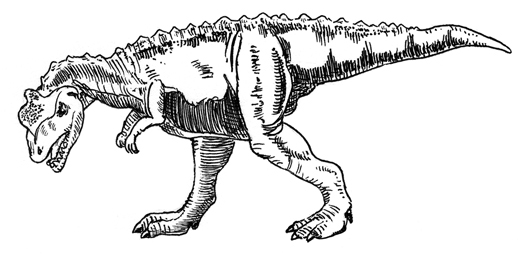
Evidence of cannibalism has been found in the dinosaur fossil record.  For example, at the famous Ghost Ranch site, (New Mexico), more than 100 skeletons of the basal theropod Coelophysis have been discovered.  It seems that these animals perished after a prolonged drought, but not before at least one adult devoured a young Coelophysis (fossilised bones found in the stomach cavity).  However, this theory has been recently challenged with the tiny bones perhaps belonging to a lizard.  At least one other case of cannibalism amongst theropods also springs to mind.  Teeth marks on some of the bones of the abelisaurid Majungatholus match the size, spacing and teeth serrations of Majungatholus teeth.  The environment where this dinosaur lived (northern Madagascar) was prone to seasonal extremes including a prolonged dry season.  Conditions where food runs short are a prerequisite for cannibalistic behaviour.

An Illustration of the Abelisaurid Majungatholus
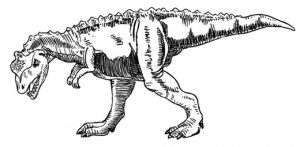
A drawing of Majungasaurus.

An illustration of the abelisaurid Majungatholus.

Picture credit: Everything Dinosaur

However, according to this research there are at least four examples of Tyrannosaurus rex feeding on another T. rex, which is quite stunning when you consider how limited the fossil evidence is for cannibalistic feeding in other theropods.  Perhaps it is time to re-examine the extensive fossil evidence of the allosaur A. fragilis to see if some more tell-tale teeth marks can be found.

To view models of Tyrannosaurus rex and Majungatholus: CollectA Age of Dinosaurs Prehistoric Life Models.

18 10, 2010

Dinosaurs “Rain Supreme” New Raincoats in Stock

By |2024-04-20T07:48:01+01:00October 18th, 2010|Categories: Main Page, Press Releases, Product Reviews|0 Comments

New Dinosaur Raincoats now in Stock

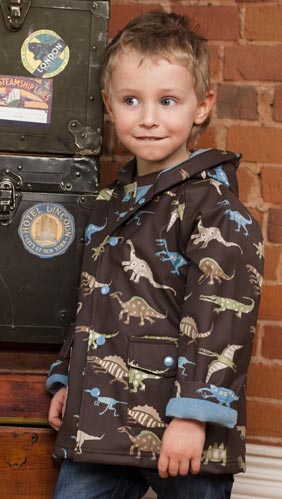
With the autumn weather closing in and the first of the frosts forecast for the UK this week, it is good to know that the new range of dinosaur raincoats has arrived at Everything Dinosaur.

Dinosaur Themed Rain Wear

With a 100% waterproof polyurethane outer and a soft and cosy terry cotton lining these durable, hooded raincoats are ideal for budding young palaeontologists.  Available in a range of sizes, the raincoats have a really funky dinosaur motif and they are bound to be a big hit with little explorers.

The New Dinosaur Raincoat

Picture credit: Hatley

This dinosaur raincoat even has two super-sized front pockets for budding palaeontologists to keep their fossil finds in.

Everything Dinosaur

To view the raincoats, just part of the extensive range of dinosaur and prehistoric animal inspired range of children’s clothing from Everything Dinosaur:

To view the extensive range of dinosaur and prehistoric animal themed toys and gifts take a trip to Everything Dinosaur’s award-winning website: Visit Everything Dinosaur.

On the theme of water, a little something to “float your boat” as it were.  The rain that falls on us, also fell on dinosaurs – it is the same water (hydrological cycle).  So the next time you get caught in a shower, imagine how a 30 metre Diplodocus felt!

17 10, 2010

Finding a Fossil Fish on a Bulgarian Highway

By |2023-01-13T17:45:42+00:00October 17th, 2010|Categories: Dinosaur and Prehistoric Animal News Stories, Main Page, Palaeontological articles|0 Comments

Triassic Fish Fossil Unearthed by Construction Workers

The near perfectly preserved fossil of a large predatory fish, discovered by construction workers building a relief road in Bulgaria has been identified as a new type of Triassic fish.  The fossil, which measures 58 centimetres long, was first unearthed last December and is amongst a number of fossil fish discoveries that have come to light as the 130 million Euro Sofia relief road project continues.

The relief road, designed to help ease traffic flows in western Bulgaria is known as the Lyulin highway, the building commenced four years ago and as the excavations have pressed on, so a number of interesting fossil finds have been made.  Zoologists and palaeontologists at the Pernik Regional History Museum, have concluded that the fossil represents an unknown species of Mesozoic predatory fish.  The rock containing the rare fossil has been dated to the Upper Triassic, making this fish more than 200 million years old.  Very few Triassic vertebrate fossils are known from this part of eastern Europe, although the highway construction teams have found a number of invertebrate specimens, including ammonites and ancient sea urchins.

Much of this area of Bulgaria was covered by an immense lake during the Triassic, it seems likely that the fish found itself in an isolated pool of water and perished as the pool dried up.  The specimen is going to be put on display at the Pernik Regional History Museum.

Fossil Fish

The head of the fish can be seen in the right of pictures that have been released, with the beautifully preserved pectoral fins just in front of the gill covers.  A black ruler has been placed next to the fossil to provide a scale.

In total, more than thirty other fish fossils have been found, but most are only fragmentary and date from a much more recent time (Cenozoic).  A spokesperson for the museum commented that the Bulgarian authorities were going to ask foreign palaeontologists for help with the study of these fossils as local museums did not really have the specialists in such ancient species.

It may be strange to think of the fish fossils being found in this part of Bulgaria, an area famous for its mountainous terrain, but 200 million years ago, this part of Europe was underwater and the fossil fish being found as the highway is built are testament to the geological forces that have acted upon the terrain and landscape.

For models and replicas of Triassic animals, visit the models section of Everything Dinosaur’s website: Dinosaur and Prehistoric Animal Models.

16 10, 2010

Unique Southsea Dinosaur “Luna Park” is Extinct

By |2024-04-20T07:48:39+01:00October 16th, 2010|Categories: Dinosaur and Prehistoric Animal News Stories, Dinosaur Fans, Main Page|0 Comments

Charred and Twisted Remains of Dinosaur Art Installation Taken Away

This morning, a local team of demolition experts dismantled the last vestiges of the huge Luna Park dinosaur sculpture that was destroyed by fire at the beginning of this month.  The remaining metal parts, including much of the tail and the body were finally chopped up and taken away by early this afternoon.  The huge dinosaur model had been on display at Southsea Common (Portsmouth, England), but the structure was raised to the ground in the fire.

Luna Park Dinosaur Sculpture

A small crowd of onlookers had gathered to watch the demolition team carefully pulling down the rest of the 53 foot long structure.  Part of the body was still off the ground but ropes were attached to a vehicle and the last of the upright parts of this once enormous art installation came crashing down.

It is a sad end for the giant dinosaur sculpture, it was due to go on a short UK tour this week, but the fire, which virtually destroyed it has put paid to that.  At first, arson was suspected, perhaps a student prank during freshers week that went wrong, but an electrical fault in the animal’s underbelly lighting caused by bad weather seems the most likely reason for the blaze.

For the past two weeks or so, the remains of the Ultrasauros dinosaur model had been protected by a metal security fence.  The fence had been built to help protect passers by should any of the structure fall to the ground and to aid the police investigators in their work.  The bulk of the scrap metal and debris has now been removed, leaving just a few pieces awaiting collection.

For models and replicas of sauropod dinosaurs, take a look at the models section of the Everything Dinosaur website: Dinosaur Models and Figures.

15 10, 2010

Video Review of Wild Safari Dinos Liopleurodon

By |2023-01-13T07:53:45+00:00October 15th, 2010|Categories: Everything Dinosaur videos, Main Page|0 Comments

Video Review of Liopleurodon Model (Wild Safari Dinos)

The new Liopleurodon model from Safari of the United States has been very well received by team members at Everything Dinosaur.  This model, part of the not to scale, replica prehistoric animal range called Wild Dinos is a real winner. Everything Dinosaur has produced a short video review of the Wild Safari Dinos Liopleurodon model.

Video Review of Wild Safari Dinos Liopleurodon Model

Video credit: Everything Dinosaur

Wild Safari Dinos Liopleurodon

The Liopleurodon figure that we review in the video, is part of the Safari Ltd – Wild Safari Prehistoric World range of models and replicas. This range includes a number of Jurassic reptiles and also features several marine reptiles.

To view the wide range of dinosaur and prehistoric animals featured in this amazing model range: Safari Ltd – Wild Safari Prehistoric World Models and Figures.

14 10, 2010

Sneak Preview of New Safari Wild Dinos Models 2011

By |2024-04-20T07:49:08+01:00October 14th, 2010|Categories: Everything Dinosaur News and Updates, Main Page, Product Reviews|0 Comments

Safari Wild Dinos – Four new Models for 2011

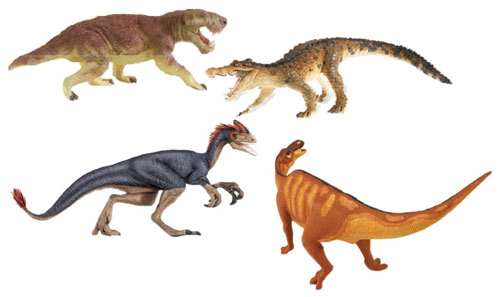
Those clever people at Safari Ltd have created four new exciting models in readiness for 2011 as part of the Safari Wild Dinos models range.  The four models represent two dinosaurs, a gorgonopsid and an ancient crocodile.  The two dinosaurs are Edmontosaurus, a hadrosaurine and Guanlong, an Early Cretaceous theropod from China.  The gorgonopsid is an Inostrancevia, a Late Permian carnivore, whose fossils are associated with Russia.

The Four New Models from Safari Ltd

New “Wild Dinos” models and figures for 2011.

Picture credit: Everything Dinosaur

Safari Wild Dinos Models

Clockwise from the back, Inostrancevia, Kaprosuchus, Edmontosaurus, Guanlong.  The crocodile is an ancient ancestor of modern crocodiles.  Its fossils have been found in Africa, and Kaprosuchus was about the size of a modern Nile Crocodile (Crocodylus niloticus), but was much better adapted to a cursorial lifestyle, and was capable of running quite quickly.  It fed on a variety of animals including small dinosaurs.  This particular animal is sometimes known as “Boar Croc”, due to the size of its tusk-like teeth in its jaws.  Lots of new replicas including dinosaur models available from Everything Dinosaur shortly.

Dinosaur models and prehistoric animal figures in the Safari Ltd replica range: Safari Ltd. Wild Safari Prehistoric World Models and Figures.

Go to Top