All about dinosaurs, fossils and prehistoric animals by Everything Dinosaur team members.
3 10, 2010

Something Fishy This Way Comes

By |2023-03-06T09:23:52+00:00October 3rd, 2010|Categories: Book Reviews, Main Page|0 Comments

Ray Troll’s New Book – Top Quality Contemporary Art

Alaskan based artist Ray Troll has a new book out.  It features some of his amazing T-shirt illustrations that Ray has created over the years.  We got to hear about Ray and his unique art work through the “palaeontology grapevine”.  Ray, not only creates art based around living creatures today, but he has produced some stunning and unique interpretations of animals in the fossil record.  The book is entitled “Something Fishy This Way Comes”.  The book is published by Sasquatch Books of Seattle (Washington State).

Ray Troll’s Art

The book is a collection of Ray’s T-shirt art over the last three decades.  It features a wide range of subjects, some of them rarities.  They are all created by a highly talented and individual artist with a love of all things fish and fossil.  The book has 128 pages and is produced in full colour so readers and fully appreciate the intricate details of Ray’s creations.

To help promote the book, Ray is leaving his beloved fishing grounds to go on a short book signing tour of the west coast.  We wish him well with his endeavours.  Long may Ray continue to produce stunning works of art depicting the rich and diverse life that exists or has existed on our planet.

For models and replicas of prehistoric fish and other extinct creatures: PNSO Age of Dinosaurs.

2 10, 2010

Giant Dinosaur Model at Southsea Common Burnt Down

By |2023-03-06T09:24:40+00:00October 2nd, 2010|Categories: Dinosaur Fans, Everything Dinosaur News and Updates, Main Page|0 Comments

Fire Fighters Called out at 3am to Try to Save Dinosaur

The huge model of a long-necked dinosaur created by artists Heather and Ivan Morison has been destroyed in a blaze.  It is not known how the fire started that destroyed the 53 feet long statue, but police officers from Portsmouth’s Targeted Patrol team are looking into the matter.

To read an article on the installation of the giant dinosaur model: Ultrasauros Visits Southsea Common.

The enormous dinosaur was brought to Southsea Common earlier in the summer and it has proved to be a very popular attraction, especially with young children.  Unfortunately, despite the best efforts of the fire service the metal and fibreglass structure, known as “Luna Park”  has been virtually destroyed.

The life-size sculpture represents an Ultrasauros, an enormous brachiosaurid dinosaur whose fossilised bones were discovered in the United States.  The genus is now no longer valid, dinosaur hunter Jim Jenson described the dinosaur based on several large bones that had been found in association with each other, but these fossils appear to represent two different and distinct sauropod genera.  As these two genera have already been described and named, the genus Ultrasauros is no longer valid.

For Professor Jenson the difficulties over Ultrasauros had begun earlier with the naming of this dinosaur.  He originally named the beast Ultrasaurus, however, the name had to be changed to Ultrasauros because the name Ultrasaurus had already been used two years earlier to describe the fossils of a smaller sauropod (long-necked dinosaur) discovered in South Korea.

Long-necked Dinosaur

Fire fighters were called to the scene around 3am this morning, but they were unable to save the sculpture, citing difficulties in accessing the common and the fact that the fibre glass was well alight by the time they were able to take any action.

Acting crew manager Scott Yule, from Hampshire fire service, said the model’s location meant crews could not gain easy access.

He added:

“We were called to reports to a dinosaur alight on Southsea Common – not something you get every day on the call log”.

Commenting on the remains of the structure he went on to add:

“The neck of the dinosaur is on the floor, completely collapsed, it is quite a sight, unfortunately.”

Portsmouth councillors had hoped that the statue would have become a permanent resident in Hampshire once the installation had finished a tour.  It was due to be erected in Colchester in a few days time, before travelling onto Cardiff.

The leader of Portsmouth City Council, Gerald Vernon-Jackson said that the model had proved very popular, especially with young children and families.

The councillor stated:

“It’s incredibly sad, families have loved it, kids have loved climbing all over it”.

The cause of the fire is unknown, but arson has not been ruled out.  The blaze coincided with student freshers week and some residents and locals have been quick to blame students, believing that the fire may have been a student prank that went horribly wrong.

PC Jack Oakley from Portsmouth’s Targeted Patrol team commented:

“What we’re dealing with currently is an unexplained fire.  We’re looking into the possible causes to establish whether it was accidental or deliberate.  We’ve got police and fire experts looking into the possibility of forensics although unfortunately the current bad weather is not helping.   I understand there were a number of people who witnessed the fire and took footage of it on their mobile phones and I’m hoping they will be able to help my enquiries. ”

The police have appealed for anyone on Southsea Common at the time of the fire, to come forward as they may be able to help determine how the blaze began.

It is such a shame to report on the demise of the Ultrasauros sculpture, very disappointing to hear of its destruction, perhaps it was a lightning strike but if deliberate arson is proved then we hope that the culprits are brought to justice.

Visit Everything Dinosaur’s website: Everything Dinosaur.

1 10, 2010

Last Safe Posting Dates for Christmas – An Important Update

By |2024-04-20T07:47:34+01:00October 1st, 2010|Categories: Everything Dinosaur News and Updates, Main Page|0 Comments

Last Safe Posting Dates for Christmas – Update

It may only be October 1st, there is Halloween, Bonfire Night, Thanks giving and a whole host of other items to consider but already one of the last safe posting dates for Christmas has passed.

Posting Dates

Yesterday, September 30th was the last recommended posting date for parcels being sent by International Surface Mail through the Royal Mail network for non-European destinations except Canada, the Far East, the Middle East, Hong Kong, South Africa and the United States.

Staff at Everything Dinosaur, do all they can to ensure that parcels and packages are despatched quickly, we check addresses, get customs forms sorted and then despatch as rapidly as possible.  We have noticed that a number of customers are taking the precaution of ordering Christmas goods early, this is very sensible.  Ordering early spreads the cost of Christmas and will help to avoid disappointment as some parcels from online shops will inevitably not be delivered in time for the big day.

Visit our shipping pages for the latest information about our shipping and despatch policy:

Delivery information: Everything Dinosaur Shipping and Delivery Policy.

30 09, 2010

Celebrating the Flintstones Cartoon Series

By |2023-02-25T20:08:38+00:00September 30th, 2010|Categories: Dinosaur Fans, Main Page|0 Comments

Google Doodle Marks Fifty Years of the Flintstones

Any one turning to Google this morning will be greeted by a “Google Doodle” on the site’s homepage featuring the Flintstones family.  The image has been created to celebrate the fiftieth anniversary of the animated American sitcom “The Flintstones”; that was first shown in the United States on the 30th September 1960.

The Flintstones

This cartoon show featured the antics of Fred Flintstone and his best buddy Barney Rubble with their long suffering wives Wilma and Betty.  The Flintstones was set in the stone age town of Bedrock and like all good television programmes and films depicting the past made in the sixties, there were lots of dinosaurs and other prehistoric creatures sharing this fantasy world.

The Flintstones even had their own pet dinosaur – Dino, as well as a giant, pussy cat which we think was supposed to be a Sabre-toothed cat.  Although, most of us at Everything Dinosaur are too young to remember the original broadcasts, the cartoons are frequently showed on UK television, especially in the Summer holidays when the children are off school.

Cartoon Sitcom

This sitcom was a Hanna-Barbera production and it has been shown in many countries around the world.  In the fifty years that the Flintstones has been around, we wondered how many palaeontologists the programme had inspired.  For many young viewers, this programme may have been their first opportunity to view dinosaurs on TV.

For models and replicas of Stone Age people and prehistoric mammals: Everything Dinosaur.

29 09, 2010

Forty Eight Million Years before Van Gogh – Eocene Sunflowers

By |2023-01-12T22:01:29+00:00September 29th, 2010|Categories: Dinosaur and Prehistoric Animal News Stories, Educational Activities, Main Page|0 Comments

Fossils of Ancient Member of the Daisy Family Discovered in Argentina

The Dutch born, post impressionist, artist Vincent Van Gogh famously painted a number of still life pictures of sunflowers.  One such painting was sold at auction in the late 1980s for a little under $40 million USD.  However, researchers at the Argentinian Museum of National Sciences have discovered their own “portrait of sunflowers” with the finding of two exquisitely preserved fossilised flowering heads in southern Patagonia (Argentina).  Sunflowers are members of the Asteraceae (otherwise known as Compositae – we think) Family.  This family of flowering plants (Angiosperms), is one of the most diverse and widespread of all the plant families.  This family includes plants such as the daisy, dandelion and commercially important plants such as the tea bush and sunflowers.

Plant material is rarely preserved as a whole fossil, for instance, a fossil of the entire plant with roots, leaves and flowers all together.  Fossils normally occur as isolated individual parts such as cones, pollen grains, pieces of trunk and such like.  Delicate flowering heads (capitula) are extremely rare in the fossil record.  However, the discovery of a fossil that shows two complete flower heads, winged seeds and the flower stem is helping scientists to understand the evolution of this very important group of plants.

The fossil has been dated to approximately 47.5 million years ago (Eocene Epoch) and it was found in strata along the Pichi Leufu river.  During the Eocene, this part of the world had a sub-tropical climate with average temperatures of around 19 degrees Celsius.  The dense flower-head would have been attractive to pollinating insects, suggesting that flowers such as these primitive ancestors of the sunflower already had a long established relationship with insect pollinators.

Sunflowers

Dr Viviana Barreda, one of the authors of the paper, the details of which have been published in the journal “Science”, suggests that the finding of this fossil supports the hypothesis that the ancestors of the Asteraceae Family evolved in the southern region of Gondwanaland and spread to most of this super-continent before this landmass began to break up.  This would explain the wide geographical dispersal of related genera.

Scientists believe that the common ancestor to a number of related plant families first evolved in sub-tropical Antarctica, (which was part of Gondwanaland), before migrating to Australia and South America as Antarctica cooled and became an unfavourable climate for most plant species.

Commenting on the discovery, University of Vienna (Austria) botanist, Dr Tod Stuessy stated that this fossil and the related pollen grains were clear evidence of the existence of the sunflower sub-family at the early stages of Asteraceae diversification.  Dr Stuessy wrote an accompanying article to the Argentinian scientific paper.  He went on to add that little is known about the origins of sunflowers and there is much still to learn about how these plants evolved and spread all over the world or indeed how members of the Asteraceae became so “incredibly diverse.”

The scientific paper on which the journal article is based is the culmination of two years of research.

Visit Everything Dinosaur’s award-winning website for models of prehistoric plants: Everything Dinosaur.

28 09, 2010

Largest Dinosaur Thigh Bone In Europe

By |2023-02-25T20:09:27+00:00September 28th, 2010|Categories: Dinosaur and Prehistoric Animal News Stories, Dinosaur Fans, Main Page|2 Comments

Huge Dinosaur Femur found In Spain

Palaeontologists from a dinosaur research institute in Spain have announced the discovery of a dinosaur thigh bone, the femur of a huge, long-necked dinosaur.  This bone, the femur, is the longest found in Europe to date, the colossal bone measures nearly two metres in length.  This discovery is one of a number of recent finds from the famous Las Hoyas Formation in central Spain.  For example, a few weeks ago, we wrote an article on the discovery of a new genus of meat-eating dinosaur from Spain – Concavenator corcovatus,  a bizarre theropod that may have had a hump on its back.

To read this article: New European Meat-eater Discovered – One Lump or Two?

Dinosaur Thigh Bone

The femur, which is very well preserved, is believed to have come from the body of a huge sauropod dinosaur.  Although, the species identification has yet to be confirmed, scientists involved with the excavation suspect that the thigh bone may have come from a Turiasaurus riodevensis.  Remains of this huge, thirty-metre-long animal had been found in the same area in 2004, and this monstrous reptile was officially named and described in 2006.

The name means “Teruel lizard”, as Turia is the Latin name of Teruel, the Spanish province in which the fossils were found.  Alongside the enormous femur was a 1.25- metre-long-tibia (lower leg bone) and a number of vertebrae.

The Las Hoyas site is in the Iberian Mountain Ranges, it has provided scientists with a number of very well preserved specimens from the Jurassic/Cretaceous geological boundary, helping to provide palaeontologists with information on the changes to the environment and ecosystems at this important time in our planet’s history.  The huge sauropod fossils date from just before the end of the Jurassic, they have been dated to around 145 million years ago.

The scientists are confident that this new material, combined with the holotype material for Turiasaurus, will enable them to attempt a reconstruction of this huge, long-necked dinosaur, which may turn out to be the biggest genus of dinosaur known from Europe to date.

For models and replicas of giant sauropods: Papo Dinosaur and Prehistoric Animal Models.

27 09, 2010

Mammoth Ivory Trade could Threaten Modern Elephants

By |2023-01-12T18:53:30+00:00September 27th, 2010|Categories: Animal News Stories, Dinosaur and Prehistoric Animal News Stories, Main Page|0 Comments

Trade in Siberian Mammoth Tusks could Aid in Elephant Extinctions

The once diverse and widespread Order Proboscidea (animals with trunks) have very few representatives left on planet Earth.  Of the Elephants, these once quite common creatures are restricted to Africa and parts of Asia, however, trade in the ivory of long-dead members of the Elephantidae family – Mammoths, could harm existing populations of these animals.  Scientists warn that the Mammoth ivory trade could threaten extant elephant populations.

Mammoth Ivory Trade

Mammoths have been known for many thousands of years.  Humans relationship with the Mammoth goes back a very long way, the cave paintings of these hairy, long tusked creatures by our ancestors are testament to this relationship.  They are perhaps the most well researched animals from the Ice Ages and recent films such as the Ice Age trilogy have made “Manny the Mammoth” almost as popular as Tyrannosaurus rex.  Indeed, in the Everything Dinosaur annual prehistoric animal popularity survey, the Woolly Mammoth usually comes out in the top ten and is the often the most popular non-dinosaur animal.

The permafrost in Siberia is melting, as climate change takes affect.  So much fossil material is being discovered that a trade in dead Mammoth ivory has sprung up.  The trade has actually been around for over 100 years or so.  In the 19th Century, the native herds-people of Siberia used to regard the exposed carcases of Mammoths with fear.  Many of these people believed the Mammoths to be giant moles that were very much alive and to approach a thawing carcase would bring disease and bad luck.

The very last Mammoths, a population of dwarf Woolly Mammoths lived on Wrangel Island, to the north of Siberia. This isolated population became extinct only 4,000 years ago, just a few hundred years before the great Egyptian civilisation came about.

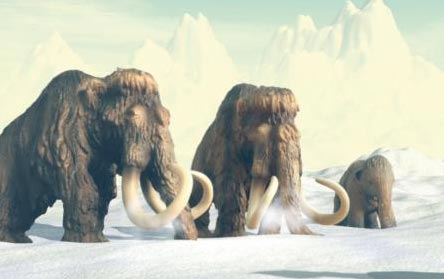
An Ice Age Woolly Mammoth Herd

Woolly Mammoths. An Ice Age scene. What caused the extinction of the mammalian megafauna?

Trade in Mammoth ivory could threaten modern elephants.

Picture credit: Schleich of Germany

To view Schleich prehistoric animals and other models including Schleich dinosaurs: Schleich Dinosaur and Prehistoric Animal Models.

A new study, undertaken by Care for the Wild, a conservation charity, suggests that up to sixty tons of ivory is taken from Siberia each year.  The amount of Mammoth ivory entering the global market now exceeds that from elephants, most of which is obtained by illegal poaching in sub-Saharan Africa.  So plentiful are the Mammoth remains, that some Russian businessmen have taken to hiring planes to scour the vast tundra so that rotting carcases can be spotted and the ivory removed.  This growing trade in prehistoric ivory has raised concerns over the effect on extant species of elephant.  The Mammoths may be fossils, but they are not permineralised, the ivory is not replaced by minerals.  The fossils are firstly, too young for full permineralistion to occur and their method of preservation, essentially frozen in the permafrost, like being stored in a giant freezer permits the organic ivory and other material to remain intact.

Some conservation groups are concerned that real elephant ivory could be passed off as Mammoth ivory, thus permitting the poaching network a route to market.  In the meantime, we shall continue to monitor the situation.

The author of this new study, Esmond Martin, an expert in the ivory trade; stated:

“Every year from mid-June when the tundra melts until mid-September, hundreds of people search the tundra in northern Siberia looking for Mammoth tusks”.

Scientists have estimated that the frozen north of Russia may still contain an estimated 150 million dead Mammoths, however, the exploitation of the Mammoths as a resource is also denying palaeontologists the chance to study these extinct animals.

A spokesperson for Everything Dinosaur commented:

“It is important to remember that we still have a great deal to learn about these amazing creatures [Woolly Mammoths], the ransacking of the tundra for Mammoth ivory is denying scientists the opportunity to study the remains properly.  As climate change affects our own species, we have the opportunity to learn about how temperature changes led to the demise of another large mammal species.”

The report is published in “Pachyderm” a journal focusing on elephant conservation.  It is published by the International Union for the Conservation of Nature.  Rather than taking the pressure off those elephant species that remain, the huge amount of Mammoth ivory coming onto the global market could lead to increased demand for ivory from any source, including extant elephants.

Esmond Martin, commented that the greatest threat on modern elephants lies in the possibility of Mammoth ivory being exported to Africa, where shipments could be mingled with tusks from African elephants.  The Indian Government has already imposed a complete ban on Mammoth ivory, fearing just such a threat and wanting to protect the few wild Indian elephants that remain.

Mark Jones, a spokesperson for Care for the Wild said:

“The trade in elephant ivory is illegal and we need to monitor anything that might increase the threat to elephants.  The hope must be that this Mammoth ivory will reduce demand but it is changing the whole market and we need to monitor it.”

There is another factor that needs to be considered when examining the trade in Mammoth ivory.  When scientists are working on the thawing carcase of a Mammoth such as Lyuba, the remarkably well preserved baby Mammoth found a few years ago, great care is taken to avoid contamination from germs and other pathogens that may be de-frosting too.  Some of these bugs could be quite harmful to our own species, after all, we have not been exposed to them for thousands of years.  When working with such fossil material there is always the risk of exposure, we suspect that no precautions are taken by the Mammoth ivory hunters.  Trade in Mammoth ivory may not just be deadly to elephants.

26 09, 2010

Special Silver Jubilee for Royal Tyrrell Museum (Alberta, Canada)

By |2024-04-19T19:13:00+01:00September 26th, 2010|Categories: Dinosaur and Prehistoric Animal News Stories, Dinosaur Fans, Main Page, Palaeontological articles|0 Comments

Royal Tyrrell Museum in Drumheller Celebrates 25 Years

This weekend marks the 25th anniversary of the opening of the Royal Tyrrell Museum in Drumheller (Alberta, Canada), a museum dedicated in the main to dinosaurs and the specimens to be found in the amazing strata of the Canadian province of Alberta.

Royal Tyrrell Museum

The Tyrrell opened on September 25th 1985, it did not get the “Royal” status until 1990, this museum, adjacent to numerous outcrops and exposures of  Upper Cretaceous strata, has done much to put Canada “on the map” as it were when it comes to palaeontology and related disciplines.

Don Brinkman, Director of Preservation and Research at the museum, recalls that in the early 1980’s scientists began working on an extensive horned dinosaur bone-bed, at the time a very ambitious excavation.  The project to build a museum in the area of Drumheller was already underway when he joined in 1982.

He recalled:

“We had three years for designing the building, building the building and collecting the specimens.  Looking back it was phenomenally ambitious, but we were all very young and we had no idea that a project [of that size] should take ten years.”

At first the staff worked out of offices in Edmonton, but the first museum director, David Baird decided that to work best, the scientists needed to be in and amongst the fossils, so the young Don Brinkman found himself working in a converted Co-op grocers in Drumheller, with colleagues and facilities scattered around the town.  From the beginning, he knew that working for the “Tyrrell” would be very different.

As the Royal Tyrrell staff emphasise, this museum was never going to be simply a collection of fossilised bones.  The museum is named after the famous Canadian geologist Joseph Burr Tyrrell (1858-1957), who discovered the skull of Canada’s first meat-eating dinosaur (Albertosaurus) whilst prospecting for coal on behalf of the Geological Survey of Canada.  The name is pronounced with the onus on the first syllable, as in “squirrel”.

Discussing the culture and ethos of the museum, Don added:

“It was decided that the focus would be on palaeobiology.  We wanted to understand the animals as they were living.  The foundation of palaeobiology is the fossil, but now we’ve taken an object and created a world around it.”

He admits it wasn’t a widely followed approach:

“It was viewed as wishy-washy, because there hadn’t been the scientific rigour for that kind of observation.  One of the most important things over the museum’s 25 years has been the development of this type of approach as rigorous science.”

This philosophy explains why today, although most of the galleries feature dinosaurs, there are also extensive exhibits on life on Earth over the last 300 million years or so.  The museum has experts on dinosaurs, and also geologists, palaeobotanists, and other specialist all helping to take care of over 110,000 fossil specimens and over the twenty-five years of the museum – ten million visitors.

When people visit the museum, as Don Brinkman says:

“They are seeing dinosaurs in the context of where they lived and how they interacted.”

We at Everything Dinosaur have been lucky enough to visit the museum on several occasions.  We have worked on some of the dig sites and helped in the huge fossil store rooms, indeed we would wager that there are a number of new species awaiting to be discovered, once the staff at the museum get round to studying all the fossils that have been placed with them after their excavation.

The museum really is an amazing place and very user friendly, full of helpful staff.   It is one of our favourite museums in the world.

Dr Don Brinkman, Preservation and Research Director at the Royal Tyrrell Museum, is delighted to preside over the 25th anniversary of the museum’s opening.  It is difficult to say exactly what the exhibit is in the background, but we assume it is a specimen of Albertosaurus sarcophagus, the same type of dinosaur the Joseph Burr Tyrrell discovered.

A number of special events and programmes are planned to mark the silver jubilee.  Twenty-five specimens form part of a special exhibition that tells the story of the history of the museum, one exhibit for each year of the museum’s existence.  Together they tell the story of Royal Tyrrell, chronicling the stories, the people and the events.

One of the stars of the show is the exquisitely preserved T. rex fossil known as “Black Beauty” (TMP 81.6.1), one of only two T. rex fossils found in Alberta.  The fossil specimen is jet black and represents about 25% of the entire animal, including a substantial amount of cranial material.  The jet black colour of the fossil is a result of manganese deposited by local groundwater penetrating and coating the fossil.

Senior science educator Megan McLauchlin explains that the colour is not the only thing that is special about this particular tyrannosaur fossil.  It is a fossil of a sub-adult animal, she went onto state:

“When you’re studying fossils, you really want a range of ages in the specimens.”

The specimens in this special exhibit tell uniquely local stories of scientific advancement.  The block of duck-billed hadrosaur eggs and embryos found at Devil’s Coulee in southern Alberta, for example, featured a new species of Hypacrosaurus, and helped to advance theories about how these dinosaurs cared for their young and about population dynamics.

The braincase of the Troodon, a small, meat-eating dromaeosaur, helped convince Dr Philip Currie, one of the world’s most famous palaeontologists, of the link between dinosaurs and birds.

The almost complete mosasaur skeleton, a monstrous marine reptile, included its last meal of sea turtles and large fish, a key discovery about its diet.

Example of Mosasaur Models
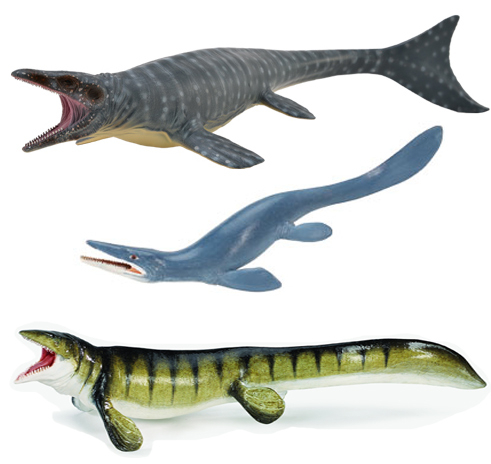
Different mosasaurs. The Royal Tyrrell Museum has a mosasaur exhibit.

Comparing different models of mosasaurs.

To view a model of a Mosasaurus, marine reptile figures and dinosaur models: Safari Ltd. Wild Safari Prehistoric World.

And that’s the secret, McLauchlin says, behind Alberta’s success in the world of palaeontology.

She added:

“We had not only great conditions for the dinosaurs to live in, but also great conditions for them to die in and then be buried.”

The parched, streaked cliffs behind her may not look like the forested, riverine plain of the Centrosaurus herd, but she says you just have to know how to read the rocks.  White sandstone indicates the fast-moving waters of oceans and rivers; darker mudstone represents slower moving swamps and lakes; black coal was once deep plant growth; and ironstone, look for the petrified wood chunks, speaks of a swampy forested environment.

And those cliffs are still talking, as Dr Brinkman says:

“We keep going back to places like Dinosaur Provincial Park because there’s high erosion there and there’s lots to be found.  Last year was one of our best years yet in terms of significance of specimens.”

Much of what we now know about the Late Cretaceous, particularly the Campanian faunal stage is down to the scientific projects and field work carried out by Royal Tyrrell staff and volunteers.  We wish them the very best for their 25th anniversary celebrations and perhaps we can get over to Alberta again ourselves soon.

Everything Dinosaur Team Members at a Dig Site (Royal Tyrrell Field Work)
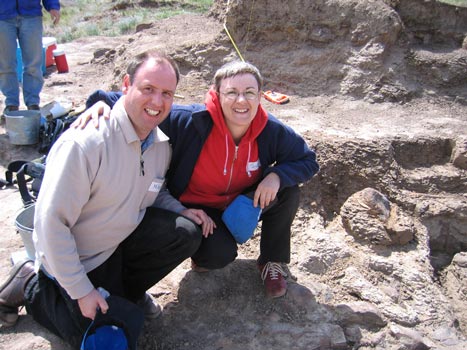
Pause for a pic next to a digs station.

Picture credit: Everything Dinosaur

Everything Dinosaur team members doing their bit for the Royal Tyrrell collection.  The pictures shows team members taking a break during a hadrosaurine excavation.

25 09, 2010

Getting Ahead with an Ichthyosaur Fossil Discovery

By |2024-04-19T19:31:51+01:00September 25th, 2010|Categories: Dinosaur and Prehistoric Animal News Stories, Dinosaur Fans, Everything Dinosaur News and Updates, Main Page|0 Comments

Local Fossil Enthusiast Benefits from Lyme Regis Landslip

In May 2008, the beach area between the towns of Lyme Regis and Charmouth on the Dorset coast had its worst landslide in over 100 years.  The cliffs in this area are extremely dangerous and landslides are common.  It was hoped that a number of new fossil specimens, possibly some marine reptile remains, could have been uncovered and for one hard working amateur fossil hunter, the landslide led to them finding a huge ichthyosaur fossil skull.

Ichthyosaurs (fish-lizards), were the most completely adapted of all the marine reptiles to a life in the sea.  These animals had streamlined bodies and four paired flippers,  Fossils of these reptiles have been found with preserved embryos inside the bodies, or even while they were giving birth – proof that these animals were viviparous (gave birth to live young).

Ichthyosaur Fossil

Devon based, local fossil enthusiast, Mike Harrison spent the last two years searching for parts of the giant ichthyosaur skull having first found a shard of fossilised bone after the Dorset landslide.  In total he recovered a number of pieces of the skull and has managed to piece the 1.5 metre skull together, like an enormous prehistoric jigsaw.

Mr Harrison, said that he had spent as much time as he could on the beach looking for the fossil remains and then he slowly but surely put the skull back together, using his kitchen table to store the 25 stone head.

Remembering the start of his ichthyosaur jigsaw puzzle, Mr Harrison commented:

“Within a week or two of the landslide in May 2008, I found the first piece of the skull.  From then on it was a race to find the rest of it which I did after six months hard work.  There were twenty-one pieces which were quite large, around 18 inches by 2 feet.”

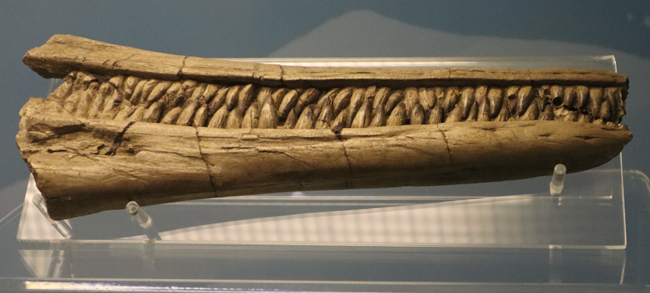
A Museum Exhibit Showing an Ichthyosaur Jaw

Ichthyosaur fossil.

A museum exhibit showing the jaw of a large ichthyosaur. Picture credit: Everything Dinosaur.

Picture credit: Everything Dinosaur

We at Everything Dinosaur pay tribute to Mike for his sterling efforts.  After all, if Mike had not recovered the fossil bones, they would have been eventually destroyed by abrasion and erosion forces on the beach.  Mike has been photographed with his amazing fossil find.  He is shown behind his ichthyosaur fossil, a fossilised ichthyosaur paddle is in the foreground.  The skull certainly looks exquisite even the sclerotic ring of bone in the orbit of the skull has been found.  This overlapping ring of bone helped support the eyeball at depth and may have aided vision by allowing sophisticated focusing of the eye lens in a marine environment.

Commenting on the teeth in the long jaws, Mr Harrison stated:

“Some of the teeth have broken off but the roots are still there.  So this may suggest that the dinosaur died of old age, or that it couldn’t feed itself.  They would have had around 150 teeth.”

When asked about his domestic arrangements, after all, not many households have a 190 million year old ichthyosaur skull in the kitchen, Mike said:

“I’ve been storing the pieces in a spare room, but now it’s on the kitchen table so it’s been TV dinners for a while.”

For Mike Harrison this is the find of a life time and it is certainly the biggest specimen that we are aware of to have come out of the May 2008 landslide.

The discovery has been registered with the Charmouth Heritage Centre and will then be sent to a museum.

Palaeontologist Phil Davidson said:

”It’s fairly common to find small isolated bones on the beach, but to find such an enormous skull is very rare.  The time and effort Mike put into finding it, going back again and back again after the landslide is incredible.”

We would like to add our congratulations to Mike Harrison .  The specimen looks superb and we know just how hard it is to put one of these Jurassic “jigasauruses” together.  Team members were actually on beach at Lyme Regis the day before the landslide, fortunately the slip occurred at high tide and at night so no people were hurt when it happened.  We have been teased a little and “blamed” for the landslide, but it was not our fault, besides we are far too sensible to risk going to near the cliffs, we know just how dangerous they are.

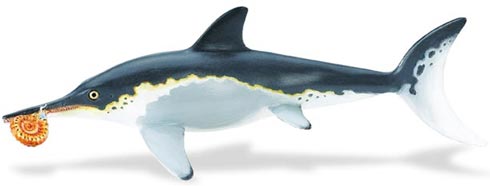
We have just added a new ichthyosaur model into the Everything Dinosaur model range, this ichthyosaur has an ammonite in its mouth, great to see a model so strongly associated with Lyme Regis and the Jurassic coast.

Carnegie Collection Ichthyosaurus Model

Ichthyosaurus Model (Carnegie Collectibles).

To view the models and replicas of marine reptiles: Safari Ltd. Wild Safari Prehistoric World.

24 09, 2010

Making a Note of Dinosaurs – New Dinosaur Notepads from Everything Dinosaur

By |2024-04-19T21:40:44+01:00September 24th, 2010|Categories: Dinosaur Fans, Everything Dinosaur Products, Main Page|0 Comments

Dinosaur Notepads – A Stocking Filler Idea

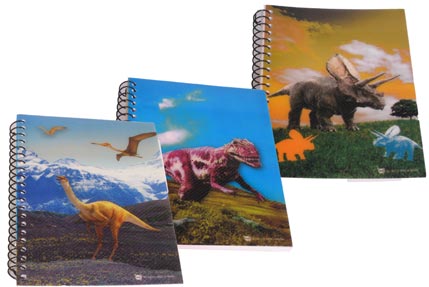
Notepads and notebooks for school children are always a good idea and to help encourage young dinosaur fans to do more writing, Everything Dinosaur has introduced a range of dinosaur themed notepads.  Each pocket sized notepad is securely spriral bound and contains sixty lined pages, ideal for school.  On the cover of each notepad is an illustration of a dinosaur scene, there is a bright and colourful Theropod (meat-eating dinosaur), a horned dinosaur and as a special request, we have ensured an Ornithomimid is on the third notebook in this series.

The Range of Dinosaur Notepads from Everything Dinosaur

Picture credit: Everything Dinosaur

The choice of an ornithomimid on the cover of a dinosaur notebook, may seem a little unusual but we at Everything Dinosaur know that dinosaurs such as Gallimimus and Struthiomimus are very popular with young dinosaur fans and we are asked frequently to provide dinosaur toys and games with illustrations of these dinosaurs.

To view notepads and other dinosaur themed school items, take a look at the huge range of dinosaur and prehistoric animal themed toys and gifts available from Everything Dinosaur’s award-winning website: Visit Everything Dinosaur.

These handy-sized, practical notebooks can easily fit into a school bag or satchel and they make an ideal stocking filler for Christmas.

Go to Top