All about dinosaurs, fossils and prehistoric animals by Everything Dinosaur team members.

Our back catalogue of dinosaur inspired videos, model making tips and advice, reviews of models etc.

28 06, 2014

Wild Safari Dinosaurs Ammonite Model – A Video Review

By |2023-03-13T20:24:53+00:00June 28th, 2014|Categories: Everything Dinosaur Products, Everything Dinosaur videos, Product Reviews|0 Comments

Video Review of Ammonite Model

Safari Ltd have introduced a replica of an ammonite into their Wild Safari Dinosaurs model range.  This model series certainly has a lot more than just dinosaur models to offer collectors and this new ammonite replica is a welcome addition.

In this short video review (six minutes and twelve seconds long), Everything Dinosaur discusses the merits of this model and explains why its introduction will prove very helpful to teachers and fossil collectors.

Wild Safari Dinosaurs Ammonite

Wild Safari Dinosaurs Ammonite Model Reviewed

Video credit: Everything Dinosaur

Although the soft parts of members of the Ammonoidea are virtually unknown in the fossil record, this replica reflects what palaeontologists actually think that the soft tissues of ammonites looked like. From the front the animal looks quite foreboding with its two long tentacles and eight muscular arms.  Imagine how you would feel if a three-metre-long specimen came hurtling towards you out of the dark waters – very scary!

The Wild Safari Dinosaurs ammonite model and the rest of the Safari Ltd prehistoric animal model range can be seen here: Safari Ltd. Wild Safari Dinos Models and Figures.

This ammonite model is great for use in schools as a teaching resource and it will also find a role in helping to explain ammonite fossils in museum display cases.

26 06, 2014

New Papo Dilophosaurus Video Review

By |2024-05-01T15:28:32+01:00June 26th, 2014|Categories: Dinosaur Fans, Everything Dinosaur Products, Everything Dinosaur videos, Product Reviews|0 Comments

Papo Dilophosaurus Dinosaur Model – A Video Review

With the introduction of the second Papo prehistoric animal figure for 2014, it is time to get the camcorder out again and to produce a video review of this new addition to Everything Dinosaur’s range.  In this short video, we reveal a surprise about this dinosaur model and comment on how this replica reflects the known Dilophosaurus fossil material.

Papo Dilophosaurus

Everything Dinosaur’s Video Review

Video credit: Everything Dinosaur

The video lasts for five minutes and ten seconds, we examine the model in a little more detail.  Naturally, the Everything Dinosaur team members focus on those bizarre crests, after all, the name Dilophosaurus does mean “double crested lizard”.  The pose of the model is discussed as is the colouration, on what is an excellent new addition to the Papo prehistoric animals model range.

To view the Papo Dilophosaurus and the rest of the Papo prehistoric animals:  Papo Dinosaurs and Prehistoric Animal Models.

13 06, 2014

A Video Review of the Papo Mini Dinosaurs Set

By |2023-03-13T18:21:47+00:00June 13th, 2014|Categories: Everything Dinosaur Products, Everything Dinosaur videos, Main Page|1 Comment

Papo Mini Dinosaurs Tub Reviewed

New for 2014, this set of six dinosaur models in a handy plastic tub by Papo. The model set features Triceratops, Tyrannosaurus rex, Spinosaurus, Stegosaurus, Brachiosaurus and Velociraptor.  This tub of dinosaurs, for want of a better name, is part of a range of figures made by Papo of France which are available as play sets.  The models range in size from around five centimetres in length (the Velociraptor) to around ten centimetres long (the Brachiosaurus).

Papo Mini Dinosaurs

Here is Everything Dinosaur’s video review:

Papo Mini Dinosaurs Reviewed

Video credit: Everything Dinosaur

In this short video (4.57) we look at the models in a little more detail and we suggest that some of the dinosaur figures can be used as baby dinosaurs when put together with the larger Papo dinosaur models.

To view Everything Dinosaur’s range of Papo prehistoric animal models: Papo Prehistoric Animal Models and Figures.

28 05, 2014

Museum Line Lambeosaurus Video Review

By |2023-03-13T11:52:50+00:00May 28th, 2014|Categories: Dinosaur Fans, Everything Dinosaur Products, Everything Dinosaur videos, Product Reviews|0 Comments

A Video Review of the Bullyland Lambeosaurus Dinosaur Model

Duck-billed dinosaurs had been relatively under represented in the Bullyland range of prehistoric animals.  In fact, Everything Dinosaur team members had trouble remembering what duck-billed dinosaur models this German manufacturer had made in the past.  There used to be a Parasaurolophus in the range, but the last version of this model, a lovely replica with a bright orange crest was retired a few years ago, so it is refreshing to see the name sake of the lambeosaurines stepping into the spotlight as Bullyland added a Lambeosaurus to their Museum Line series.

Museum Line Lambeosaurus

In this short video review, we take a look at this new for 2014 replica, comment on the fossil evidence and naturally, we discuss that wonderful head crest.

Everything Dinosaur’s Review of the Bullyland Museum Line Lambeosaurus

Video credit: Everything Dinosaur

The video is 5 minutes, 33 seconds long, it gives viewers a little more information about this dinosaur, where it lived and how difficult it is to classify lambeosaurine fossil material.

To view Everything Dinosaur’s range of Bullyland Museum Line prehistoric animal models including replicas of ornithischian dinosaurs: Bullyland Museum Line Prehistoric Animal Models.

20 05, 2014

New Schleich Pentaceratops Video Review

By |2024-04-12T15:44:41+01:00May 20th, 2014|Categories: Dinosaur Fans, Everything Dinosaur videos, Product Reviews|0 Comments

A Video Review of the 2014 Schleich Pentaceratops Dinosaur Model

The colourful Schleich Pentaceratops dinosaur model gets the Everything Dinosaur video treatment.  In this short video review, (five minutes and forty-two seconds), team members discuss the model, compare it to the Schleich Triceratops replica that came out in 2012 and talk about Pentaceratops fossil finds.

Schleich Pentaceratops Dinosaur Model

Everything Dinosaur’s Video Review of the Schleich Pentaceratops Dinosaur Model

Video credit: Everything Dinosaur

Titanoceratops (Titanoceratops ouranos) even gets a mention.

To view Everything Dinosaur’s range of Schleich models: Schleich Prehistoric Animal Figures and Models.

It may be more than ninety years since the first fossils of Pentaceratops were discovered in New Mexico, but there is a lot of fossil material from the San Juan basin ascribed to Pentaceratops that requires further research and study.  It is also possible that in many of the burlap and plaster wrapped specimens that lie in the vaults of museums there may be other species of ceratopsid awaiting discovery.

18 05, 2014

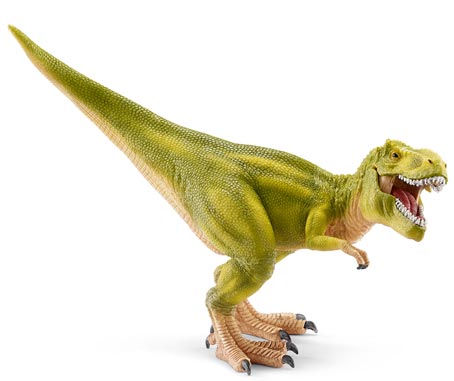
A Video Review of the New Schleich Light Green T. rex Dinosaur Model

By |2024-04-12T15:45:13+01:00May 18th, 2014|Categories: Dinosaur Fans, Everything Dinosaur Products, Everything Dinosaur videos, Product Reviews|0 Comments

Schleich Light Green Tyrannosaurus rex Video Review

The new for 2014 Schleich light green Tyrannosaurus rex is the first of the new Schleich dinosaurs to have a a video review created for it.  Team members at Everything Dinosaur have enthusiastically plotted the progress of the four new models scheduled for introduction this year by Schleich into their “World of History” series.  It is our intention to produce reviews for all the new models, but the T. rex replica is a very good place to start.

Tyrannosaurus rex Model

There are a total of three tyrannosaurs currently made by Schleich, two within the larger model series and a third, smaller model in what was called “die kleinen Dinos” by our German friends.  As with all prehistoric animal model manufacturers, T. rex tends to act as a flagship model for the factory, after all, it is the one dinosaur replica that is made by all the model manufacturers and the new, light green Tyrannosaurus rex from Schleich stands up very well to scrutiny.

The Light Green Tyrannosaurus rex Model (Schleich)

T. rex (Schleich 2014)

T. rex (Schleich 2014).

A Video Review by Everything Dinosaur

It is a very tactile model, has lots of detail and the articulated lower jaw is bound to make it very popular amongst young dinosaur fans.  The five minute video review discusses some of the features of this new replica and compares it to the 2012 tyrannosaur model introduced by Schleich when their revamped prehistoric animal model range “Urzeittiere Dinosaurier”, this translates as prehistoric animals – dinosaurs, first came out.

Everything Dinosaur’s Video Review of the Light Green T. rex (Schleich)

Video credit: Everything Dinosaur

In this short video, we look at the possibility of making this new T. rex model the male in a pair of tyrannosaurs with the slightly larger, dark green, 2012 T. rex being the female.  There is evidence to suggest that the females were larger than the males.  The fossil record from locations such as the the Hell Creek Formation of the western United States indicates two forms of Late Cretaceous tyrannosaur, a robust form and a gracile form.  Could this fossil material represent differences between boys and girls just as we see today with some species of birds?

To view the Schleich prehistoric animals available from Everything Dinosaur: Schleich Dinosaur Models and Prehistoric Animal Figures.

The females may have been bigger as they required wider hips to permit the storage and passage of eggs.  Females in many different types of animal tend to be bigger than the males, In tyrannosaur circles, could the girls have ruled the roost?  For the moment, the fossil evidence poses this intriguing question finding definitive proof is somewhat tricky, however, thanks to Schleich at least dinosaur fans and model collectors can create their own family of tyrannosaurs.

21 04, 2014

A Video Review of the CollectA Ichthyovenator Dinosaur Model

By |2023-03-12T09:38:56+00:00April 21st, 2014|Categories: Dinosaur Fans, Everything Dinosaur Products, Everything Dinosaur videos|0 Comments

CollectA Ichthyovenator – A Video Review

Ichthyovenator laosensis, the “fish hunter from Laos is the only member of the Spinosauridae known from Asia.  Prior to this dinosaur’s discovery in 2010, fossil teeth from Asia had been ascribed to a spinosaur and this dinosaur was tentatively named Siamosaurus.  Teeth that could have potentially belonged to a spinosaur have been found in several locations in south-east Asia, most notably Thailand, hence the name Siamosaurus “lizard from Siam”, but the validity of this genus remains under dispute.

CollectA Ichthyovenator Dinosaur Model

Ichthyovenator remains, for the moment, as the only unambiguous member of the Spinosauridae from Asia.  In this short video (6.06), team members at Everything Dinosaur compare the new CollectA dinosaur model with the fossil material.

A Video Review of the CollectA Ichthyovenator Dinosaur Model

Video credit: Everything Dinosaur

Bizarre Twin Sails

Although the video covers the bizarre twin sails on the back of this theropod, it is not known why this dinosaur may have possessed such a strange anatomical feature.  Palaeontologists cannot even be sure what these structures looked like, or indeed how long they were.  As to their function, a number of theories have been put forward, for example, the first sail at the front may have played a role in visual communication, whilst the second structure, positioned over the hips, may actually have been a fleshy hump where food reserves could be stored, rather like the hump of a bison or the humps seen in extant camels today.

To view the Ichthyovenator dinosaur model at Everything Dinosaur and to see the complete range of CollectA prehistoric animals stocked: CollectA Prehistoric Animal Models.

18 04, 2014

Extracting a Rare Ichthyosaur Fossil

By |2024-04-12T18:28:30+01:00April 18th, 2014|Categories: Everything Dinosaur News and Updates, Everything Dinosaur videos, Palaeontological articles|0 Comments

Newly Discovered Ichthyosaur Fossil Removed from Beach

After the exhilaration of finding a fossil specimen such as a near complete ichthyosaur, comes the hard work of extracting the specimen.  This has to be done with great care and planning, as the aim is to remove the material as intact as possible without damaging any of the actual fossils.  For Ben and his dad Dave, they also had to cope with the threat of an incoming tide as Ben found his ichthyosaur on the eastern beach of Lyme Regis (Dorset, England) and although the specimen was exposed at low tide, once the tide starts to turn, it comes in really quickly, so there is added pressure.

For models and replicas of ichthyosaurs and other marine reptiles: Wild Safari Prehistoric Dinos Models.

Ichthyosaur Fossil

The specimen, representing a young ichthyosaur was found by Ben a couple of days ago.  He and his father then set about working most of that day and into the evening trying to prepare the fossil for that all important lift, the first time that the ichthyosaur would have been moved for 180 million years or so.

Our chum Brandon, a local fossil expert himself, was on hand to record the moment when the fossil was ready for extraction.

Carefully Extracting an Ichthyosaur Specimen from the Beach at Lyme Regis

Video credit: Brandon Lennon

Fragile Specimen

The specimen was quite fragile, so glue was used to help secure the fossil and keep it intact.  Once this had been done,  it was time to prepare the block of Blue lias in which the fossil was located for lifting.  Chisels were then hammered into key points underneath the block to allow it to be freed from the bed.  Once this process had been completed it was time to get ready to lift the specimen and remove it.  This in itself is a tricky process, in the video you can see just how much water was seeping into the dig site and Ben and Dave were aware of the oncoming tide.

With skill and care the two intrepid fossil hunters were able to lift out the fossil.  The tail section broke, if you look carefully on the video you can see that there is a natural fault on the block and as a result the end piece broke off.  However, we can report that the rest of the specimen was removed safe and sound.

The two pieces of rock will now be prepared so that the skeleton can be fully exposed.

Lyme Regis is a great place to visit and fossil hunting on the beach is a lot of fun, however, we at Everything Dinosaur suggest that visitors take advantage of a guided fossil walk led by a local expert.

To read more about guided fossil walks: Lyme Regis Fossil Walks.

Congratulations to Ben and Dave, glad all their hard work paid off.

17 04, 2014

Rare Ichthyosaur Fossil Discovered at Lyme Regis

By |2024-04-12T18:29:10+01:00April 17th, 2014|Categories: Dinosaur and Prehistoric Animal News Stories, Dinosaur Fans, Everything Dinosaur videos, Geology|0 Comments

New Ichthyosaur Fossil Discovery at Lyme Regis

Yesterday, team members at Everything Dinosaur received news that a beautifully preserved ichthyosaur specimen had been discovered at Lyme Regis.  Our chum Brandon, a local fossil expert from Dorset, sent us some pictures and a video which illustrate the exciting discovery.   The specimen was discovered on the beach to the east of the town of Lyme Regis, near to where the council have been working to strengthen the cliff area and to improve the town’s coastal defences.

Video Footage of the Ichthyosaur Discovery

Video credit: Brandon Lennon

 The video shows the block which contains the fossil specimen, vertebrae can be clearly seen along with some of the rib bones, the skull is only partially exposed.  The dig team will cut the block away from the surrounding material and carefully transport the specimen away so that it can be prepared and examined in detail.  From the video, the bones don’t look too compressed or deformed and although some of the distal elements of the skeleton are probably missing, this particular ichthyosaur looks relatively complete.

Ichthyosaur Fossil

It is a little difficult to get our bearings just from the video and the photographs that we have received but we think the specimen was discovered in the Blue Lias of the Church Cliffs section of beach, immediately east of Lyme Regis.

The Location of the Fossil Discovery

The location of the fossil find.

The location of the fossil find.

Picture credit: Brandon Lennon

Water is carefully removed from around the fossil matrix, sand bags will be put in position to help keep the fossil material protected and then the dig team will map the exposed bones and work out the best way to cut and remove the stone block.

The Fossil Material is Carefully Examined

Icthyosaur fossil find April 2014.

Ichthyosaur fossil find April 2014.

Picture credit: Brandon Lennon

Exposing the Specimen

Carefully the specimen is exposed and then the layout and orientation of the fossil material is studied.  Consideration needs to be given to the tide times as the specimen will be covered once the tide turns.

A Close up of the ichthyosaur Fossil

The vertebrae can be clearly made out.

The vertebrae can be clearly made out.

Picture credit: Brandon Lennon

The hand in the photograph helps to provide scale.  The ichthyosaur is lying with its head facing towards the bottom right and the tail up towards the top left of the photograph.  The vertebrae can be clearly seen in the picture.  It is certainly a member of the Ichthyosauria Order, but it is very difficult to assign a species name to the specimen at this stage just having the short video and the photographs to study.  As a guess, it might be an example of Ichthyosaurus breviceps, however, it is best to wait until the fossil material has been more thoroughly prepared before any precise identification can be made.

The Ichthyosauria were an Order of fast-swimming, nektonic and (as far as we know entirely marine), predatory marine reptiles with dolphin-shaped bodies.  As a group, these highly specialised reptiles evolved in the Early Triassic and thrived throughout the Jurassic and for much of the Cretaceous, before finally becoming extinct around 80 million years ago.

For models and replicas of ichthyosaurs and other Mesozoic marine reptiles: CollectA Age of Dinosaurs Popular Models.

A Typical Jurassic Ichthyosaur Model

An Ichthyosaurus model

The Ichthyosaurus model (Wild Safari Prehistoric World) ready to take its turn on the Everything Dinosaur turntable. Picture credit: Everything Dinosaur.

Lyme Regis is an amazing place to visit and a fossil hunting trip to the beach is highly recommended, although we at Everything Dinosaur would advise that you take advantage of the local knowledge of a fossil hunting expert so that you can get the most from your visit.

To read more about guided fossil walks: Guided Fossil Walks (Lyme Regis).

We look forward to hearing more about this exciting fossil find and no doubt there will be more marine reptile discoveries made over the next few months.

16 04, 2014

A Review of the CollectA Xenoceratops Dinosaur Model

By |2023-03-12T08:57:23+00:00April 16th, 2014|Categories: Dinosaur Fans, Everything Dinosaur Products, Everything Dinosaur videos, Product Reviews|0 Comments

CollectA Xenoceratops Dinosaur Model Reviewed

Although this dinosaur was named and formally described less than two years ago, CollectA have been quick to introduce a model of this strange horned dinosaur, whose fossil remains have been found in Alberta, Canada.  In this brief video review, (4.42),  team members at Everything Dinosaur discuss the model and relate this replica to the known fossil material.  Since only cranial material has been found, the shape of the body is based on other centrosaurine members of the Ceratopsidae such as Pachyrhinosaurus, Centrosaurus and Styracosaurus.

CollectA Xenoceratops Dinosaur Model

The Video Review of the CollectA Xenoceratops

Video credit: Everything Dinosaur

This video looks at the colouration chosen for the model, comments on how the horns and neck frill have been depicted and we even talk about posterior vents!

To view Everything Dinosaur’s range of CollectA dinosaur and prehistoric animal models: CollectA Prehistoric Life Magazine.

Measuring around six metres in length, Xenoceratops (Xenoceratops foremostensis) was a sizeable beast.  In a number of on-line articles and reports, it has been stated that this dinosaur was named because with its many horns it looked alien.  Xenoceratops does mean “alien horned face”, but this ornithischian dinosaur was named not because of its “alien looking” appearance but due to the rarity of ceratopsian fossil material known from the Foremost Formation of south-western Alberta.

Go to Top