In the summer, Everything Dinosaur was contacted by Kate from Nottingham University who was conducting research into the predatory habits of extinct felids. Our team members are contacted quite frequently by academics, museum staff and students requesting our advice and guidance. Kate wanted to know whether there were any replicas available that could represent Pseudaelurus, a genus of prehistoric cat that was both geographically and temporally widely distributed. In addition, our advice was sought over finding suitable models of Smilodon species, specifically S. fatalis, S. gracilis and S. populator.
Models of Prehistoric Felids
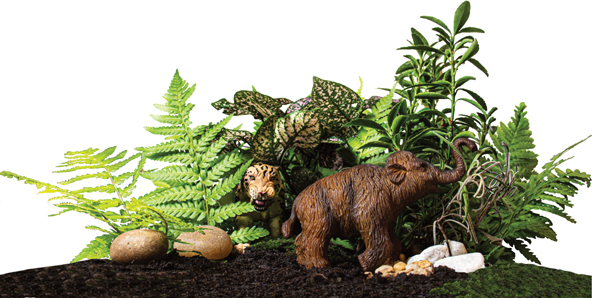
Smilodon Ambush – Creeping Up on a Young Mammoth
Everything Dinosaur was asked about potential predator/prey interactions with specific reference to Smilodon. A beautifully composed diorama depicting a hunting strategy of the sabre-toothed cat Smilodon.
Picture credit: Kate/Nottingham University
Everything Dinosaur has been involved in a number of prehistoric mammal themed projects recently. Many museums around the world may have been closed due to the current pandemic but this has permitted exhibition organisers and curators the opportunity to review and revamp some of their public displays. For example, Everything Dinosaur was asked to supply replicas of several prehistoric elephants including Deinotherium and Palaeoloxodon antiquus (Straight-tusked elephant), to a German natural history museum as part of a display featuring the teeth of extinct members of the Proboscidae.
Our work is certainly diverse, no two days are the same.
Identifying Prehistoric Animal Models
Having worked with several academics previously on enigmatic sabre-toothed predators, including gorgonopsids, we were able to advise Kate on which prehistoric animal models could be used to differentiate between the various species and sub-species of Smilodon.
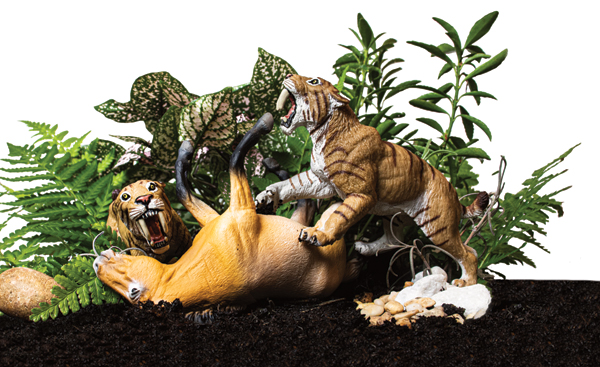
As part of her project work, Kate created some beautiful dioramas using these figures in a bid to replicate hunting behaviours.
Smilodon hunting. As apex predators these powerful animals would have preyed on a variety of animals including prehistoric horses, if they could get close enough to ambush them.
Picture credit: Kate Nottingham University
Commenting upon the assistance received from Everything Dinosaur, Kate stated:
“Thank you for your help and advice with the Smilodon models and prey species. I had a lot of fun using them in my final project.”
A spokesperson from Everything Dinosaur commented:
“We get asked to work on all kinds of prehistoric animal related activities supplying models and figures to museums and other educational bodies all over the world. The replicas that we supply have proved extremely useful in helping to visualise ancient, prehistoric landscapes and to inform and educate visitors.”
New Study Refutes the Idea of Protofeathers in the Pterosauria
A newly published study casts doubt on the idea that members of the Pterosauria had an integumentary covering of insulating protofeathers. Professor David Martill (University of Portsmouth), in collaboration with fellow flying reptile expert Dr David Unwin (University of Leicester), have reviewed the evidence and they propose that these vertebrates essentially lacked a feathery covering or indeed pycnofibres.
This research contradicts and refutes an earlier study published in the academic journal “Nature Ecology and Evolution” in 2018.
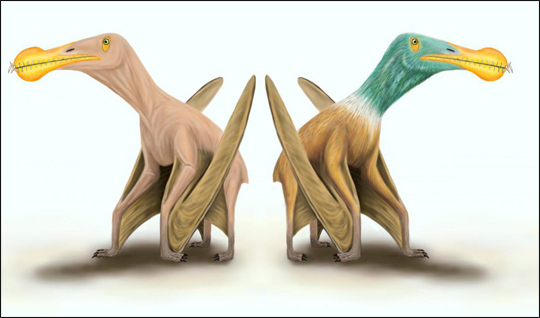
Pterosaurs Uncovered – Lacking an Integumentary Covering
Naked pterosaurs – British researchers refute the idea of protofeathers in the Pterosauria.
Picture credit: Megan Jacobs (University of Portsmouth)
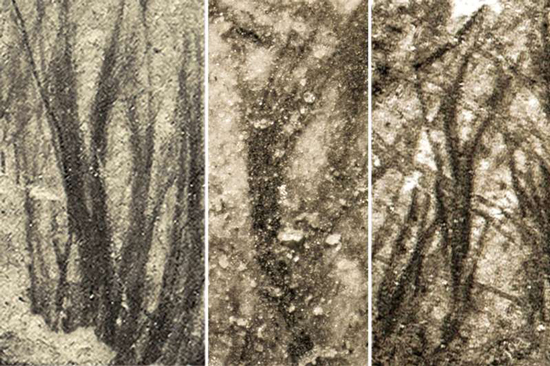
Feather-like Branching Filaments
Dr Unwin and Professor Martill have challenged the findings of a research paper that examined the fossilised remains of two anurognathid pterosaurs which concluded that some of the structures preserved in association with the fossil bones were pycnofibres with characteristic features of feathers including non-vaned grouped filaments and bilaterally branched filaments. The 2018 paper implied that if pterosaurs as well as dinosaurs had feather-like body coverings, then this type of integumentary covering was deeply rooted in the Archosauria. This would suggest that the common ancestor of both the Pterosauria and the Dinosauria evolved this type of body covering.
If this interpretation of the fossil evidence is correct, then the very first feather-like elements evolved at least eighty million years earlier than currently thought. It would also suggest that all dinosaurs started out with feathers, or protofeathers but some groups, such as the Sauropoda, subsequently lost them again, the complete opposite of currently accepted theory.
Unwin and Martill challenge the interpretation of the material that featured in the 2018 paper. The propose that tiny, hair-like filaments reported by Yang et al (2018), are not protofeathers at all but tough fibres which form part of the internal structure of the pterosaur’s wing membrane, and that the “branching” effect may simply be the result of these fibres decaying and unravelling.
Dr Unwin from the University of Leicester’s Centre for Palaeobiology Research commented:
“The idea of feathered pterosaurs goes back to the nineteenth century but the fossil evidence was then and still is, very weak. Exceptional claims require exceptional evidence – we have the former, not the latter.”
Feather-like Filaments in Pterosaur Fossils
Close-up views of different types of feather-like filaments identified in pterosaur fossils.
Picture credit: Yang, Jiang, McNamara et al
Considering Theories Related to the Pterosauria
Highlighting the difficulties of interpretating filament-like structures, Professor Martill commented that either way, palaeontologists have to take care when considering theories related to the Pterosauria, they have no extant equivalents so the reliance of fossil material is perhaps greater when compared to the Dinosauria with their close relatives the birds still very much with us.
Professor Martill observed:
“If they really did have feathers, how did that make them look and did they exhibit the same fantastic variety of colours exhibited by birds. And if they didn’t have feathers, then how did they keep warm at night, what limits did this have on their geographic range, did they stay away from colder northern climes as most reptiles do today. And how did they thermoregulate? The clues are so cryptic, that we are still a long way from working out just how these amazing animals worked”.
The scientific paper: “No protofeathers on pterosaurs” by David M. Unwin and David M. Martill published in Nature Ecology and Evolution.
Famous Feather Fossil – Probably Represents a Feather from Archaeopteryx
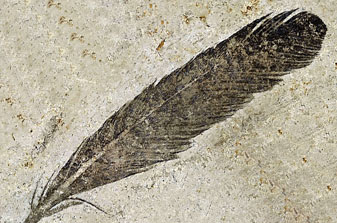
The feathers are flying when it comes to an iconic fossil, arguably one of the most significant in any vertebrate palaeontology collection – a single, carbonised feather from the Solnhofen area of southern Germany.
Described in 1861, this isolated feather specimen is regarded as the first fossil feather known to science. Having been scientifically studied just two years after the publication of Charles Darwin’s “Origin of Species”, the “Urfeder” – first feather in German, a modern-looking bird feather preserved in lagoonal sediments laid down around 150 million years ago, sent shock waves around the scientific community when it was first described.
The Iconic Feather Fossil – Is this from the “Urvogel” (Archaeopteryx lithographica)?
The slab from the Berlin museum showing the iconic feather, so long associated with Archaeopteryx and recently thought to have come from a dinosaur. New research suggests this is a feather from Archaeopteryx.
The Application of Laser-Stimulated Fluorescence
Ever since its discovery, scientists have debated what sort of creature this single feather came from. In February 2019, Everything Dinosaur reported on research conducted by a team of international scientists that applied a sophisticated imaging method called Laser-Stimulated Fluorescence (LSF) to reveal previously unseen details in a forensic examination of both the slab and the counter slab of the fossil feather. The team, which included Dr Michael Pittman (University of Hong Kong), proposed that the feather did not come from the famous “first bird”, but instead from an unknown species of dinosaur that co-existed with Archaeopteryx.
This new research utilised images generated from an electron microscope of the single feather specimen along with detailed examinations of known Archaeopteryx fossils that displayed feather impressions. The study published in “Scientific Reports” was led by Ryan Carney, an assistant professor of integrative biology at the University of South Florida. The researchers analysed nine characteristics of the feather, particularly the long quill, which runs up the centre of the specimen (centreline). This centreline is composed of two parts:
Calamus – centreline below the skin (shown in red in the diagram below)
Rachis – tubular extension of the calamus above the skin (shown in blue in the diagram below)
The New Study Suggests The Single Feather Fossil is Congruent with Archaeopteryx Feathers
The centre line of the feather has been recalculated to show that the 2019 paper was inaccurate in this regard. The placement of the centreline now falls within the range of selected modern Aves species.
Picture credit: Carney et al (Scientific Reports)
The photograph (above), shows (a) centrelines of the isolated fossil feather modified from Hermann von Meyer’s original 1861 description and (b) Laser-stimulated fluorescence image modified from the 2019 scientific paper. In (a) and (b), the centerline comprises the calamus (red) and rachis (blue). An alignment error made in the earlier (2019) research led to the orientation of the centreline of the fossil feather to be out of the expected range found in extant birds (c). The final figure (d) has been modified from (c) and shows a more representative range of centreline morphologies associated with modern birds (areas shaded yellow in (c) and (d).
A Feather from the Left Wing of Probably Archaeopteryx
Based on this new research, the scientists conclude that the single feather represents a feather from the left wing called a primary covert. Primary coverts are small contour feathers that overlay the main wing feathers. As similar feather characteristics were identified in other Archaeopteryx fossil feathers Carney et al conclude that the 1861 specimen probably does represent a feather lost by the famous “Urvogel” (Archaeopteryx lithographica).
Ryan Carney commented:
“There’s been debate for the past 159 years as to whether or not this feather belongs to the same species as the Archaeopteryx skeletons, as well as where on the body it came from and its original colour. Through scientific detective work that combined new techniques with old fossils and literature, we were able to finally solve these centuries-old mysteries.”
The Location of the Fossil Finds
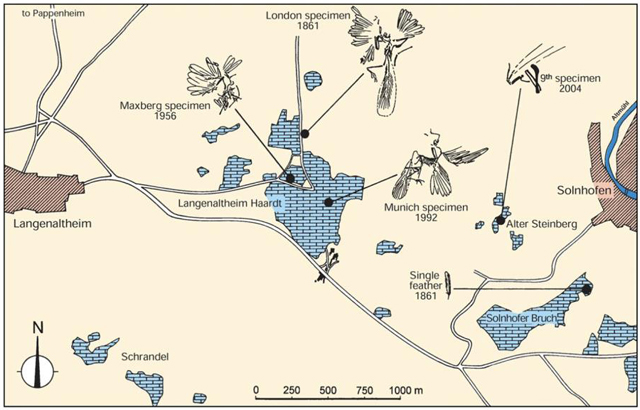
In addition, the research team looked at the provenance of the single feather, where it was found in relation to known discoveries of Archaeopteryx remains. Four Archaeopteryx specimens, including the London specimen which is now the holotype for A. lithographica were found within 2.2 kilometres of the site where the single feather was discovered. All of these specimens are coeval (having the same age and origin), from the same horizon in the limestone, all linked by biostratigraphy. The Archaeopteryx material being associated with the same zonal ammonite fossils (Subplanites rueppellianus).
The Provenance of the Single Feather Fossil in Relation to Other Archaeopteryx Specimens
Map of the Solnhofen-Langenaltheim quarry district, illustrating locations of the isolated feather and the London (type), Maxberg, Munich, and Ottmann & Steil (9th) specimens of Archaeopteryx.
Picture credit: Carney et al (Scientific Reports)
Detecting and Interpreting Melanosomes on the Feather
The electron microscopy employed permitted the scientists to identify melanosomes (microscopic pigment structures). They determined that this primary covert feather was coloured matte black. Other studies have also shown the Archaeopteryx may have been black in colour, with some feathers showing iridescence.
The scientific paper: “Evidence corroborates identity of isolated fossil feather as a wing covert of Archaeopteryx” by Ryan M. Carney, Helmut Tischlinger and Matthew D. Shawkey published in Scientific Reports.
One of the problems we encounter when visiting schools to explain to young people about fossils and ancient life, is that children struggle to grasp the concept of deep time. The idea that Diplodocus roamed the Earth 150 million years ago can be a challenge when you think that the summer holiday seems to last forever. In addition, it’s tricky trying to convince an eight-year-old that the beautiful, shiny ammonite fossil that they are holding represents the shell of an animal that once swam in the sea.
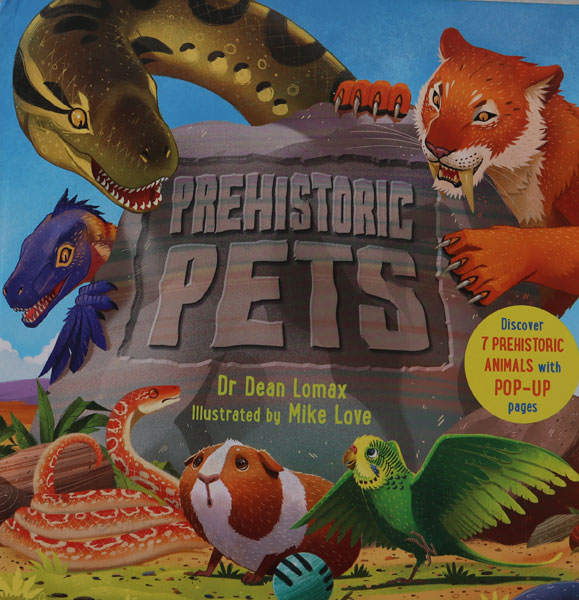
If only there was a simple way in which we could get the children to see a link between animals alive today and what occurred in past. A new book entitled “Prehistoric Pets” written by the talented palaeontologist Dr Dean Lomax, provides a fresh perspective, bridging the gap between living animals and their ancient ancestors.
The Front Cover of “Prehistoric Pets” by Dr Dean Lomax and Illustrated by Mike Love
This colourful and well-written book takes the reader on a journey back in time, linking common household pets with their prehistoric ancestors.
Picture credit: Templar Books/Everything Dinosaur
Palaeontology Meets Pets
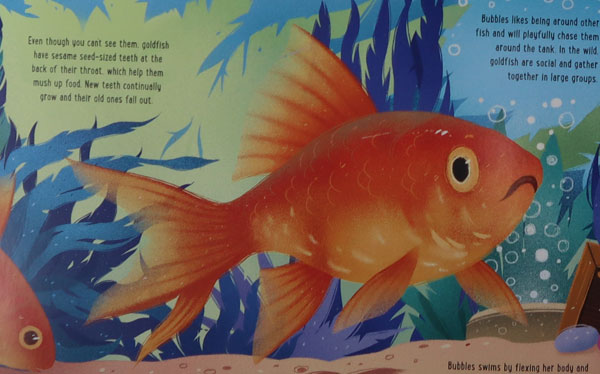
The premise is simple, “Prehistoric Pets” takes the reader on a journey back in time, linking familiar animals with their prehistoric ancestors. Dr Lomax examines seven of our nation’s favourite pets and uses fossil clues and other evidence to reveal who their animal ancestors were. Palaeontology meets pets when the evolutionary history of the goldfish is summarised succinctly and with a liberal sprinkling of fishy-themed facts.
The gauntlet is thrown down with readers invited answer to the question “Which prehistoric fish was a Jurassic giant longer than a T. rex?” The solution presents itself in pop-up form, turn the page and the reader encounters a trio of prehistoric monsters including a huge Leedsichthys (leeds-ick-thus), a fish as long as a humpback whale.
Say Hello to Bubbles the Goldfish and Learn About her Ray-finned Ancestors
Did you know that goldfish are social creatures? The evolutionary history of fish dates back more than 500 million years.
Picture credit: Templar Books/Everything Dinosaur
Incorporating Scientific Terms to Expand the Vocabulary of Young Readers
The beautiful illustrations by Mike Love compliment the copious detail that has been incorporated into this publication. The text has been laid out in an easy-to-follow and appealing style and we heartily approve of the mix of vocabulary chosen.
Dean Lomax has balanced the need to keep the text easy to comprehend but also slipped in some scientific terms which children will relish. For example, Jasper the Corn snake is ectothermic and when the weather turns cold in the southern and east-central USA, where these snakes can be found in the wild, these reptiles brumate! No need to worry, Dr Lomax has made sure that simple explanations of these scientific terms have been provided.
Scientists think that the first snakes evolved in the Jurassic!
Picture credit: Templar Books/Everything Dinosaur
Birds and Dinosaurs Feature in “Prehistoric Pets”
Budding young palaeontologists will relish the prospect of learning about Josephoartigasia monesi, (pronounced joseff-oh-arty-ga-see-ah mon-es-ee), a one tonne, giant rodent distantly related to a guinea pig, as well as making the connection between a budgerigar and famous, meat-eating dinosaur Velociraptor. This is a cleverly constructed publication that will enthral and entertain both young and old readers alike.
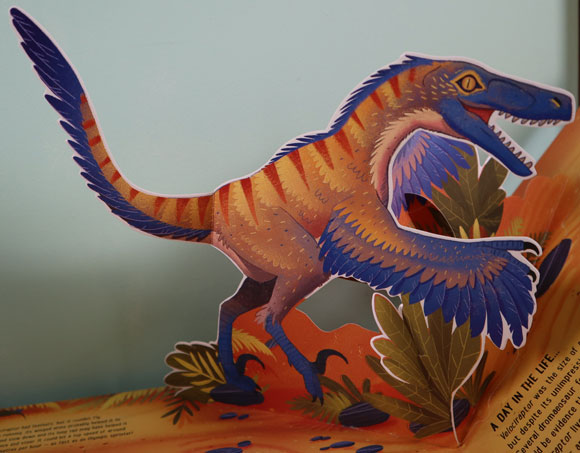
A Velociraptor Pops Up! Velociraptor Demonstrates that Budgerigars are Dinosaurs!
A non-bird dinosaur Velociraptor. The book “Prehistoric Pets” demonstrates the link between a budgie and a dinosaur!
Picture credit: Templar Books/Everything Dinosaur
Published by Templar Books and available in a hardcopy format, this eye-catching and humorous book makes an ideal Christmas gift.
For further information about “Prehistoric Pets” and other gift ideas for young readers: Email Everything Dinosaur.
Highly recommended!
Visit the award-winning and child-friendly Everything Dinosaur website: Everything Dinosaur.
Sabre-toothed Predators Evolved Different Hunting Styles Over the Last 250 Million Years
New research suggests that sabre-toothed predators evolved an unknown diversity of hunting and killing methods over the last 250 million years or so.
Sabre-toothed cats are among the most iconic of all the prehistoric animals known to science. However, not all the tetrapods that evolved long, knife-like canine teeth were members of the cat family (Felidae). Some animals that evolved sabre-like teeth even predate the Dinosauria.
Sabre-toothed Predators
Enlarged canine teeth, some of which in some species reached sizes in excess of thirty centimetres in length, evolved independently in seven different evolutionary lines of carnivores. Due to similar skull morphology and tooth shape, it had long been assumed that all these predators occupied very similar niches in ecosystems and hunted and killed prey in the same manner.
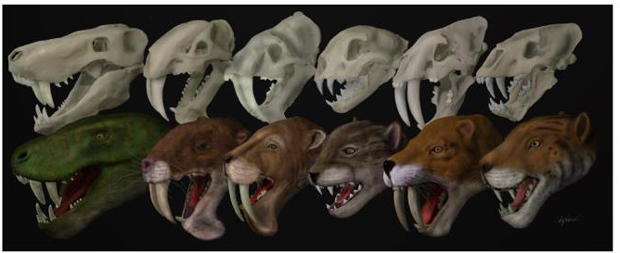
The Six Different Types of Sabre-toothed Tetrapod included in the Study
Skulls and life reconstructions of the six different sabre-tooth species used in the study.
Picture credit: Stephan Lautenschlager, University of Birmingham
That assertion has been challenged and now refuted in a new study published today in the “Proceedings of the Royal Society B.”
Examining the Functional Capabilities of Teeth and Skulls
An international team of scientists from Spain, Germany and the UK, analysed over sixty different sabre-tooth species. Using computer models and simulations the researchers investigated the functional capabilities of the teeth and skulls, such as calculating bite forces, the stresses on the skull and bending strength.
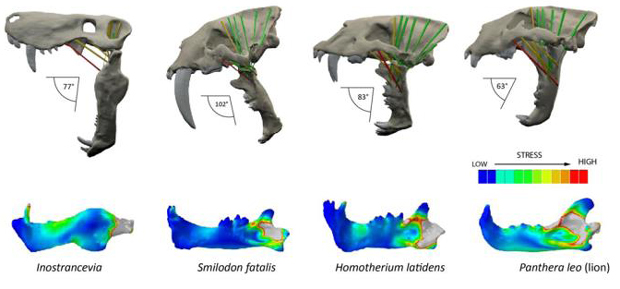
Computer Simulations Assessed Bite Forces and Skull Stress in the Sabre-toothed Predators
Computer simulation results for three fossil sabretooth species compared to a modern lion showing maximum jaw gape and stress distribution in the lower jaw.
Picture credit: Stephan Lautenschlager, University of Birmingham
Lead author of the scientific paper, Dr Stephan Lautenschlager (Lecturer for Palaeobiology at the University of Birmingham), commented:
“It is fascinating to see that so many different species have evolved elongated canine teeth to subdue prey, but our results show that they used these sabre-like teeth differently to do so.”
Computer Simulations
The analysis of the skull material in combination with the computer simulations revealed that sabre-toothed predators may have looked superficially similar, but they used their canine teeth in different ways. Some species specialised in hunting small prey using the canine teeth to inflict deep, debilitating wounds, whilst other species were probably pack hunters specialising in tackling larger prey. Those species that were probably pack hunters specialising in hunting and killing larger prey had reinforced bone structures to help stabilise their jaws.
Dr Lautenschlager added:
“We know that different sabre-tooth species shared the same ecosystem. Using computational methods, we can show that their specialisation on different prey allowed them co-exist and to avoid competition.”
A Sabre-Toothed Cat – An Iconic Animal from the Cenozoic
A model of a Sabre-toothed cat. The Mojo Smilodon model is a replica of a sabre-toothed cat. The Smilodon model measures approximately 13 cm long. Picture credit: Everything Dinosaur.
Picture credit: Everything Dinosaur
The picture (above) shows a Mojo Fun Smilodon figure.
Gravicalymene bakeri – Trilobite Named After Actor Tom Baker
Two Australian scientists have named a new species of trilobite in honour of Tom Baker, the English actor, perhaps most famous for portraying the fourth incarnation of the long-running BBC television series Doctor Who. The trilobite fossils, preserved in mudstone, come from Ordovician-aged strata in the Gunns Plains area of northern Tasmania. The new species has been named Gravicalymene bakeri.
Gravicalymene bakeri
This genus had never been found in Australia before, it is known from Europe and North America, so this discovery significantly raises the distribution of this genus. The discovery reported in the “Alcheringa: An Australasian Journal of Palaeontology”, raises the intriguing possibility that around 450 million years ago, oceanic currents could have somehow linked eastern and western hemispheres.
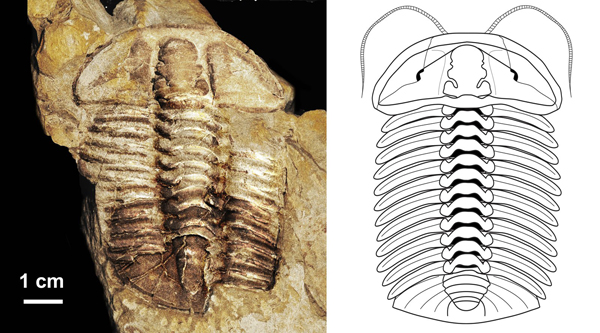
A Photograph of the Newly Described Gravicalymene bakeri with an Explanatory Line Drawing
Gravicalymene bakeri trilobite fossil with line drawing. Note scale bar equals 1 cm.
Picture credit: Australian Museum
A Serendipitous Discovery
Co-author of the scientific paper Dr Malte Ebach of the University of New South Wales, explained that the first evidence of a new species of trilobite was found by chance. Whilst driving through the Gunns Plains area, a “call of nature” break was required. It was whilst on this “call of nature”, that a boulder was spotted that was covered in the remains of these ancient, marine invertebrates.
As for the species name, fellow co-author Dr Patrick Smith, (Australian Museum, Sydney, New South Wales), stated that both he and Dr Ebach wanted to honour Tom Baker as his stint as the fourth doctor had inspired them both to pursue a career in the sciences.
Dr Smith commented:
“I’m not old enough to remember Tom Baker’s episodes which were originally aired in 1974-81. However, growing up as a teenager when the series re-aired in the early 2000’s, I followed the show religiously and became convinced that a career in science was guaranteed to improve the world.”
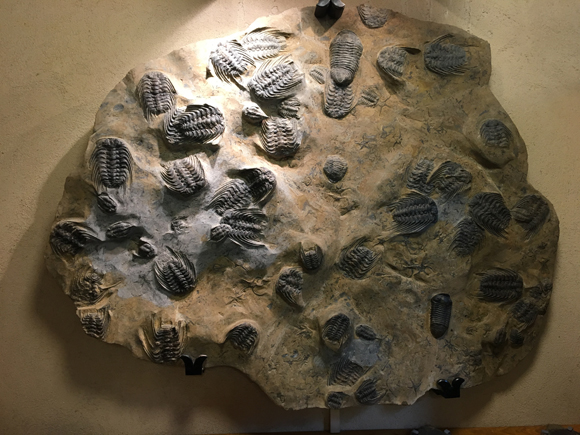
A collection of fossilised trilobites. Picture credit: Everything Dinosaur.
Actor Tom Baker expressed his delight when he was told the news that he had been honoured by having a Tasmanian trilobite name after him.
The actor who has enjoyed a long career in film, television and radio commented:
“I am delighted to be entitled at last. I hope the Who World will share my joy. Will I be allowed to tack “Fossil” on official correspondence? I hope the Who World will celebrate this fresh honour and will spread the news to those who live in remote places. Happy days to all the Who fans everywhere.”
The Gravicalymene genus is known from marine deposits associated with Avalonia, Baltica and Laurentia (Europe and North America) but this is the first time this genus has been reported from eastern Gondwana (Australasia).
The scientific paper: “A new Ordovician (Katian) calymenid, Gravicalymene bakeri sp. nov., from the Gordon Group, Tasmania, Australia” by Patrick M. Smith and Malte C. Ebach published in Alcheringa: An Australasian Journal of Palaeontology.
Happy 160th Birthday to the Oxford University Museum of Natural History
This year, one of our favourite museums is celebrating its 160th birthday. The Oxford University Museum of Natural History was opened 160 years ago. There would have been lots of events to commemorate this, but 2020 has proved to be an exceptionally challenging year for museums.
The Oxford University Museum of Natural History
The Museum Collections are Housed in a Stunning Example of Victorian Neo-gothic Architecture
The imposing main entrance of the Oxford University Museum of Natural History. The grassy area in front of the main entrance is home to a replica of a theropod dinosaur trackway. Visitors can take the opportunity to “walk with a dinosaur”.
Picture credit: Oxford University Museum of Natural History
This museum was established back in 1860 to house the various scientific collections that had been built up at Oxford University. Prior to all the collections being installed, it hosted one of the most significant scientific debates ever recorded, a clash of ideologies when Thomas Huxley debated the concept of natural selection as postulated by Charles Darwin, with the Bishop of Oxford Samuel Wilberforce.
Seven Million Items Including Important Dinosaur Fossils
Over 7 million items our housed in the spectacular Victorian neo-Gothic building with its vaulted arches and beautiful ironwork. The collection continues to play a prominent role in on-going research with more than 6,000 specimen loans made annually. It attracts around three-quarters of a million visitors each year, but 2020 has seen it suffering, like so many other institutions, from restrictions imposed due to the COVID-19 pandemic.
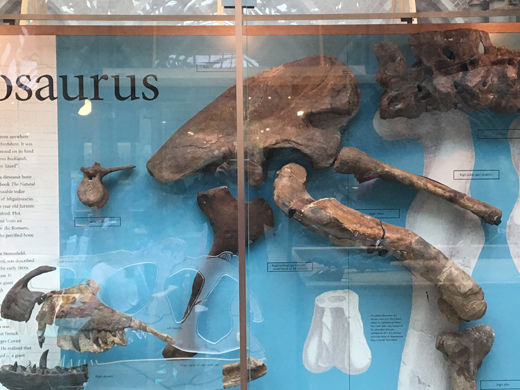
The Megalosaurus bucklandi Display at the Museum
The Megalosaurus display case (Oxford Museum of Natural History). Picture credit: Everything Dinosaur.
Highlights of the collection include the world-renowned Oxford Dodo specimen, amazingly beautiful trilobite fossils and the remains of the first scientifically described dinosaur Megalosaurus bucklandi. The Oxford University Museum of Natural History is back open again after the lockdown period. Admission is free, but visits have to be booked on-line and once in the building social distancing measures have to be followed.
The Spectacular Interior of the Museum
The spectacular Victorian ironwork of the Oxford University Museum of Natural History. Picture credit: Everything Dinosaur.
Monsters of the Deep: Science Fact and Fiction at the National Maritime Museum Cornwall (July to 3rd January 2022)
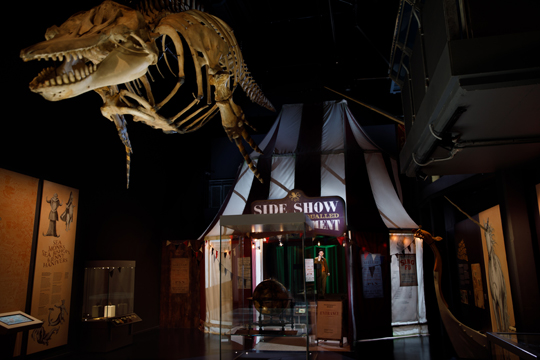
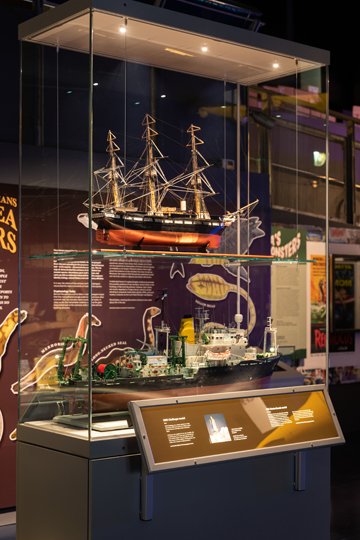
We might be living in a world of track and trace, where everywhere we go and who we meet can be uploaded into a gargantuan database, but there is a part of our planet that remains relatively unknown even in today’s digitally dominated environment. The deep, dark depths of our oceans harbour some of the most bizarre and amazing creatures to have ever evolved and a recently re-opened exhibition at the National Maritime Museum (Falmouth, Cornwall), permits visitors to meet up with some of nature’s most curious creatures as well as plunging into the depths of our own imagination to explore legendary sea monsters – all without getting our feet wet.
Monsters of the Deep: Science Fact and Fiction
Monsters of the Deep: Science Fact and Fiction at the National Maritime Museum (Cornwall). Take the plunge! Encounter myths, legends and real sea monsters.
Picture credit: Courtesy of the National Maritime Museum Cornwall
Monsters of the Deep Real and Imagined
Running until January 2022, this carefully crafted exhibition takes visitors on a voyage of discovery from Medieval folklore through cryptozoology and the modern-day monster hunters employing the very latest maritime technology used to explore those parts of planet Earth furthest from our sun.
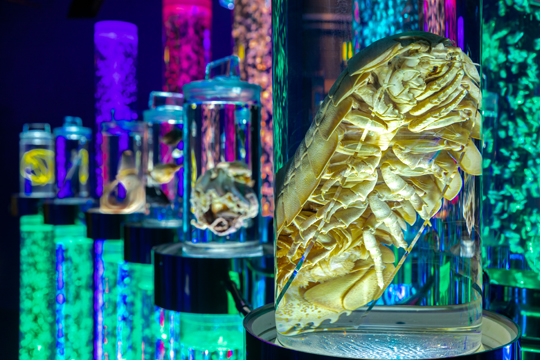
A Collection of Ocean-dwelling Curiosities
Curious crustaceans such as giant isopods with their huge compound eyes stare back at you. The exhibition permits visitors to closely examine some of the most amazing ocean-dwelling creatures known to science.
Picture credit: Courtesy of the National Maritime Museum Cornwall
A Collaboration Between Leading Institutions
World class scientific collections from such august bodies as the British Museum, the National Oceanography Centre, the Science Museum, Royal Museums Greenwich and Cambridge University Library have been plundered by modern day buccaneers on a mission to inform, educate and entertain. Rarely seen specimens, artwork and artefacts all housed under one roof including a large scale reproduction of the Carta Marina, the world’s most famous medieval map of the sea, complete with fanciful monsters and mermaids.
The exhibition highlights the myths associated with early exploration and showcases exquisite illustrations of sea monsters including the strange “mirror creatures”, denizens of the deep that haunted the nightmares of many a seafarer in the age of sail.
Early Explorers Brought Home Tales of Encounters with Fantastic Sea Creatures
Early explorers brought back fanciful tales of sea serpents, mermaids and monsters.
Picture credit: Courtesy of the National Maritime Museum Cornwall
As Real as Elephants and Giraffes
Prior to the Age of Enlightenment which hastened a revolution in scientific thinking in the 17th century, little was known about the exotic fauna that inhabited our world. On display at this exhibition is the Hortus sanitatis, the first ever natural history encyclopaedia. Originally printed in 1491, the year before Christopher Columbus set out on his voyage that led to the discovery of the New World, it represents a significant landmark in our attempts to document and understand the natural world with unicorns and mermaids considered just as real as elephants and giraffes.
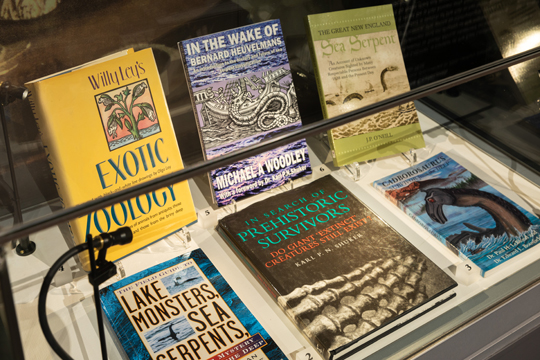
A Collection of Books on Cryptozoology on Display
A large number of books documenting our fascination with monsters of the deep are on display.
Picture credit: Courtesy of the National Maritime Museum Cornwall
Guest Curators and Leading Specialists
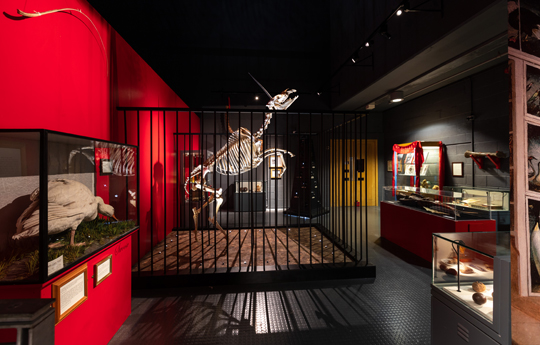
Monsters of the Deep: Science Fact and Fiction has been developed in co-operation with leading specialists and guest curators, including Viktor Wynd, the custodian of the “UnNatural History Museum”, bringing together a collection of curiosities including a mummified feegee mermaid and a skeleton of a unicorn! This section of the exhibition is dedicated to exploring ideas about what is real and what can be falsified or faked.
A Rearing “Unicorn” on Display at the National Maritime Museum
An exhibit from the “UnNatural History Museum” – a rearing unicorn skeleton.
Picture credit: Courtesy of the National Maritime Museum Cornwall
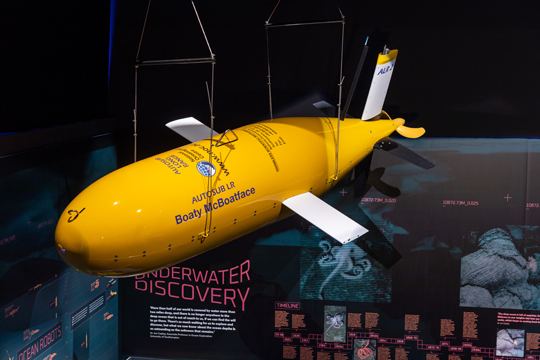
As well as exploring the theme of sea monsters in popular culture, the exhibition provides an insight into some of the very latest cutting-edge technical developments that have allowed marine biologists rare glimpses of the natural wonders that still exist in the largely unexplored regions of our planet such as the vast abyssal plain.
Combining Myth and Fantasy with Scientific Endeavour and Research
The exhibition highlights state-of-the-art technology such as the latest mini submersibles that are transforming our understanding of the world’s oceans.
Picture credit: Courtesy of the National Maritime Museum Cornwall
To ensure the safety and wellbeing of all visitors and staff, the Museum has implemented a number of new health and safety measures, in line with the latest government advice including timed arrival slots, social distancing measures and on-line only booking.
As half-term approaches, escape your bubble and take the plunge! Immerse yourself in a world of folklore, fun, facts and fantasy.
Monsters of the Deep: Science Fact and Fiction at the National Maritime Museum Cornwall (July to 3rd January 2022). For further details: The National Maritime Museum.
Rebor “Bites the Dust” and Oddities Fossil Studies Skulls
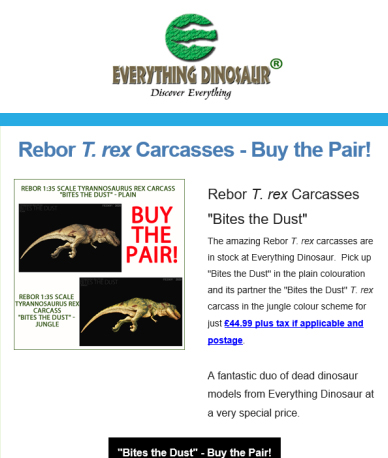
Everything Dinosaur despatched a special newsletter to its subscribers earlier this month announcing the arrival of the two T. rex carcasses in the Rebor “Bites the Dust” model line. In addition, the newsletter announced that pre-orders were being taken for the exciting Rebor Oddities Fossil Studies Skulls (Wave 1). All three, beautiful theropod skulls, Yutyrannus huali, Ceratosaurus dentisulcatus and Carnotaurus sastrei were available to pre-order from Everything Dinosaur at very special prices.
The offers don’t just stop there, the newsletter included a special offer on the duo of dead dinosaurs too!
The Rebor “Bites the Dust” Tyrannosaur Carcasses (Plain and Jungle)
The Rebor T. rex carcasses “Bites the Dust” provide the headlines for the latest Everything Dinosaur customer newsletter. Buy the pair at a special discounted price courtesy of Everything Dinosaur. Picture credit: Everything Dinosaur.
Picture credit: Everything Dinosaur
Rebor “Bites the Dust” T. rex Didn’t Always Win!
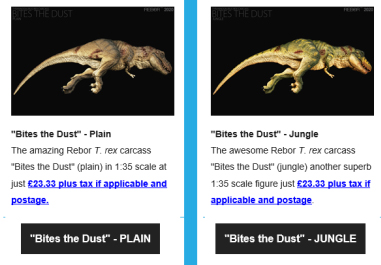
The Rebor “Bites the Dust” figures are available in two colour schemes. Firstly, there is a brown dominated model called “plain”, there is a second model “jungle” with more of a greenish hue. These carefully constructed carcasses are in 1:35 scale and reflect the fact that tyrannosaurs like most predatory dinosaurs had very tough, short lives.
Most dinosaurs did not make it to adulthood and for tyrannosaurs such as T. rex, life at the top of the food chain was particularly hard. It was a question of kill or be killed, not only did these theropods have to battle horned dinosaurs and hadrosaurs, they also had to contend with attacks from their own kind as well. The fossil record provides evidence of tyrannosaurs biting other tyrannosaurs, for example, in 2010, a paper was published in PLOS One entitled “Cannibalism in Tyrannosaurus rex”. The eminent authors, Longrich, Horner, Erickson and Currie identified four T. rex specimens that preserved potential T. rex bites on their bones.
The Two T. rex Bites the Dust Carcass Models (Plain and Jungle)
The Rebor T. rex carcass plain (left) and the Rebor T. rex carcass jungle (right) two beautiful 1:35 scale replicas of a deceased Tyrannosaurus rex.Picture credit: Everything Dinosaur.
Picture credit: Everything Dinosaur
The scientists concluded that Tyrannosaurus rex routinely hunting full-grown members of its own species was unlikely, however, it is possible that intraspecific combat led to casualties, with the dead becoming a convenient source of food for the victorious T. rex. These figures show bite marks from another very large predator, since T. rex is the only enormous terrestrial carnivore known from the latest Upper Cretaceous deposits of North America, it can be inferred that these two Rebor models show the result of an intraspecific combat.
Rebor Oddities Fossil Studies Skulls
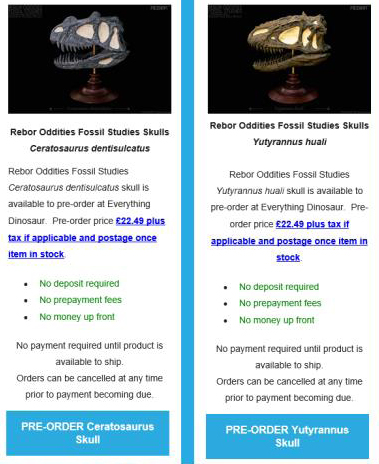
The newsletter also provided subscribers with details of the forthcoming Rebor Oddities Fossil Studies skulls, a set of three amazing theropod skulls, namely, C. sastrei, Y. huali and C. dentisulcatus. These museum quality replicas are available to pre-order from Everything Dinosaur.
The Rebor Ceratosaurus dentisulcatus and Yutyrannus huali Fossil Skulls
The Rebor Oddities Fossil Skull Ceratosaurus dentisulcatus (left) with the Rebor Oddities Fossil Skull Yutyrannus huali.Picture credit: Everything Dinosaur.
The three fossil skulls, regarded as the first wave in an intended series of skull models are likely to be in stock at Everything Dinosaur in November (2020). Customers have the opportunity to pre-order the replicas and to take advantage of a special offer to purchase all three Rebor Oddities Fossil Studies models.
A Trio of Amazing Fossil Skulls
The Rebor Oddities Fossil Studies Carnotaurus sastrei model (left) and the opportunity to pre-order all three skulls at a special discounted price (right).
Picture credit: Everything Dinosaur
The Rebor “Bites the Dust” T. rex carcasses and the pre-order options for the fossil skulls can be found here: Rebor Models and Figures.
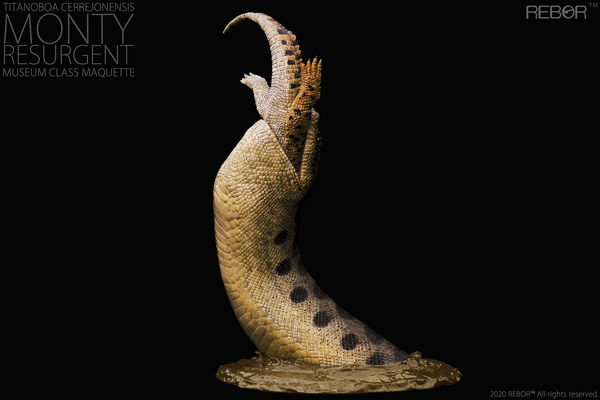
The stunning Rebor Titanoboa Museum Class Maquette Monty Resurgent and the Rebor Titanoboa Museum Class Maquette Brian Diccus are available to pre-order at Everything Dinosaur. These amazing models of a Titanoboa (T. cerrejonensis) swallowing a crocodilian are going into production in the next few months and both replicas are expected in stock at Everything Dinosaur sometime around quarter two of 2021.
The New for 2021 Rebor Titanoboa Museum Class Maquette Monty Resurgent Figure
The Rebor Titanoboa Museum Class Maquette Monty Resurgent. A stunning replica of the largest snake known to science – Titanoboa cerrejonensis complete with its unfortunate crocodilian victim which is in the process of being swallowed whole.
Rebor Titanoboa – Hot on the Heels of Monty
This year (2020), saw the release of the limited edition Rebor Titanoboa figure “Monty”, this beautiful replica of the largest snake described to date, sold out very quickly. Aware of how popular this prehistoric animal is Rebor have plans to introduce two more Titanoboa replicas. Each one “Monty Resurgent” and “Brian Diccus”, will have a single production run and they are going to be made in a few months’ time. Customers of Everything Dinosaur have the chance to secure their figures early.
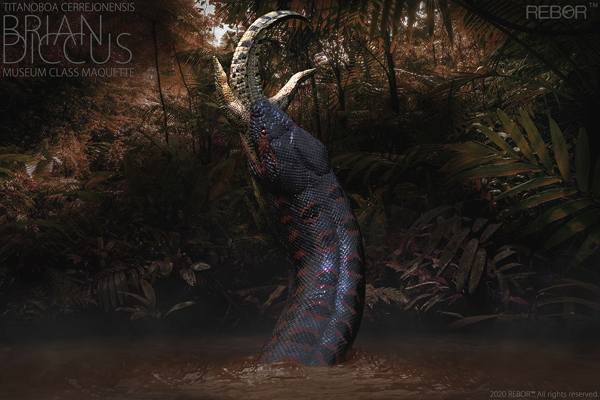
The New for 2021 Rebor Titanoboa Museum Class Maquette Brian Diccus Replica
The Rebor Titanoboa Museum Class Maquette Brian Diccus. Each model has a different colour scheme and this extends to the crocodilian prey as well with the “Monty” Titanoboa having a brown crocodilian victim, whilst Brian Diccus has a green crocodilian prey item.
Pre-order Available from Everything Dinosaur
Both colour variants are available for pre-order. Customers can choose which figure they want and then add it to their shopping cart and go through the checkout process as per usual. However, with Everything Dinosaur, there are no fees to pay, no upfront costs, no surcharges, no deposit required.
Customers also need to note that due to the complexity of the pre-order checkout process, an order may contain only a single pre-order Titanoboa product, and no other products, pre-order or otherwise. If a customer adds a pre-order product to a non-empty cart, the cart will be automatically emptied and the pre-order product will be added. This means that if you want both Titanoboa colour variants, customers will have to place two pre-orders (one for each prehistoric snake figure).
The Rebor Titanoboa Museum Class Maquette Brian Diccus
The Rebor Titanoboa Museum Class Maquette Brian Diccus.
Rebor Titanoboa is Praised
A spokesperson from Everything Dinosaur commented:
“These are two beautifully crafted figures. Each replica shows the anterior portions of the giant snake emerging out of the water as it gulps down its unfortunate victim. We look forward to bringing these products into our warehouse sometime around the early summer of 2021.”