A team member at Everything Dinosaur has gone back to school. The company has been invited to participate in the last-ever SMART Cheshire innovation programme. SMART Cheshire Digital is a fully funded programme aimed to help small to medium-sized businesses in the north-west of England looking to explore, adopt and implement improvements and business innovations.
The training is provided by the Manchester Metropolitan University. The programme has been running for more than 5 years and over 140 businesses have been through the ten-week course. Sadly, this is the last time this course will be run. Financial support from the European Regional Development Fund has now come to an end.
Everything Dinosaur
Everything Dinosaur are delighted to have been invited to take part. The company can explore new ideas and innovations in a supportive and collaborative environment. With two day’s training already completed, Everything Dinosaur has already met up with like-minded fellow business owners and learned a lot.
As the course is coming to an end in the summer, the Everything Dinosaur team member was given two special promotional mugs. These mugs were produced when the course first started, and stocks are extremely low. We are grateful for our pair of mugs, they shall take pride of place in our kitchen at work. We think the Spinosaurus model approves too.
A pair of SMART Cheshire mugs given to Everything Dinosaur. A Spinosaurus model inspects the two mugs with their Manchester Metropolitan University logos. Picture credit: Everything Dinosaur.
The Spinosaurus model guarding the recently acquired SMART Cheshire mugs is from the Wild Safari Prehistoric World range. To view this range of figures: Safari Ltd. Wild Safari Prehistoric World.
Picture credit: Everything Dinosaur
SMART Cheshire Digital
One of the many benefits of this type of training is that it allows the exploration of ideas. Peers can bounce ideas of one another, explore future collaborations and share experiences.
If the Everything Dinosaur team member is able to complete this demanding course, they can toast their success with a cup of tea.
A few years ago, Everything Dinosaur visited Sandbrook Community Primary. Team members had been contracted to deliver some dinosaur themed workshops with the Reception classes as a provocation for the start of the term topic. As part of the teaching team’s scheme of work, a large strip of white paper had been laid out on the floor and children had been challenged to create some dinosaur footprints on it.
Using a foam cut which had been dipped in paint, the children were able to walk along a strip of paper and produce some super dinosaur tracks.
Dinosaur footprints created by Reception children. Picture credit: Everything Dinosaur.
Picture credit: Everything Dinosaur
Dinosaur Footprints
During the lunch break one of our dinosaur and fossil experts was allowed to return to the classroom to take some pictures of the children’s work whilst the children were either on lunch or playing outside. We praised the teaching team for their innovative scheme of work. We also praised the teachers for managing to keep the classroom floor so clean!
Team members were soon back to work delivering the afternoon workshops. The young palaeontologists in the Reception class had a wonderful time, some of the Nursery school staff came in to take a look at the activities. The Nursery school staff were due to have an inspection that week and they wanted to pick up some ideas on lesson plans.
As part of our follow-up work, we set the children a few challenges. Could they produce a dinosaur drawing? Could they count all the green dinosaur feet on the floor? How would they get on with the dinosaur hokey-cokey song we supplied?
A teacher enquired about soft toy dinosaurs helping to reinforce learning. We were happy to supply further information and advice.
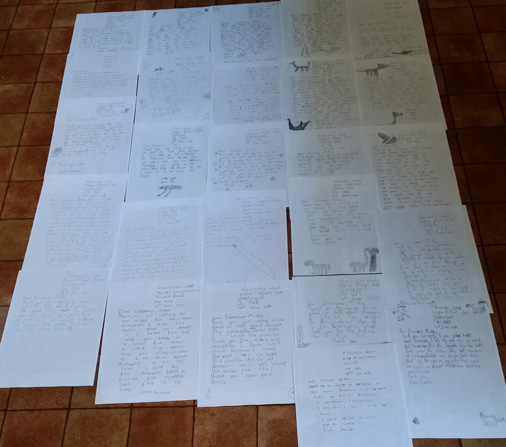
Whilst tidying up some files on the Everything Dinosaur database, an old photograph of a set of thank you letters sent into the UK-based mail order company was discovered. When team members conducted school visits lots of pupils sent in thank you letters. The letters from each class were grouped together and photographed. Often a picture of the children’s letters would have been pinned to our office notice board.
Pupils sent in thank you letters to Everything Dinosaur. A school class sent in thank you letters to Everything Dinosaur after a dinosaur workshop at their school. Picture credit: Everything Dinosaur.
Dinosaur Workshops in School
A spokesperson from Everything Dinosaur stated:
“In the past, the company visited schools to conduct dinosaur workshops. Over the years we must have worked with thousands of schoolchildren. We enjoyed our school visits, and the dinosaur workshops were an enormous success. The company has received hundreds of thank you letters from pupils. It was always a pleasure to read these notes.”
Asking the class to produce a thank you letter was a popular extension activity encouraged by Everything Dinosaur team members. These thank you letters helped the children practice their handwriting and helped build confidence with sentence construction, punctuation and grammar.
The spokesperson from Everything Dinosaur explained that the company did not visit schools at present. This service was stopped during the COVID-19 pandemic and other projects have prevented this popular service from resuming.
For educational, dinosaur and prehistoric themed toys, models and crafts: Dinosaur Toys and Gifts.
As team members tidy up files and archive more photographs, happy memories will be triggered as old school photographs are seen once more. The archiving and cataloguing of these files are part of Everything Dinosaur’s commitment to GDPR. The General Data Protection Regulations (GDPR) and the UK Data Protection legislation help to protect customer’s data.
Team members at Everything Dinosaur tried to bake a birthday cake for a family member but left it on a cooling tray too long. Having removed the baked cake from the oven, it was deposited on a cooling rack. Unfortunately, the hot cake became marked by the bars on the cooling rack. Inadvertently, we had created a dinosaur birthday cake complete with “raptor” claw marks.
The cake looks like it has been attacked by a dinosaur. Picture credit: Everything Dinosaur.
Picture credit: Everything Dinosaur
Dinosaur Birthday Cake
A spokesperson from Everything Dinosaur commented:
“It was just serendipity. We did not intend to create the marks in the cakes that we had baked, it happened by accident. However, we were rather impressed with the result. The cake looks like it has been clawed by the three-clawed hand of a dinosaur.”
Once decorated the cake looked quite presentable. It was soon eaten but at least whilst it lasted, we could be comforted with the thought that we had produced a cake that was “on brand”.
Everything Dinosaur team members have come up with a fun and easy chocolate dinosaur nests with eggs recipe. It is our way of providing a little a treat for children. We are also confident that many dedicated teaching professionals will enjoy these tasty cakes too.
Our recipe for dinosaur chocolate nests will provide a dozen or so little chocolate cakes. For a healthy, balanced diet, we suggest that would-be chefs are reminded by the grown-ups about the benefits of fruit and vegetables when it comes to eating sensibly.
Super dinosaur chocolate nests which are fun and easy to make. Picture credit: Everything Dinosaur.
Picture credit: Everything Dinosaur
A Simple and Inexpensive Recipe
Here is a list of ingredients to make 8 to 12 chocolate dinosaur nests.
Plain or Milk cooking Chocolate 225 grammes (8oz)
Packet of Breakfast Cereal Cornflakes or Shredded Wheat variety
Packet of Sugar Coated Mini-chocolate Eggs
Pack of Small Cake Cases
With our recipe there is some measuring involved. There is some mixing too, so this is a good exercise to help little ones with number confidence and manual dexterity. Please take care when supervising children when it comes to melting the chocolate.
These chocolate nests also make super cakes for a dinosaur themed party. They are simple to create, require no baking and are very tasty. If you are having a dinosaur party, please, don’t forget the fruit and vegetables. After all, palaeontologists calculate that around seventy percent of all the Dinosauria were herbivores!
You can be quite imaginative, laying out a “Stegosaurus salad”, or perhaps some crunchy “Cretaceous cucumber” or “Camarasaurus carrots”.
Everything Dinosaur team members were sent a question by a young dinosaur fan who wanted to know how big was the brain of T. rex? We put our own brains trust to work on this intriguing question.
Having a large brain does not necessarily indicate intelligence, how that organ is configured, and its complexity can provide neuroscientists with an insight into the intelligence of organisms.
Ironically, a controversial study published earlier this year, postulated that Tyrannosaurus rex might have been as smart as a primate, it may have possessed a comparable number of brain cells to that of a monkey.
An endocast of the brain of T. rex derived from internal moulds of the brain case. Picture credit: Everything Dinosaur.
Picture credit: Everything Dinosaur
How Big was the Brain of T. rex?
CAT scans of theropod skulls have enabled palaeontologists to trace nerve pathways and to build up a picture of what some brains of dinosaurs might have looked like. The Tyrannosaurus rex fossil material known as Stan (BHI3033), has provided researchers with a detailed understanding of T. rex brain function. For example, fifty percent of the brain volume was dedicated to analysing smells. Hence the assertion that the sense of smell was extremely important to this carnivore.
As for brain size, estimates vary, but a recent paper published in the Journal of Comparative Neurology estimated the T. rex brain to have weighed around 350 grammes, and endowed this predator with considerable intelligence, putting the “King of the Tyrant Lizards” on a par with extant monkeys.
To read an article from 2013 that looks at research that indicated that dinosaurs had complex brains and postulated that they were capable of sophisticated behaviours similar to modern birds and mammals: Scientists Create a Detailed Map of a Dinosaur’s Brain.
Capable of Tool Use?
Author of the recently published paper, Dr Suzana Herculano-Houzel from the Department of Psychology at Vanderbilt University (Tennessee), postulates that Tyrannosaurus rex had approximately 3 billion cerebral neurons, a greater number than found in baboons.
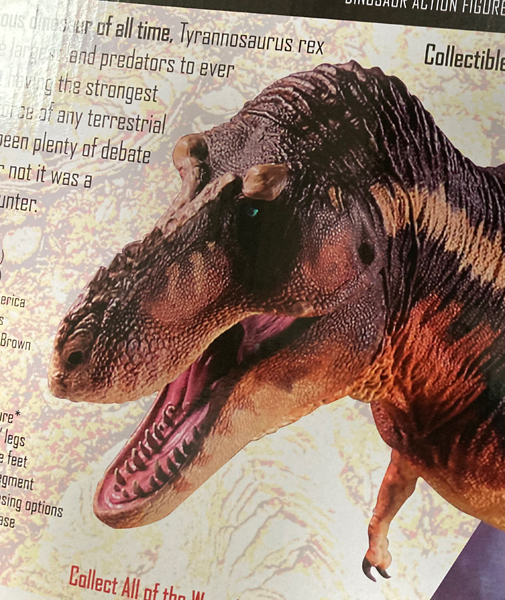
The image of the Beasts of the Mesozoic Tyrannosaurus rex model in 1:18 scale that features on the back of the product packaging. A recent research paper has suggested T. rex was as clever as a monkey. Picture credit: Everything Dinosaur.
The picture (above) shows an image of an articulated Tyrannosaurus rex from the Beasts of the Mesozoic range. To view this range of prehistoric animal figures: Beasts of the Mesozoic Models and Figures.
Using data on living birds and reptiles, Dr Herculano-Houzel inferred the number of neurons extinct creatures had based on calculations of brain mass, including many theropods such as Allosaurus, Archaeopteryx and T. rex.
Writing in the “Journal of Comparative Neurology”, a publication edited by Dr Herculano-Houzel, the doctor extrapolated how many brain cells T. rex possessed in its cerebrum (telencephalon), the most highly advanced part of the brain associated with higher cognitive functions.
Dr Herculano-Houzel postulates that Tyrannosaurus rex would have matured rapidly, lived to about forty years of age and was smart enough to use tools and to pass on acquired knowledge to offspring.
Controversial Ideas
Summarising her research, the doctor concludes:
“That theropods such as Tyrannosaurus and Allosaurus were endotherms with baboon and monkey-like numbers of telencephalic neurons, respectively, which would make these animals not only giant but also long-lived and endowed with flexible cognition, and thus even more magnificent predators than previously thought.”
T. rex brain endocast. Was T. rex really smart? Picture credit: Everything Dinosaur.
As Clever as a Primate!
The paper has attracted scepticism from palaeontologists and other researchers. Gaining an understanding of the neuronal composition of the brains of dinosaurs would provide fundamental insights into their behavioural and cognitive capabilities.
However, brain tissue is rarely fossilised and to achieve her calculations Dr Herculano-Houzel assumed that the entire volume of the braincase was filled by brain tissue. This may not have been so. Perhaps, less than fifty percent of the braincase of T. rex was filled with brain tissue. Dinosaur brains could have been considerably smaller than the size postulated in the scientific paper.
In addition, how the brain is configured, its composition, if you like how it is “wired”, will have a significant impact on an organism’s intelligence.
Claiming that theropods such as Tyrannosaurus and Allosaurus were “the primates of their times”, is exceptionally difficult to substantiate in the absence of a living animal to study.
To read an article from October 2016 about the remarkable discovery of a preserved partial iguanodontid brain: Dinosaur Brain from Southern England.
Bird Brains
Assessing intelligence is challenging, even in living creatures. Pigeons for example, would perhaps not be regarded by many people as being particularly smart, but these avian dinosaurs are capable of remarkable feats of navigation. Many birds demonstrate advanced cognitive abilities such as corvids (crows and their relatives) using tools. Crows have much smaller brains than most monkeys, they have far fewer cerebral neurons but they can outperform some primates when it comes to cognitive assessment tasks.
Dr Herculano-Houzel argues that estimating neuron counts from brain mass is a method that has been applied to hundreds of mammal, bird, and non-avian dinosaur species, the methodology is robust.
However, claiming that T. rex was a smart as a monkey is quite a leap.
The Dinosaur Renaissance
A spokesperson from Everything Dinosaur commented:
“The research paper is free to access, so readers can make up their own minds. Whilst it is extremely challenging to try to work out how intelligent an extinct animal was, the days of regarding dinosaurs as creatures so stupid that they were an evolutionary dead end are long gone.”
The spokesperson added:
“Since the 1960s and the work of palaeontologist John Ostrom, the view of the Dinosauria has fundamentally changed. These animals were perfectly adapted to their environments and they were capable of complex behaviours just like mammals and their close relatives the birds. Just how smart T. rex was is difficult to quantify and validate with scientific evidence. Along with other theropods such as the dromaeosaurids and the oviraptorids these predators might have demonstrated very complex behaviours derived from their cognitive abilities.”
Unfortunately, as we are unlikely to ever observe a living non-avian dinosaur, assessments regarding dinosaur intelligence remain speculative.
How Big was the Brain of T. rex? Something to Ponder
However, the idea of a smart, 7 tonne carnivore measuring in excess of 12 metres long, it makes you think…
The scientific paper: “Theropod dinosaurs had primate-like numbers of telencephalic neurons” by Suzana Herculano-Houzel published in the Journal of Comparative Neurology.
Plans are in place for an expedition to explore the seabed of the Adriatic for signs of early human settlement. Dr Simon Fitch, a geo-archaeologist at the University of Bradford is to embark on a mission to map submerged ice age landscapes and sunken settlements in what has been described as “a first of its kind”, scientific enquiry.
At the end of the month (March 2023), Dr Fitch will travel to Split in Croatia to begin a five-day survey of the Adriatic seabed using state-of-the-art underwater 3-D seismic sensors.
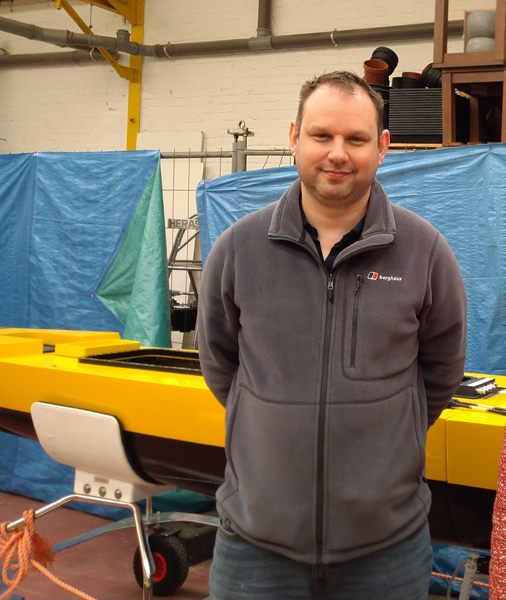
Dr Simon Fitch from the University of Bradford. Picture credit: University of Bradford/Simon Fitch.
Mapping Parts of the Adriatic and the North Sea
This expedition is the first of several that are being planned. Over the next five years, the researchers hope to map parts of the Adriatic and the North Sea. The North Sea being an area of particular interest to University of Bradford archaeologists as they have previously worked extensively on Doggerland, the huge tract of land that once linked Britain to continental Europe.
To read a recent article about research from the University of Bradford examining the impact of ancient Tsunamis on Doggerland settlements: Ancient Tsunamis Once Devastated Doggerland.
Between 24,000 and 10,000 years ago, global sea levels were around a hundred metres lower than they are today. This latest expedition is part of a long-term project to explore the archaeology of submerged human settlements.
The Life on the Edge Project
The Life on the Edge project is part of a UKRI future leaders fellowship for Dr Fitch, which last year attracted just over £1m in funding from UKRI, as well as £400,000 in-kind ship time from VLIZ (Flanders Marine Institute), and a PhD studentship from the University.
The University of Bradford’s Faculty of Life Sciences now has the largest submerged landscapes research group in the world and is one of the few places specialising in this exciting area of academic research.
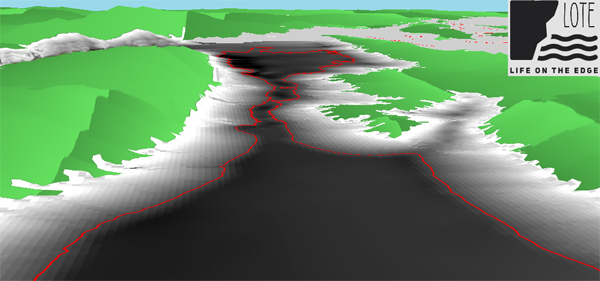
3-D image of the coastline of Croatia with the 14000-year-old coastline outlined in red. Picture credit: University of Bradford/Simon Fitch.
Commenting on the significance of the study, Dr Fitch stated:
“This is the first time anyone is going more than 500 metres from the coastline in the Adriatic to map the seabed. We know humans once lived on the land down there because trawlers regularly dredge up artefacts. This is about finding out who we are as a species and where we come from”.
An Incomplete Picture of Our History
Dr Fitch went onto explain that we have an incomplete picture of our own history. During the Late Palaeolithic (24,000 to 10,000 years ago), our planet was in the grip of an Ice Age and during this time we experienced the last “glacial maximum”, when sea levels were much lower than today, due to the amount of water stored in the ice caps and glaciers. More land around coasts would have been exposed and it is very likely that Stone Age people lived in these areas.
Dr Fitch added:
“We know most human populations like to live on the coastline, so it’s likely there were settlements on what is now the seabed. Our aim is to find evidence of those settlements and then recover the archaeology.”
Helping Renewable Energy Companies
Archaeologists from Bradford University along with collaborators from the University of Split and Flanders Marine institute (VLIZ), are working with commercial companies, who are already mapping the seafloor as they prepare to construct wind farms.
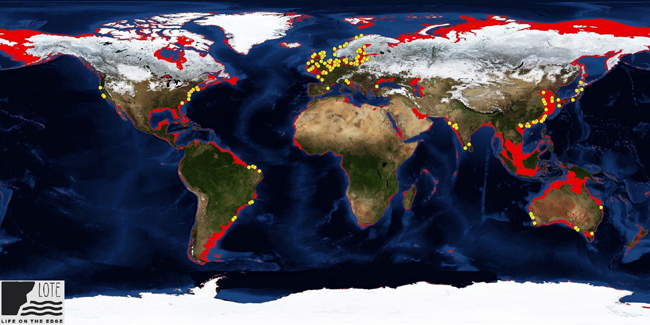
World map showing sea levels as they were during last glacial maximum, circa 22,000 years ago with yellow dots to show proposed wind farm activity. Picture credit: University of Bradford/Simon Fitch.
Powerful supercomputers installed at the University of Bradford are being used to process the huge volumes of data the expeditions will produce and The Life on the Edge Project has already attracted attention from other archaeologists based overseas. Dr Jessica Cook Hale (University of Georgia, USA), is to join the project.
The Search for Sunken Settlements
The academic is an experienced archaeologist with over two decades of research and field work behind her, including having dived underwater prehistoric sites in the Gulf of Mexico and the Atlantic coast.
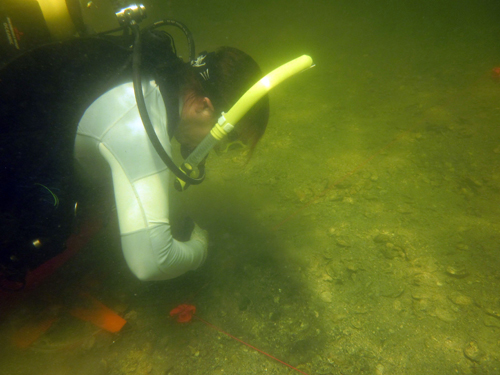
Dr Jessica Cook Hale, (University of Georgia), who has joined the Life on the Edge project, diving a 5,000-year-old “midden heap” in the Econfina Channel site off the coast of Florida in August of 2015. Picture credit: Jessica Cook Hale.
Dr Cook Hale commented that she was excited to be joining this project and stated:
“Bradford is one of the few places doing this. I looked at this project from afar and wanted to be a part of it, so I’m thrilled to be joining the team. Carrying out geo-archaeology on submerged landscapes is really the only way to approach the problem of finding out about our prehistoric ancestors. As archaeologists, we’re naturally curious, we always want to ask, what came before?”
Training the Next Generation of Geo-archaeologists
One of the aims of the project team is to help recruit and train the next generation of geo-archaeologists.
The Life on the Edge project is an appropriate moniker, the team will be using cutting-edge mapping and computer technology and they will be exploring places that no archaeologists have explored before.
We wish the team every success with this intriguing venture.
Everything Dinosaur acknowledges the assistance of a media release from the University of Bradford in the compilation of this article.
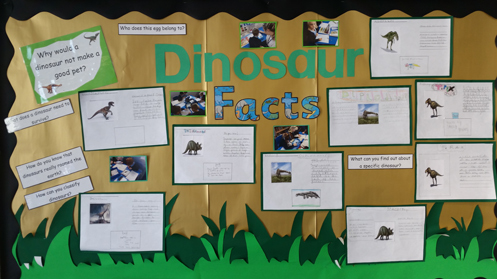
A colourful dinosaur wall display was spotted in a classroom when Everything Dinosaur team members conducted a dinosaur workshop at the school. The Year Two pupils had been learning all about prehistoric animals and fossils. The wall display had been produced during the term topic exploring “Would a Dinosaur Make a Good Pet”?
Everything Dinosaur team members are always impressed by school displays that feature dinosaurs and fossils. For example, Oakdene Primary pupils produced a colourful dinosaur wall display during their term topic studying prehistoric animals. Picture credit: Everything Dinosaur.
A Colourful Dinosaur Wall Display
Children at Oakdene Primary produced fact sheets featuring their favourite prehistoric animal. There were fact sheets on Velociraptor, Tyrannosaurus rex and Triceratops. The eager, young palaeontologists had illustrated their dinosaur data sheets. The pictures and fact sheets were then posted up onto the “Wow Wall” in the classroom. The dinosaur facts and other learning materials made an attractive and most informative display.
A spokesperson from Everything Dinosaur commented:
“We visited Oakdene Primary some years ago to deliver a dinosaur themed workshop. Everything Dinosaur had been invited into the school to support the children’s learning. At the time we praised the colourful wall display, and we were given permission to take a photograph.”
Learning About Dinosaurs
The spokesperson explained that Everything Dinosaur team members always tried to encourage children and to help them with their studies. Team members were quick to praise the teaching team for their hard work and dedication.
Many schools in England and Wales introduce a dinosaur and fossil themed term topic. Foundation Stage pupils as they transition from Nursery to Reception can find a dinosaur topic helpful. Year 3 pupils often learn about fossils and dinosaurs when studying rocks and soils.
A dinosaur term topic is also enjoyed by the teaching team. It certainly brings out plenty of creativity in the pupils that Everything Dinosaur team members have met.
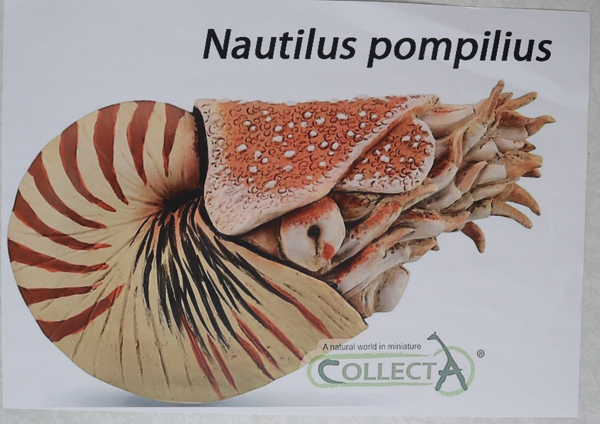
Whilst tidying up some papers, team members at Everything Dinosaur came across a visual of the CollectA nautilus model which was used in a YouTube video when this invertebrate figure was introduced back in 2020. The nautilus figure was one of seventeen new replicas introduced by CollectA in 2020.
The CollectA Nautilus model, a splendid replica of a living cephalopod. Picture credit: Everything Dinosaur.
Picture credit: Everything Dinosaur
CollectA Nautilus Model
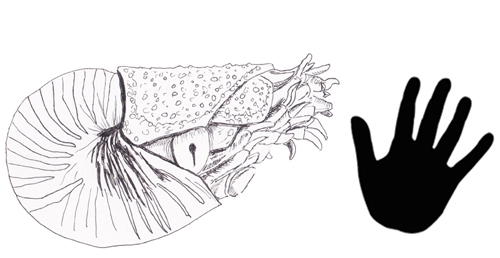
The largest extant species is Nautilus pompilius, which is sometimes also referred to as the Emperor nautilus. All living species are confined to tropical waters and these molluscs usually live at depths of more than a hundred metres.
In 2017, all the species of nautilus were afforded protection under Appendix II of the Convention on International Trade in Endangered Species of Wild Fauna and Flora (CITES). The shells are highly prized and attempts have been made to regulate the trade in shells. However, much of the trade in Asia remains uncontrolled and although not directly threatened with extinction conservationists have expressed concern about their long-term survival unless trade in the shells is better regulated.
A scale drawing of an extant nautilus (Nautilus pompilius). Picture credit: Everything Dinosaur.
In January, Everything Dinosaur received an order for two PNSO Sinosauropteryx models. These are popular prehistoric animal figures but we did contact Claire, the customer, just to check that they had not purchased an additional figure in error. Claire replied to our email and reassured us stating:
“Thank you for emailing! No, the purchase of a second PNSO Sinosauropteryx figure was not a mistake. My fiancé and I are planning to use them as cake toppers for our wedding.”
Intrigued, we asked Claire would it be possible for her to send us a picture of her dinosaur themed wedding cake.
Sure, enough over the weekend we were sent a photograph of the fabulous cake.
PNSO Sinosauropteryx models used as cake toppers for a spectacular dinosaur themed wedding cake. Picture credit: Claire.
Picture credit: Claire
PNSO Sinosauropteryx Wedding Guests
What a spectacular wedding cake. Even the two PNSO Sinosauropteryx models have been dressed up for the occasion. The cake looks beautiful, and we love the little flourishes such as the ammonite fossils on the side and the cascading waterfall made from blue icing.
Claire and her husband Bradley cutting the dinosaur themed wedding cake. Picture credit Claire.
Picture credit: Claire
We at Everything Dinosaur would like congratulate the happy couple. We wish Claire and Bradley every success and happiness as they build their new lives together.
To view the Sinosauropteryx figures that featured on the wedding cake and the rest of the PNSO prehistoric animal replicas: PNSO Age of Dinosaurs.